

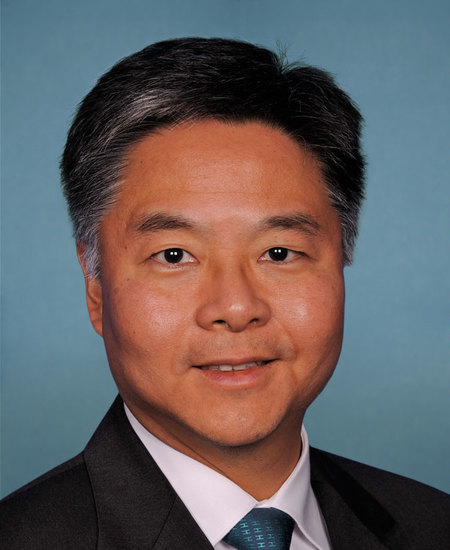
Photo of Ted Lieu
D United States House · District 36 · California On the 2026 ballot

Rep. Ted Lieu

Compare
Total votes
2,837
all sessions
Attendance
97%
85 missed
Near the chamber average
With party
98%
of cast votes
Near the chamber average
Bipartisan score
1%
crosses aisle rarely
Near the chamber average
Sponsored
2,333
bills & resolutions
Higher than 93% of chamber peers
Committees
3
assignments
2,333 bills and resolutions

Sponsored bills

Total
2,333
Primary
160
Co-sponsor
2,173
This page
2,333
matching current filters
Co-sponsor HR 9330
In committee · United States House · Co-sponsor
Strengthening Agency Management and Oversight of Software Assets Act

Strengthening Agency Management and Oversight of Software Assets Act This bill requires each federal agency to develop assessments of their software inventories and software licenses and a plan to reduce costs by consolidating licenses and adopting enterprise license agreements to the greatest extent practicable. The bill also requires the Office of Management and Budget and the Government Accountability Office to report on various government-wide issues relating to federal software licenses and inventories.

In committee Nov 17, 2022 1 co-sponsor
Co-sponsor HR 3630
Passed · United States House · Co-sponsor
Lymphedema Treatment Act

Lymphedema Treatment Act This bill provides for Medicare coverage of lymphedema compression treatment items. Specifically, the bill provides for coverage of standard and custom fitted gradient compression garments and other approved items that are prescribed by a physician or other specified health care professional to treat lymphedema.

Passed Nov 17, 2022 1 co-sponsor
Co-sponsor HR 4458
In committee · United States House · Co-sponsor
KELP Act

Keeping Ecosystems Living and Productive Act or the KELP Act This bill directs the National Oceanic and Atmospheric Administration (NOAA) to award grants to carry out projects related to the conservation, restoration, or management of kelp forest ecosystems. NOAA shall award grants for projects that address greatest relative regional declines in kelp forest ecosystems; focus on, among other things, long term ecosystem resilience, kelp forest seeding and connectivity, or urchin removal and other actions to reestablish trophic structure; or are identified by federal or state restoration and management plans as focal areas for recovery of kelp forests and associated species.

In committee Nov 16, 2022 1 co-sponsor
Primary HR 404
In committee · United States House · Lead sponsor
Driftnet Modernization and Bycatch Reduction Act

Driftnet Modernization and Bycatch Reduction Act This bill addresses certain driftnet fishing. Driftnet fishing is a method of fishing in which a gillnet composed of a panel or panels of webbing, or a series of such gillnets, is placed in the water and allowed to drift with the currents and winds for the purpose of entangling fish in the webbing. Currently, the use of large-scale drift gillnets with a total length of 2.5 kilometers or more is prohibited in the United States.The bill expands the definition of large-scale driftnet fishing to prohibit the use of gillnets with a mesh size of 14 inches or greater. This expanded prohibition does not apply within the U.S. exclusive economic zone for five years. The Department of Commerce must conduct a transition program to facilitate the phase out of large-scale driftnet fishing and to promote the adoption of alternative fishing practices that minimize the incidental catch of living marine resources. Commerce must award grants to program participants. Further, the North Pacific Fishery Management Council may recommend and Commerce may approve regulations to collect fees from charter vessel operators that guide recreational anglers who harvest Pacific halibut.

In committee Nov 16, 2022 0 co-sponsors
Co-sponsor HR 5441
Passed · United States House · Co-sponsor
PAST Act of 2021

Prevent All Soring Tactics Act of 2022 or the PAST Act of 2022 This bill addresses the practice of soring horses. The soring of horses includes various actions taken on horses' limbs to produce higher gaits that may cause pain, distress, inflammation, or lameness. Specifically, the bill expands soring regulation and enforcement at horse shows, exhibitions, sales, and auctions, including by establishing a new system for inspecting horses for soring. In addition, the bill increases penalties for violations.

Passed Nov 15, 2022 1 co-sponsor
Co-sponsor HR 1931
Passed · United States House · Co-sponsor
Japanese American Confinement Education ActNorman Y. Mineta Japanese American Confinement Education Act

Norman Y. Mineta Japanese American Confinement Education Act This bill increases the authorization of appropriations for the Japanese American Confinement Sites (JACS) grant program, which supports the preservation of U.S. confinement sites that were used to detain Japanese Americans during World War II (i.e., internment camps). It also establishes a program within JACS to provide grants to Japanese American nonprofits to educate individuals about the historical significance of these events.

Passed Nov 14, 2022 1 co-sponsor
Co-sponsor HR 8450
In committee · United States House · Co-sponsor
Healthy Meals, Healthy Kids Act

Healthy Meals, Healthy Kids Act This bill reauthorizes and expands (1) child nutrition programs, including the National School Lunch Program (NSLP) and other institutional food service programs; and (2) the Special Supplemental Nutrition Program for Women, Infants, and Children (WIC).

In committee Nov 7, 2022 1 co-sponsor
Co-sponsor HR 2193
In committee · United States House · Co-sponsor
Asunción Valdivia Heat Illness and Fatality Prevention Act of 2022

Asunción Valdivia Heat Illness and Fatality Prevention Act of 2022 This bill directs the Occupational Safety and Health Administration to promulgate a standard that requires employers to implement certain measures for protecting workers from heat stress and related illnesses or injuries. Heat stress refers to the load of heat that a person experiences due to sources of heat or heat retention (including metabolic heat, environmental factors, and clothing or personal protective equipment) or the presence of heat in a work setting. Further, if an employer cannot reduce exposure to heat stress below hazardous levels through engineering controls (e.g., heat shields and insulation) or personal protective equipment (e.g., heat reflective clothing), the employer must implement a program that mitigates such exposure through access to appropriate hydration and cool-down spaces, acclimatization policies, and periodic paid rest breaks. Additionally, the bill establishes requirements concerning judicial review, implementation, enforcement, recordkeeping, and whistle-blower protections related to the standard. The bill also requires the Department of Labor to include questions about heat-related illness and injury in the National Agricultural Workers Survey (an employment-based, random-sample survey of U.S. crop workers that collects demographic, employment, and health information).

In committee Nov 7, 2022 1 co-sponsor
Showing 1,511 to 1,520 of 2,333 bills