

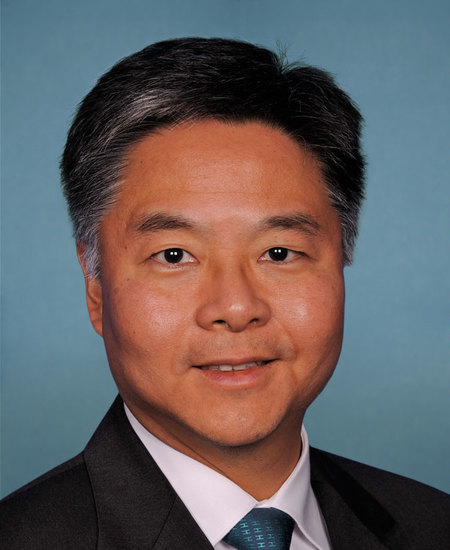
Space Infrastructure Act This bill directs the Department of Homeland Security to designate space systems, services, and technology as a critical infrastructure sector. Under current law, critical infrastructure means systems and assets, whether physical or virtual, so vital to the United States that the incapacity or destruction of such systems and assets would have a debilitating impact on security, national economic security, national public health or safety, or any combination of those matters.
Rep. Ted Lieu
Sponsored bills
Maddy summaryHR 5054, the Equal and Uniform Treatment in the Military Act (EQUITY Act), prohibits discrimination in the U.S. military based on race, color, religion, sex, national origin, gender identity, or sexual orientation. It amends Title 10 of the U.S. Code to require that military service, advancement, and evaluations be based solely on an individual’s merit, fitness, capability, and performance. The bill explicitly bans policies that consider protected characteristics in eligibility or treatment, replacing prior frameworks with this clear standard. It directly affects all active-duty service members, reservists, and military personnel across all branches.
Maddy summaryHR 4963, the Tax Fairness for Workers Act, would restore tax deductions for certain employee expenses. It creates an above-the-line deduction for union dues and expenses paid by wage-earning employees, and allows miscellaneous itemized deductions for other work-related expenses (like uniforms or supplies) that were previously disallowed after 2017 tax law changes. These provisions directly affect employees who pay union dues or incur qualifying job-related costs. The bill amends specific sections of the Internal Revenue Code to make these deductions available for taxable years beginning after December 31, 2022. It does not change tax rates or provide new benefits, only reinstating previously eliminated deductions for eligible workers.
Maddy summaryThe Rebuild America's Schools Act of 2023 creates a $20 billion annual federal grant program to fund long-term improvements to public school facilities across the United States. It requires states to prioritize school districts serving high-poverty students (with high percentages of students eligible for free/reduced lunch) and those with deteriorating infrastructure, while mandating that recipient schools develop 10-year facilities master plans. The bill specifies that funds must be used for construction, renovation, and modernization projects that improve energy efficiency, address environmental health hazards (including lead, asbestos, and poor air quality), and ensure school safety, while requiring the use of American-made materials for construction projects.
Maddy summaryThis bill removes an age restriction for expunging certain criminal records. It amends federal law to eliminate the requirement that a nonviolent offender must have been under 21 years old at the time of a simple possession conviction involving controlled substances. As a result, individuals convicted of these offenses who are now 21 or older can now qualify for record expungement, regardless of their age at the time of the offense. The bill directly affects nonviolent offenders with past simple possession convictions who previously could not seek expungement due to their age when convicted. This change expands eligibility for record clearance under federal expungement provisions.
Maddy summaryThe PLANT Act (Peas, Legumes, And Nuts Today Act) creates new support systems for plant-based food producers by amending agricultural programs to include plant protein products like peas, legumes, and mushrooms. It increases marketing loan rates for certain commodities (including mushrooms at $1.16 per pound), defines "plant protein products" for the first time, and establishes an Office of Plant-Based Foods and Innovative Production. The bill authorizes $25 million annually for fiscal years 2024-2028 to fund research, business development, and market expansion for plant-based foods through programs like the Plant-Based Food Innovation Initiatives. It directly affects farmers growing plant-based ingredients, food processors, and rural communities working with these products. The legislation provides concrete policy changes to support the growing plant-based food industry through defined programs and dedicated funding.
Maddy summaryHR 4965, the Kimberly Vaughan Firearm Safe Storage Act, requires the Attorney General to create voluntary best practices for safe firearm storage in homes, businesses, vehicles, and other locations within 180 days of enactment, with public input. Starting January 1, 2025, firearm manufacturers must include a "SAFE STORAGE SAVES LIVES" notice with each new handgun, rifle, or shotgun, directing buyers to the public website with these guidelines. The bill also establishes a $10 million annual grant program for states and tribes to fund public programs distributing safe firearm storage devices (like locked containers) and requires grantees to use at least 75% of funds for these programs. It does not mandate storage for individuals but provides resources and information to promote safer practices.
Maddy summaryHR 4986, the Student Loan Interest Elimination Act, would eliminate interest accrual on most existing Federal student loans starting July 1, 2024, without requiring borrower action, while allowing borrowers to opt out if desired. The bill would also enable refinancing of non-Federal direct loans into Federal Direct Consolidation Loans with no interest, no origination fees, and preservation of previous loan forgiveness benefits. New loans made on or after July 1, 2024, would have interest rates based on borrower income relative to area median income (0-4%), and the bill terminates interest-subsidized loans after June 30, 2024. The bill establishes an Education Affordability Trust Fund, financed by loan repayments, to support these changes and fund additional Pell Grants and college affordability programs.
Maddy summaryHRES 615 is a symbolic congressional resolution condemning Florida's 2023 African-American history standards for public schools. It specifically targets standards the resolution claims erroneously suggest "slavery could have been beneficial" for enslaved people and downplay slavery's horrors. The resolution calls on Congress to denounce these standards as racist, demands the Florida Board of Education reverse its decision, and asserts that students deserve an unfiltered account of slavery's brutality. It does not create new laws but expresses the House's position against what it describes as "revisionist history" that omits slavery's central role in U.S. history. The resolution directly affects Florida's public school curriculum and its implementation of history standards.
Maddy summaryHRES 578 is a non-binding House resolution calling for the immediate release of Eyvin Hernandez, a U.S. citizen and Los Angeles County public defender wrongfully detained by Venezuela since March 2022. The resolution urges U.S. officials, including the President and Secretary of State, to press Venezuela for his release and condemns Venezuela’s practice of detaining U.S. citizens for political purposes. It specifically references Hernandez’s wrongful detention without evidence or fair trial, noting his status as a Department of State-designated wrongfully detained individual. The resolution expresses support for Hernandez and other Americans detained abroad, without creating new legal requirements or funding.