

Maddy summaryHR 5758 would reimburse federal employees, District of Columbia workers, and federal contractors for out-of-pocket costs (like loan payments or credit card fees) incurred during government shutdowns. It requires the Treasury to pay these costs as soon as possible after a shutdown ends, with applicants submitting documentation within one year. States that cover federal programs during shutdowns lasting 14 days or more would also receive reimbursement for those expenses. The bill establishes a Reserve Fund in the Treasury to cover future reimbursement costs.
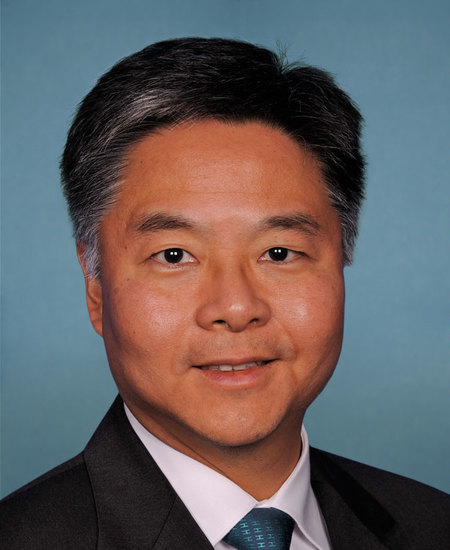
Rep. Ted Lieu
Sponsored bills
Maddy summaryThe Alice Cogswell and Anne Sullivan Macy Act amends the Individuals with Disabilities Education Act to better serve children and youth who are deaf, hard of hearing, deafdisabled, blind, visually impaired, or deafblind. It requires states to identify and provide appropriate services to these students regardless of how they're classified in disability categories, ensures access to language instruction in the student's primary language (including American Sign Language), and mandates improved data collection about these students. The bill establishes the Anne Sullivan Macy Center on Visual Disability and Educational Excellence to support research, training, and program development for blind and visually impaired students. These changes aim to improve educational outcomes by addressing the unique language, communication, and learning needs of students with sensory disabilities through concrete policy changes to IDEA.
Maddy summaryThis bill requires federal agencies to mandate that auto manufacturers bidding on vehicle assembly contracts disclose detailed workforce information for each plant involved. Specifically, contractors must provide average and range of hourly wages, temporary worker counts, and any OSHA or National Labor Relations Act violations at each manufacturing location. It also requires written agency permission - and additional disclosures - if a contractor seeks to shift production to a new plant, with notification to affected labor unions. The law directly affects auto manufacturers competing for federal vehicle assembly contracts and aims to increase transparency around labor practices.
Maddy summaryHR 5097 establishes new federal funding programs to support the development of alternative proteins - foods that mimic animal meat using plants, cell cultivation, or fermentation. It allocates $15 million annually (2024-2028) for Centers of Excellence focused on research and workforce training, $10 million for USDA research, $50 million for manufacturing grants to U.S. companies and institutions, and $25 million for workforce development programs. The bill requires the USDA to create a national strategy coordinating multiple federal agencies to advance this sector. These provisions directly affect U.S. businesses, universities, and workers in the alternative protein industry by providing targeted funding for research, production, and job training.
Maddy summaryHR 5191, the Renewable Energy for U.S. Territories Act, establishes a federal grant program administered by the Secretary of Agriculture to fund renewable energy projects in U.S. territories (Puerto Rico, Guam, U.S. Virgin Islands, American Samoa, and Northern Mariana Islands). Covered entities - defined as eligible not-for-profit organizations - can use grants to develop renewable energy systems, improve energy efficiency, build storage or microgrids, or train local residents, but cannot fund fossil fuel or nuclear projects. The bill also mandates a GAO study on renewable energy potential in territories, focusing on grid modifications, microgrid expansion, and energy resiliency, with findings to be reported to Congress. This program aims to directly support territorial energy infrastructure upgrades and workforce development through concrete funding mechanisms.
Maddy summaryHRES 700 is a non-binding congressional resolution expressing support for designating September 2023 as "National Prostate Cancer Awareness Month." It highlights that prostate cancer affects 1 in 8 U.S. men and has significantly higher mortality rates among African-American men, while urging increased public awareness, early screening promotion, and research funding. The resolution does not create new laws or allocate funds but encourages the public, healthcare providers, and organizations to promote awareness and support efforts to improve detection and treatment. It aligns with existing federal cancer research investments, such as the $7.1 billion allocated to the National Cancer Institute in 2023.
Maddy summaryHR 5686 authorizes $30 million in U.S. humanitarian aid for Armenians in Armenia and Nagorno-Karabakh affected by recent conflicts and blockades, and $12 million in foreign military financing to support Armenia's sovereignty and security cooperation. The bill requires the State Department to develop a strategy protecting Nagorno-Karabakh residents' rights, including cultural heritage and security, and mandates a 90-day report on Azerbaijani military actions during 2022-2023 attacks. It also directs the U.S. to push for International Criminal Court investigations into alleged atrocities and imposes sanctions on Azerbaijani officials involved in blockades or attacks. The legislation focuses on concrete U.S. policy actions - aid, accountability measures, and diplomatic efforts - without prescribing specific outcomes.
Maddy summaryThe Supporting Armenians Against Azerbaijani Aggression Act of 2023 authorizes $30 million in U.S. humanitarian assistance for Armenians in Armenia and Nagorno-Karabakh affected by Azerbaijani military actions and blockade. It repeals a longstanding restriction on aid to Azerbaijan, allocates $10 million for military assistance to Armenia, and requires the U.S. government to develop a strategy protecting Armenians' rights in Nagorno-Karabakh. The bill also mandates a report on alleged Azerbaijani atrocities, authorizes $650 million for energy sector development in Armenia, and requires sanctions on Azerbaijani officials responsible for attacks and the blockade of Nagorno-Karabakh.
Maddy summaryThis bill amends the Higher Education Act to require all U.S. colleges and universities receiving federal financial aid to create detailed anti-harassment policies covering physical, online, and institution-sponsored settings. It mandates policies prohibiting harassment based on race, sex (including sexual orientation and gender identity), disability, religion, and other protected characteristics, including harassment via institutional email, computers, or electronic messaging. The bill also establishes a $50 million annual grant program to fund colleges developing prevention programs, victim support services, and training for students and staff on recognizing and addressing harassment. These policies and grants must comply with existing civil rights laws like Title IX but add specific requirements for reporting and prevention.
Maddy summaryHR 5606, the Future Generations Protection Act, prohibits new fossil fuel infrastructure and exports to accelerate the transition to clean energy. It bans greenhouse gas emissions from new fossil fuel power plants, blocks approvals for new LNG terminals (with limited emissions-reduction exceptions), and prohibits hydraulic fracturing by 2027. The bill also bans most exports of domestically produced crude oil and natural gas, except for limited cases involving Canada and Mexico. These provisions directly affect energy companies, LNG developers, and oil/gas producers, aiming to reduce fossil fuel reliance while prioritizing environmental justice and worker transitions.