

Protecting Our Democracy Act This bill addresses issues involving (1) abuses of presidential power; (2) checks and balances, accountability, and transparency; and (3) election integrity and security. Specifically, regarding abuses of presidential power, the bill requires the Department of Justice (DOJ) and the President to submit to Congress specified materials relating to certain pardons, prohibits presidential self-pardons, suspends the statute of limitations for federal offenses committed by a sitting President or Vice President, prohibits the acceptance of foreign or domestic emoluments, and sets forth provisions regarding Office of Government Ethics and Office of Special Counsel jurisdiction and enforcement authority. To address checks and balances, accountability, and transparency, the bill authorizes specified actions to enforce congressional subpoenas, imposes limits on presidential declarations of emergencies, requires DOJ to maintain a log of specified communications between it and the White House, requires cause for removal of inspectors general, increases whistleblower protections, and requires a candidate for President or Vice President to provide copies of tax returns for the 10 most recent taxable years to the Federal Election Commission. To address election integrity and security, the bill requires federal campaign reporting of foreign contacts, makes various changes to requirements concerning foreign donations to political campaigns and candidates and foreign contributions to online electioneering communications, prohibits distribution of materially deceptive audio or visual media prior to an election (i.e., deepfakes), and establishes a program to support states and localities transition to ranked choice voting systems.
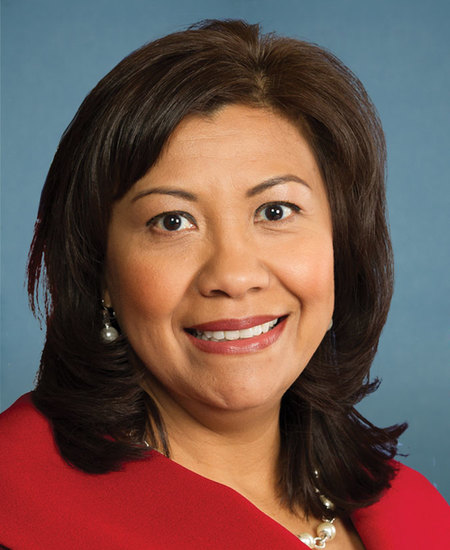
Rep. Norma J. Torres
Sponsored bills
Indian Buffalo Management Act This bill establishes a permanent program within the Department of the Interior to develop and promote tribal ownership and management of buffalo and buffalo habitat on Indian lands. Specifically, the bill requires Interior to (1) enter into contracts, award grants, and provide technical assistance to Indian tribes and tribal organizations for activities related to buffalo restoration or management; (2) consult with tribes and tribal organizations on initiatives that affect buffalo or buffalo habitat, including efforts to contain or eradicate diseased buffalo; and (3) develop a policy relating to buffalo and buffalo habitat management activities on Indian land. Additionally, Interior may enter into agreements with tribes or tribal organizations to transport surplus buffalo from federal land onto Indian land.
This resolution sets forth rules for consideration of H.R.6119 (continuing resolution for FY2022 appropriations). The resolution also amends H.Res. 188 (regarding certain procedural requirements in the House of Representatives).
National MEP Supply Chain Database Act of 2021 This bill requires the National Institute of Standards and Technology to establish a database that provides a national overview of the networks of U.S. supply chains.
Veterans Administration Backlog Accountability Act of 2021 This bill requires the Inspector General of the Department of Veterans Affairs (VA) to report on the backlog of VA disability compensation claims.
GI Bill Distance Learning Improvement Act This bill requires the Department of Veterans Affairs (VA) to make a one-time $500 payment for the purchase of a computer for an individual who is entitled to educational assistance under the Post-9/11 GI Bill and is pursuing a program of education solely or partially through distance learning on more than a half-time basis. An individual must submit an application to the VA to be eligible for the computer payment.
Wildfire Grid Resiliency Act This bill requires the Office of Cybersecurity, Energy Security, and Emergency Response of the Department of Energy (DOE) to carry out a Resilience Accelerator Demonstration Program. Under the program, the office must make awards to DOE's National Laboratories for projects that demonstrate innovative technologies to improve the electric grid's resilience to wildfires.
National Wildland Fire Risk Reduction Program Act This bill directs the President to establish a National Wildland Fire Risk Reduction Program to achieve major measurable reductions in the losses of life and property from wildland fires. This program shall coordinate federal efforts to improve the assessment of fire environments and the understanding and prediction of wildland fires, associated smoke, and their impacts; develop and encourage the adoption of science-based and cost-effective measures to prevent and mitigate wildland fire and associated smoke impacts; and improve the understanding and mitigation of the impacts of climate change and variability on wildland fire risk, frequency, and severity and inform the other goals described here. Not later than 90 days after enactment of this bill, the Office of Science and Technology Policy shall establish an Interagency Coordinating Committee on Wildland Fire Risk Reduction to oversee the planning, management, and coordination of the program. The committee shall submit a strategic plan for the program to Congress. The Government Accountability Office shall submit a report to Congress on the progress and performance of the program. Further, the bill sets forth the responsibilities of the National Institute of Standards and Technology, National Science Foundation, National Oceanic and Atmospheric Administration, Federal Emergency Management Agency, National Aeronautics and Space Administration, Environmental Protection Agency, and Department of Energy with respect to the program.
Maddy summaryHRES 785 is a symbolic resolution designating November 8, 2021, as "National First-Generation College Celebration Day." It urges all Americans to celebrate this day, recognize the contributions of first-generation college students (those whose parents did not earn bachelor's degrees), and honor the Higher Education Act of 1965. The resolution highlights existing federal programs like TRIO and Pell Grants that support underrepresented students but does not create new laws or funding. As a non-binding resolution, it has no direct policy impact but aims to raise awareness about first-generation students' challenges and achievements.
FHA Fairness Act This bill increases the mortgage limit for federal mortgage insurance eligibility for homes in certain cities and counties. Specifically, this increase applies to metropolitan cities and urban counties with higher housing costs that have experienced a decrease in home values over a specified time period.