

Maddy summaryThis bill prohibits the Federal Aviation Administration (FAA) from reducing, replacing, or outsourcing 1% or more of its workforce without explicit congressional approval. It requires the Transportation Secretary to submit a detailed report to Congress explaining such decisions and their potential impacts on aviation safety and operations. The bill also explicitly bans the privatization or outsourcing of the entire FAA air traffic control system and blocks external oversight bodies (like "DOGE") from controlling FAA functions. These provisions directly affect FAA staffing decisions and ensure public control over air traffic management, with no new services or funding created.
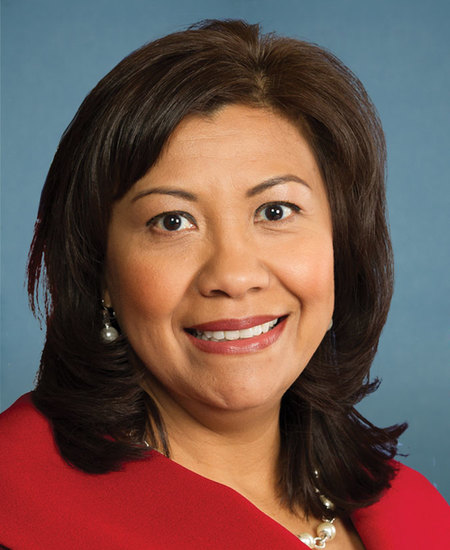
Rep. Norma J. Torres
Sponsored bills
Maddy summaryThis bill establishes federal minimum standards for collective bargaining rights for public employees and supervisors. The Federal Labor Relations Authority would determine if state laws provide these rights, and if not, would establish them for affected employees. The bill guarantees public employees the right to form unions, bargain collectively, and engage in concerted activities, while requiring public employers to recognize unions and put agreements in writing. It also prohibits strikes or lockouts that would disrupt emergency services. This would apply to public employees in states that don't meet the federal standards for collective bargaining rights.
Maddy summaryThis is a ceremonial resolution (HRES 296) passed by the U.S. House of Representatives to formally congratulate the Los Angeles Dodgers on winning the 2024 Major League Baseball World Series. It recognizes the team's championship victory, playoff achievements, and key players like Freddie Freeman (World Series MVP) and Shohei Ohtani, while directing the House Clerk to send a copy to Dodgers leadership including owner Mark Walter, president Stan Kasten, and manager Dave Roberts. The resolution has no policy impact - it is purely a symbolic gesture with no legal or financial effect on any individuals or entities.
Maddy summaryThe Tax Fairness for Workers Act (HR 2671) would allow certain employees to deduct work-related expenses directly from their gross income. Specifically, it creates an above-the-line deduction for union dues (amending IRC Section 62(a)(1)) and reinstates a deduction for other out-of-pocket work costs like uniforms or tools (amending IRC Section 67(g)), effective for 2025 tax years. This directly affects union members and workers with significant job-related expenses who previously could not deduct these costs. The bill removes the prior limitation that barred these deductions, making them available without needing to itemize. The policy change simplifies tax filing for affected workers by treating these expenses as deductible business costs.
Maddy summaryThis bill, HR 2253 (Puppy Protection Act of 2025), sets new federal standards for commercial dog dealers who sell puppies to the public. It requires specific housing sizes based on dog size (e.g., 12-30 square feet per dog), daily exercise in safe outdoor areas, clean water and nutritious food twice daily, and annual veterinary exams including dental checks. The bill also limits breeding frequency (max 2 litters in 25 months), sets age minimums for breeding (18 months for small dogs, 2 years for large dogs), and mandates health screenings to prevent genetic diseases. These requirements apply directly to commercial dealers, with final regulations to be issued within 18 months of enactment.
Maddy summaryThis bill, HR 2102 (Major Richard Star Act), allows veterans with combat-related disabilities to receive both full military retired pay and veterans' disability compensation simultaneously, without the previous offset that reduced retired pay. It directly affects veterans already eligible for both benefits due to combat-related injuries, removing the requirement that their retired pay be reduced by the disability compensation amount. The key provision amends Title 10 and Title 38 to eliminate the offset rule (sections 5304 and 5305 of Title 38) for these veterans. The change applies to payments starting after the bill’s enactment date, effective for all qualifying veterans. This is a policy change to increase financial support for affected veterans, not a new benefit.
Maddy summaryHR 2656, the *Removing Nitrate and Arsenic in Drinking Water Act*, establishes a federal grant program to help community water systems, schools, and other facilities reduce harmful nitrate and arsenic levels in drinking water. Eligible entities like municipalities, nonprofits, and water systems can apply for grants to install treatment technology, with priority given to disadvantaged communities, areas with past non-compliance, and facilities serving children or vulnerable populations. The program authorizes $15 million annually starting in 2026, limiting administrative costs to 4% of funds. It requires applicants to identify contamination sources and demonstrate how their project will reduce contaminants, aiming to improve water safety for at-risk communities.
Maddy summaryHR 2639, the Telehealth Access for Tribal Communities Act of 2025, permanently expands Medicare telehealth coverage for services provided by Indian health programs and urban Indian organizations. It allows these services to be delivered from any location within the U.S. (including patients' homes) starting April 1, 2025, and includes audio-only telehealth as a covered option. This directly affects tribal communities by removing location restrictions and expanding access to remote healthcare through their existing Indian health programs. The bill modifies Medicare rules to make these telehealth flexibilities permanent, ensuring continued coverage for eligible tribal patients.
Maddy summaryThis bill replaces hardbound versions of the Constitution Annotated and its supplements with digital versions. It requires the Librarian of Congress to publish digital decennial editions after each tenth Supreme Court term (starting 2031) and digital pocket-part supplements after each odd-numbered year Supreme Court term (starting 2025), instead of physical copies. All digital versions must be available on a Library of Congress public website, and the bill repeals all requirements for printing physical copies after the October 2025 Supreme Court term. This affects how Congress and the public access these legal reference documents, shifting from physical books to online resources.
Save America's Forgotten Equines Act of 2025 or the SAFE Act of 2025 This bill permanently prohibits the slaughter of equines (e.g., horses and mules) for human consumption. (Current law prohibits the slaughter of dogs and cats for human consumption. This bill extends the prohibition to equines.) Specifically, this bill prohibits a person from knowingly (1) slaughtering an equine for human consumption; or (2) shipping, transporting, possessing, purchasing, selling, or donating an equine to be slaughtered for human consumption or equine parts for human consumption. The bill subjects a violator to a fine. The bill applies to conduct in or affecting interstate or foreign commerce or within the special maritime and territorial jurisdiction of the United States. However, it does not apply to an activity carried out by an Indian for a religious ceremony. As background, in recent years, the appropriations acts have prohibited the Department of Agriculture (USDA) from using federal funds to inspect horses before they are slaughtered for human consumption. Therefore, there are currently no USDA-inspected horse slaughter facilities in the United States.