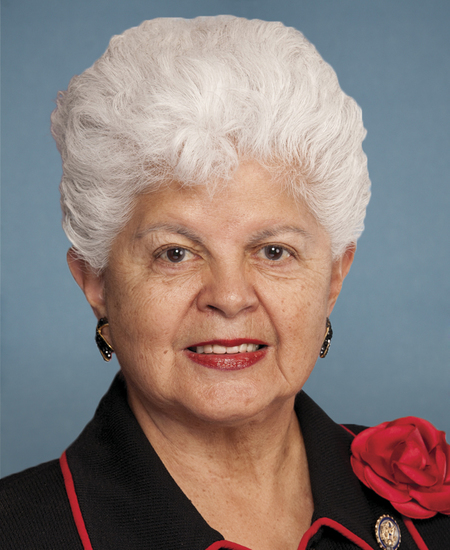
Photo of Grace F. Napolitano
D United States House · District 31 · Former member · California

Rep. Grace F. Napolitano

Compare
Total votes
2,168
all sessions
Attendance
97%
65 missed
Lower than 80% of chamber peers
With party
98%
of cast votes
Higher than 91% of chamber peers
Bipartisan score
1%
crosses aisle rarely
Lower than 90% of chamber peers
Sponsored
1,162
bills & resolutions
Near the chamber average
Committees
0
assignments
1,162 bills and resolutions

Sponsored bills

Total
1,162
Primary
29
Co-sponsor
1,133
This page
1,162
matching current filters
Co-sponsor HR 3630
Passed · United States House · Co-sponsor
Lymphedema Treatment Act

Lymphedema Treatment Act This bill provides for Medicare coverage of lymphedema compression treatment items. Specifically, the bill provides for coverage of standard and custom fitted gradient compression garments and other approved items that are prescribed by a physician or other specified health care professional to treat lymphedema.

Passed Nov 17, 2022 1 co-sponsor
Co-sponsor HR 1283
In committee · United States House · Co-sponsor
CONTRACT Act of 2021

Continuity for Operators with Necessary Training Required for ATC Contract Towers Act of 2021 or the CONTRACT Act of 2021 This bill exempts certain air traffic controllers from a required reduction in their retirement annuity payment on account of earnings from certain work performed while entitled to such annuity. Under current law, retired Federal Aviation Administration air traffic controllers receive an annuity payment during the period between the mandatory retirement age of 56 and the Social Security minimum age of 62. Such annuity payment is required to be reduced by a certain percentage of any excess earnings during this period. The bill exempts from such reduction in annuity payments an air traffic controller who participates in the Air Traffic Control Contract Program (a public-private partnership for air traffic control services) following mandatory retirement.

In committee Nov 17, 2022 1 co-sponsor
Co-sponsor HR 2872
In committee · United States House · Co-sponsor
SAFE Act

Safeguarding America's Future and Environment Act or the SAFE Act The bill requires the development of an integrated national approach to help fish, wildlife, and plants adapt to extreme weather changes and climate change. Specifically, the bill requires the President to establish an interagency National Fish, Wildlife, and Plants Climate Adaptation Strategy Joint Implementation Working Group. The working group must adopt the 2013 National Fish, Wildlife, and Plants Climate Adaptation Strategy, which addresses the effects of extreme weather and climate change on fish, wildlife, and plants. After the Committee on Earth and Environmental Sciences releases a periodic scientific assessment required under the U.S. Global Change Research Program, the working group must use sound science to review and revise the strategy to incorporate new information and advances in the development of strategies to help fish, wildlife, and plants adapt. Each federal agency must integrate the strategy into agency plans, environmental reviews, and programs. The Department of the Interior must establish a National Climate Change and Wildlife Science Center to assess and develop scientific information, tools, strategies, and techniques to support the working group and other interested parties in addressing the effects of extreme weather and climate change. Interior must establish an Advisory Committee on Climate Change and Natural Resource Sciences to advise the working group.


In committee Nov 16, 2022 1 co-sponsor
Co-sponsor HR 2026
In committee · United States House · Co-sponsor
Global Amphibian Protection Act of 2021

Global Amphibian Protection Act of 2021 This bill establishes a Highly Endangered Amphibian Species Conservation Fund and requires the Department of the Interior to use the fund to carry out a grant program for the conservation of highly endangered amphibian species. Highly endangered amphibian species means any amphibian species categorized on the International Union for Conservation of Nature (IUCN) Red List of Threatened Species as endangered, critically endangered, or extinct in the wild. The term also means any other amphibian species categorized on such list as data deficient or under a threat category lower than endangered if Interior determines that (1) the most recent IUCN Red List assessment indicates that the population is decreasing, or (2) such species is facing new or emerging threats. The bill establishes the fund as a separate account in the Multinational Species Conservation Fund.

In committee Nov 16, 2022 1 co-sponsor
Co-sponsor HR 1733
In committee · United States House · Co-sponsor
RECLAIM Act of 2021

Revitalizing the Economy of Coal Communities by Leveraging Local Activities and Investing More Act of 2021 or the RECLAIM Act of 2021 This bill revises requirements concerning the Abandoned Mine Reclamation Fund, including by expanding the eligible uses of the fund. Specifically, the bill allows the fund to be used to provide support for economic revitalization, diversification, and development in economically distressed mining communities through the reclamation and restoration of land and water resources adversely affected by abandoned coal mines. In addition, it requires specified amounts to be annually distributed from the fund through FY2026 to states and Indian tribes for reclaiming and restoring lands and waters so affected.

In committee Nov 16, 2022 1 co-sponsor
Co-sponsor HR 1734
In committee · United States House · Co-sponsor
Surface Mining Control and Reclamation Act Amendments of 2021

Surface Mining Control and Reclamation Act Amendments of 2021 This bill reauthorizes the Department of the Interior to collect fees on the production of coal through FY2036, expands the eligible uses of the Abandoned Mine Reclamation Fund, and revises requirements concerning the fund. Under current law, operators of active coal mines must pay such fees through FY2021. Revenue from the fees are deposited into the Abandoned Mine Reclamation Fund, which is used for the reclamation of abandoned coal mines. The bill authorizes Interior to reimburse states and tribal governments from the fund for the emergency restoration, reclamation, abatement, control, or prevention of adverse effects of coal mining practices. It also increases the minimum amount of funds from $3 million to $5 million that Interior must award to states and Indian tribes that have approved abandoned mine reclamation programs.

In committee Nov 16, 2022 1 co-sponsor
Co-sponsor HR 404
In committee · United States House · Co-sponsor
Driftnet Modernization and Bycatch Reduction Act

Driftnet Modernization and Bycatch Reduction Act This bill addresses certain driftnet fishing. Driftnet fishing is a method of fishing in which a gillnet composed of a panel or panels of webbing, or a series of such gillnets, is placed in the water and allowed to drift with the currents and winds for the purpose of entangling fish in the webbing. Currently, the use of large-scale drift gillnets with a total length of 2.5 kilometers or more is prohibited in the United States.The bill expands the definition of large-scale driftnet fishing to prohibit the use of gillnets with a mesh size of 14 inches or greater. This expanded prohibition does not apply within the U.S. exclusive economic zone for five years. The Department of Commerce must conduct a transition program to facilitate the phase out of large-scale driftnet fishing and to promote the adoption of alternative fishing practices that minimize the incidental catch of living marine resources. Commerce must award grants to program participants. Further, the North Pacific Fishery Management Council may recommend and Commerce may approve regulations to collect fees from charter vessel operators that guide recreational anglers who harvest Pacific halibut.

In committee Nov 16, 2022 1 co-sponsor
Co-sponsor HR 5441
Passed · United States House · Co-sponsor
PAST Act of 2021

Prevent All Soring Tactics Act of 2022 or the PAST Act of 2022 This bill addresses the practice of soring horses. The soring of horses includes various actions taken on horses' limbs to produce higher gaits that may cause pain, distress, inflammation, or lameness. Specifically, the bill expands soring regulation and enforcement at horse shows, exhibitions, sales, and auctions, including by establishing a new system for inspecting horses for soring. In addition, the bill increases penalties for violations.

Passed Nov 15, 2022 1 co-sponsor
Co-sponsor HR 1931
Passed · United States House · Co-sponsor
Japanese American Confinement Education ActNorman Y. Mineta Japanese American Confinement Education Act

Norman Y. Mineta Japanese American Confinement Education Act This bill increases the authorization of appropriations for the Japanese American Confinement Sites (JACS) grant program, which supports the preservation of U.S. confinement sites that were used to detain Japanese Americans during World War II (i.e., internment camps). It also establishes a program within JACS to provide grants to Japanese American nonprofits to educate individuals about the historical significance of these events.

Passed Nov 14, 2022 1 co-sponsor
Co-sponsor HR 2193
In committee · United States House · Co-sponsor
Asunción Valdivia Heat Illness and Fatality Prevention Act of 2022

Asunción Valdivia Heat Illness and Fatality Prevention Act of 2022 This bill directs the Occupational Safety and Health Administration to promulgate a standard that requires employers to implement certain measures for protecting workers from heat stress and related illnesses or injuries. Heat stress refers to the load of heat that a person experiences due to sources of heat or heat retention (including metabolic heat, environmental factors, and clothing or personal protective equipment) or the presence of heat in a work setting. Further, if an employer cannot reduce exposure to heat stress below hazardous levels through engineering controls (e.g., heat shields and insulation) or personal protective equipment (e.g., heat reflective clothing), the employer must implement a program that mitigates such exposure through access to appropriate hydration and cool-down spaces, acclimatization policies, and periodic paid rest breaks. Additionally, the bill establishes requirements concerning judicial review, implementation, enforcement, recordkeeping, and whistle-blower protections related to the standard. The bill also requires the Department of Labor to include questions about heat-related illness and injury in the National Agricultural Workers Survey (an employment-based, random-sample survey of U.S. crop workers that collects demographic, employment, and health information).

In committee Nov 7, 2022 1 co-sponsor
Showing 501 to 510 of 1,162 bills
Previous 1 … 50 51 52 … 117 Next