

Improving Medicare Coverage Act This bill temporarily expands eligibility for Medicare. It also temporarily establishes a premium and cost-sharing assistance program for low-income beneficiaries. Specifically, the bill lowers the age of eligibility for Medicare from 65 to 60. The Centers for Medicare & Medicaid Services must establish procedures to provide for automatic enrollment of qualifying individuals. Enrollment must be completed within 11 months of the bill's enactment. The bill also establishes a program under Medicare to assist low-income Medicare beneficiaries with premiums, coinsurance, deductibles, and other costs. Currently, such assistance is provided through Medicare Savings Programs, which are administered by state Medicaid programs. The bill also establishes a related special enrollment period under Medicare, expands eligibility for assistance to beneficiaries with income up to 200% of the federal poverty line, and provides for joint eligibility determinations with respect to the bill's program and the low-income subsidy program under the Medicare prescription drug benefit. The bill's provisions generally take effect six months after the bill's enactment and terminate five years later.
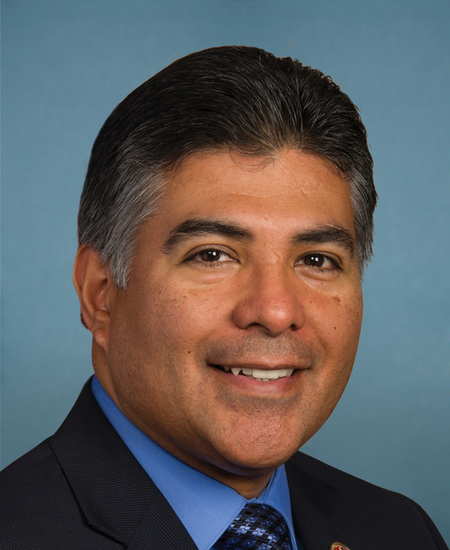
Rep. Tony Cárdenas
Sponsored bills
Prohibition of Medicaid Funding for Conversion Therapy Act This bill prohibits state Medicaid programs from covering conversion therapy. The bill defines conversion therapy as any practice or treatment that seeks to change a person's sexual orientation or gender identity in exchange for monetary compensation.
Pediatric Access to Critical Healthcare Act This bill requires the Health Resources and Services Administration (HRSA) to award grants to children's hospitals and other providers that predominately treat individuals under 21 for improving pediatric health care infrastructure. In awarding the grants, HRSA must prioritize recipients that serve significant numbers of patients receiving medical assistance through Medicaid or the Children's Health Insurance Program or children from other underserved groups.
Harlem Hellfighters Congressional Gold Medal Act This bill provides for the award of a Congressional Gold Medal to the 369th Infantry Regiment, commonly known as the Harlem Hellfighters, in recognition of their bravery and outstanding service during World War I.
Puppies Assisting Wounded Servicemembers for Veterans Therapy Act or the PAWS for Veterans Therapy Act This bill implements a program and a policy related to service dog therapy for veterans. Specifically, the bill requires the Department of Veterans Affairs (VA) to implement a five-year pilot program to provide canine training to eligible veterans diagnosed with post-traumatic stress disorder as an element of a complementary and integrative health program. Eligible veterans are those who are enrolled in the VA health care system and have been recommended for participation by a qualified mental health care provider or clinical team. The VA must seek to enter agreements containing specified elements with accredited nongovernmental entities that have demonstrated ability to provide canine training. Veterans who participate in the program are authorized to adopt the dog they assisted in training if their health provider determines it is in the best interest of the veteran. The VA must establish processes to document and track the progress of participating veterans with respect to health benefits and improvements. The Government Accountability Office must brief Congress and submit a report on the program. The bill also authorizes the VA to provide service dogs to veterans with mental illnesses, regardless of whether they have a mobility impairment.
Broadband Incentives for Communities Act This bill requires the National Telecommunications and Information Administration (NTIA) to establish a grant program to assist local governments and Indian tribes with efficient review and approval of zoning or permitting applications that facilitate the deployment of broadband infrastructure. Grant recipients must use awarded funds to build application processing capacity or to purchase technology, software, and equipment to facilitate the processing of applications. The NTIA must also establish the Local Broadband Advisory Council to develop solutions to challenges faced by local governments, Indian tribes, and infrastructure providers in facilitating wireless and broadband deployment, including in unserved and underserved communities.
This bill allows a new tax credit for carriage of qualified independent programmers by eligible distributors and multichannel video programming distributors based on license fees and the number of subscribers. The bill defines eligible distributor as any person engaged in the trade or business of a qualified distributor or multichannel video programming distributor and any person engaged in the trade or business of being a virtual multichannel video programming distributor. The term multchannel video programming distributor is defined in federal regulations as any entity engaged in the business of making available for purchase, by subscribers or customers, multiple channels of video programming. Such entities include, but are not limited to, a cable operator, a BRS/EBS provider, a direct broadcast satellite service, a television receive-only satellite program distributor, and a satellite master antenna television system operator, as well as buying groups or agents of all such entities. The bill defines qualified independent programmer as a U.S.-based person engaged in the production, creation, or wholesale distribution of three or fewer television channels in which no multichannel video programming distributor, cable programmer, or broadcast network has attributable interest, and includes rural, women, socially disadvantaged, and minority-owned programmers.
This resolution supports (1) the goals of Wildfire Preparedness Week, and (2) resources and educational initiatives that communicate how affected communities can prevent wildfires and react during a wildfire.
Language Access for Medicare Beneficiaries Act of 2021 This bill requires the Centers for Medicare & Medicaid Services (CMS) to translate the annual explanation of Medicare benefits for enrollees into multiple languages, besides English and Spanish. The CMS must prioritize languages into which Social Security documents are translated or that are most frequently requested for purposes of Social Security benefits applications.
Preserving Direct Seller Independence Act This bill excludes a real estate agent or a direct seller of consumer products from the definition of an employee for the purpose of applying the Fair Labor Standards Act of 1938.