

Restoring Fulbright Exchanges with China and Hong Kong Act This bill nullifies the portion of Executive Order 13936 that terminated the Fulbright exchange program with respect to exchanges with China and Hong Kong.
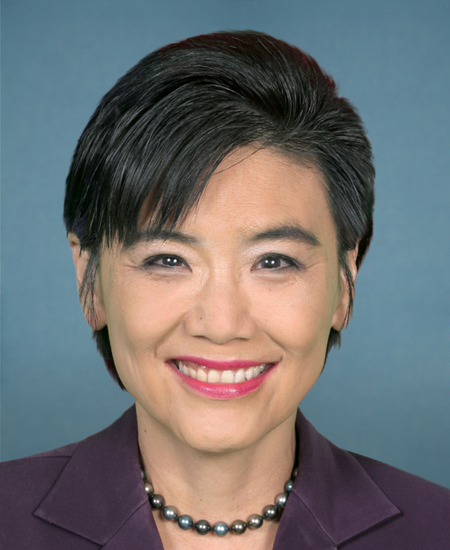
Rep. Judy Chu
Sponsored bills
New Way Forward Act This bill makes changes to immigration enforcement, including ending mandatory detention in certain cases. The Department of Homeland Security (DHS) may not enter into or extend any contract with any for-profit entity to own or operate a detention facility. The bill provides for various protections related to detaining non-U.S. nationals ( aliens under federal law), such as (1) requiring DHS to make an initial custody determination and establish probable cause within 48 hours of taking an individual into custody, (2) establishing in hearings related to such determinations a presumption that the individual be released, and (3) requiring immigration judges to impose the least restrictive detention conditions necessary. A DHS officer may not interrogate an individual as to immigration status based on factors such as the individual's race, religion, or spoken language. The bill removes mandatory detention requirements for certain individuals, such as asylum seekers with a credible fear of persecution. Certain individuals who were previously admitted into the United States may be removed only if removal proceedings commenced within five years of the individual becoming deportable or inadmissible. The bill also removes certain crime-related grounds of inadmissibility and deportability. The bill gives immigration judges discretion to provide relief from removal if the removal is not based on certain crime-related grounds. State or local officers are prohibited from performing certain immigration enforcement functions. The National Crime Information Center database may not contain an individual's immigration information. The bill repeals criminal penalties for improper entry or reentry into the United States.
Maddy summaryHR 1139, the GUARD VA Benefits Act, amends federal law to strengthen penalties for individuals or organizations charging veterans unauthorized fees when helping with VA benefit claims. It directly affects veterans seeking assistance with VA claims and the representatives (like advocates or attorneys) who might charge them fees. The bill adds a new provision making it a violation to solicit, charge, or receive any fee for preparing, presenting, or prosecuting VA claims, punishable by fines under Title 18. This change specifically targets unauthorized fee-charging while excluding fees covered under existing exceptions in sections 5904 or 1984 of the law.
Protect Our Workers from Exploitation and Retaliation Act or the POWER Act This bill expands protections for non-U.S. nationals ( aliens under federal law) who are victims of crimes or serious workplace violations. U visas (nonimmigrant visas for certain crime victims) shall be available to individuals who have suffered substantial harm related to workplace claims. The Department of Homeland Security (DHS) may allow a non-U.S. national to work and temporarily remain in the United States if the individual (1) has filed for a U visa or T visa (nonimmigrant visas for victims of human trafficking), or (2) has filed or is a material witness to a workplace claim or civil claim arising from criminal activity and is helpful to authorities investigating the claim. The bill removes direct numerical limitations on U visas. A notice to an individual to appear at removal proceedings must contain specified certifications, if the individual was taken (1) at a facility where a workplace claim has been filed, or (2) as a result of information provided in retaliation against individuals exercising their legal rights. Specifically, the notice must state that (1) an adverse immigration determination may not be based solely on information furnished by the party engaged in the unlawful activity, and (2) the individual's information may not be disclosed. Such an individual may not be removed until law enforcement has had a chance to interview the individual. Removal proceedings against an individual who has filed or is a witness to a workplace claim must be stayed until the resolution of the claim, with limited exceptions.
Maddy summaryHR 1831 would award Billie Jean King a Congressional Gold Medal to honor her lifelong advocacy for equal rights in sports and society. The bill directs the Secretary of the Treasury to strike the medal and have it presented by congressional leaders, recognizing her pivotal role in advancing women's equality through tennis (including founding the Women’s Tennis Association and securing equal prize money) and her broader impact on society through initiatives like Title IX advocacy.
Maddy summaryThis bill changes how U.S. foreign aid is provided to international health organizations. It prevents U.S. agencies from denying aid to foreign non-governmental organizations (NGOs) solely because they offer health services (like counseling or referrals) using their own funds, as long as those services follow local laws. It also stops applying stricter rules about how foreign NGOs can use their own funds for advocacy compared to U.S. NGOs receiving similar aid. The bill directly affects foreign health-focused NGOs that rely on U.S. foreign assistance funding.
Maddy summaryHR 1794 authorizes the minting of commemorative coins to honor the 2028 Los Angeles Olympic and Paralympic Games. It specifies four coin types ($5 gold, $1 silver, half-dollar clad, and proof silver $1) with defined weights, sizes, and mintage limits (e.g., up to 100,000 gold coins). A surcharge is added to each coin sale (e.g., $35 for gold coins), with all surcharge funds directed to the U.S. Olympic and Paralympic Properties to support legacy programs and the Games' operations. The coins must be issued only during 2028 and are legal tender, though the bill focuses solely on commemorative coinage, not policy changes.
Maddy summaryThe Loan Forgiveness for Educators Act would provide full student loan forgiveness to educators who work in high-need schools or early childhood education programs. After completing 5 years of qualifying service, educators would have 100% of their outstanding student loans forgiven, with the option for monthly loan forgiveness during their service period. The bill defines "high-need schools" as those with over 30% of students in poverty or identified for improvement, and includes special provisions for educators working in Native American, Tribal, and Bureau of Indian Education schools. Educators could count service completed before the law's enactment toward their 5-year requirement, and the program would cover both FFEL and Direct Loan programs.
Maddy summaryHR 1716, the Global Aircraft Maintenance Safety Improvement Act, requires U.S. airlines to annually report detailed information about heavy maintenance work performed outside the U.S. on their aircraft, including locations, work descriptions, and any safety issues identified after maintenance. It prohibits U.S. airlines from entering new contracts for such maintenance with repair stations in countries classified by the FAA as "Category 2" due to safety deficiencies. The bill also mandates that mechanics and supervisors at foreign repair stations performing heavy maintenance on U.S. aircraft must hold appropriate FAA certifications. Additionally, it establishes a working group with international aviation authorities to review and recommend improvements for overseeing foreign repair stations.
Maddy summaryThis bill restores access to VA housing loans and educational benefits for Black World War II veterans who were denied GI Bill benefits due to racial discrimination, as well as for their living spouses, children, grandchildren, or direct descendants. It defines eligibility by requiring applicants to certify that their veteran relative was denied GI Bill benefits on racial grounds, with a five-year application window starting from the bill's enactment date. The VA must process these applications within 90 days and report to Congress on the number of recipients and total benefit value within one year. This addresses historical discrimination by creating new pathways to benefits for affected individuals and their families.