

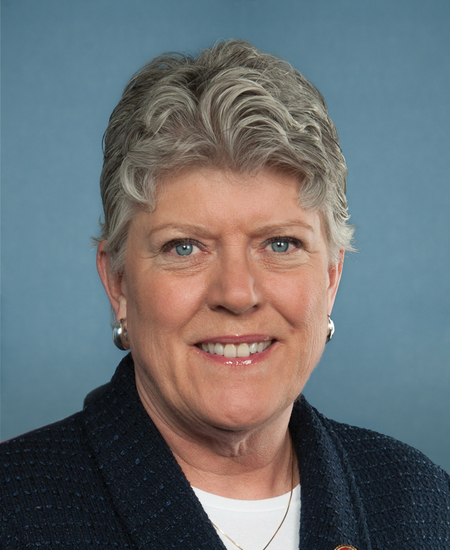
Photo of Julia Brownley
D United States House · District 26 · California

Rep. Julia Brownley

Compare
Total votes
2,837
all sessions
Attendance
98%
63 missed
Near the chamber average
With party
99%
of cast votes
Higher than 96% of chamber peers
Bipartisan score
1%
crosses aisle rarely
Lower than 97% of chamber peers
Sponsored
2,099
bills & resolutions
Higher than 92% of chamber peers
Committees
8
assignments
2,099 bills and resolutions

Sponsored bills

Total
2,099
Primary
170
Co-sponsor
1,929
This page
2,099
matching current filters
Primary HR 5583
In committee · United States House · Lead sponsor
Climate-Friendly Food Label Task Force Act

Climate-Friendly Food Label Task Force Act This bill establishes an advisory panel to study and submit a report to the Department of Agriculture (USDA) and Congress on the development of a climate-friendly certification for agricultural products. The USDA-appointed advisory panel must include representatives who are scientists (including experts on climate science and nutrition science) and representatives from environmental advocacy organizations, industry, and federal agencies. USDA may not issue any related regulations or guidance (or otherwise certify or advertise any agricultural product as climate-friendly) before the report is submitted to Congress.

In committee Jan 17, 2024 0 co-sponsors
Primary HR 6959
In committee · United States House · Lead sponsor
Fix FEDVIP Age Act

Maddy summaryHR 6959, the "Fix FEDVIP Age Act," amends federal law to extend dental and vision insurance coverage under the FEDVIP program to dependent children up to age 26, instead of the current age limit of 22. This change directly affects federal employees and their children who are under 26 and currently lose coverage at age 22. The bill modifies Section 8901(5) of Title 5, U.S. Code, by replacing "22" with "26" in the eligibility criteria. The policy change ensures continuity of health insurance for dependent children during a common transitional period, without altering other FEDVIP benefits or costs.

In committee Jan 11, 2024 0 co-sponsors
Co-sponsor HR 5657
In committee · United States House · Co-sponsor
NO TIME TO Waste Act

Maddy summaryThe NO TIME TO Waste Act establishes an Office of Food Loss and Waste within the Department of Agriculture to coordinate national efforts to reduce food loss and waste. It creates a grant program for states, local governments, and tribal entities to collect data on food waste reduction policies and develop model policies, while requiring federal contractors to report on their food waste reduction efforts. The bill sets a goal to reduce food loss and waste by 50% by 2030 compared to 2016 levels, with annual reports tracking progress to Congress. It also establishes regional coordinators to facilitate food recovery and partnerships between government, food businesses, and nonprofits, and mandates a national education campaign to teach consumers about food preservation, safety, and composting. Funding is authorized for fiscal years 2024-2028 to support these initiatives.

In committee Jan 11, 2024 1 co-sponsor
Co-sponsor HRES 955
In committee · United States House · Co-sponsor
Commending Taiwan for its history of democratic elections, and expressing support of Taiwan in the preservation of its democratic institutions.

Maddy summaryHRES 955 is a resolution commending Taiwan for its democratic election history and supporting Taiwan's democratic institutions. It recognizes Taiwan's transition to democracy since the late 1980s, including 7 presidential and 9 legislative elections held since then, all deemed free and fair. The resolution specifically expresses support for Taiwan's upcoming January 13, 2024, elections and condemns interference by the Chinese Communist Party. It affirms U.S. commitment to a strong partnership with Taiwan across multiple domains and supports Taiwan's self-defense and liberty. As a procedural resolution, it does not create new law but formally expresses congressional support for Taiwan's democratic development.

In committee Jan 10, 2024 1 co-sponsor
Co-sponsor HR 6944
In committee · United States House · Co-sponsor
INSURE Act

Maddy summaryThe INSURE Act creates a federal reinsurance program to replace the National Flood Insurance Program, requiring property insurers to offer "all-perils" policies covering specific catastrophe risks like flood, wind, hurricane, wildfire, and eventually earthquake. Insurers participating in the program must implement loss prevention partnerships that encourage investments to reduce catastrophe losses, and will pay quarterly premiums to a Federal Catastrophe Reinsurance Fund. The program will phase in coverage for different perils over eight years, starting with flood coverage (beginning four years after enactment), followed by wind/hurricane (five years), severe storms/wildfire (six years), and earthquake (eight years or when feasibility reports are submitted). The bill also establishes grant programs for states to promote loss prevention investments and provide financial assistance to low-income homeowners struggling with insurance costs.

In committee Jan 10, 2024 1 co-sponsor
Co-sponsor HR 6929
In committee · United States House · Co-sponsor
Affordable Connectivity Program Extension Act of 2024

Maddy summaryThe Affordable Connectivity Program Extension Act of 2024 allocates $7 billion in funding for the Affordable Connectivity Program (ACP) during fiscal year 2024. The ACP provides subsidies to low-income households to help cover the cost of internet service and connected devices like laptops or tablets. This funding ensures the program can continue supporting eligible households throughout the year, with the money remaining available until fully spent. The bill extends existing program funding without changing eligibility criteria or service requirements.

In committee Jan 10, 2024 1 co-sponsor
Co-sponsor HR 6888
In committee · United States House · Co-sponsor
Clean Energy Workforce Act

Maddy summaryHR 6888, the Clean Energy Workforce Act, provides $100 million in federal grants to develop clean energy job training programs. It directly affects local schools, career technical education centers, colleges, and industry partners by funding: (1) new or expanded training programs in clean energy fields (like renewable energy and climate adaptation), designed to be shared with other schools and accessible to diverse students; and (2) upgrades to school facilities to use renewable energy and improve energy efficiency. Grants require partnerships between educational institutions, industry representatives, and community groups to create replicable training that prepares students for jobs in growing clean energy sectors. The bill focuses on concrete workforce development, not environmental outcomes.

In committee Dec 22, 2023 1 co-sponsor
Co-sponsor HR 6837
In committee · United States House · Co-sponsor
Stopping Grinch Bots Act of 2023

Maddy summaryThis bill prohibits using bots to bypass online retailers' posted purchase limits or inventory controls, making it illegal to create, sell, or distribute products obtained through such circumvention. It directly affects online retailers implementing purchase limits, consumers seeking fair access to products, and sellers of goods acquired via prohibited bot activity. Key mechanisms include FTC enforcement against violations (treated as unfair/deceptive practices) and allowing state attorneys general to sue for consumer harm, with exceptions for legitimate security research. The law targets bot-driven scalping tactics during high-demand sales without specifying particular products or timing.

In committee Dec 15, 2023 1 co-sponsor
Co-sponsor HR 6749
In committee · United States House · Co-sponsor
Menopause Research and Equity Act of 2023

Maddy summaryThe Menopause Research and Equity Act of 2023 requires the National Institutes of Health (NIH) to evaluate existing and ongoing research on menopause, perimenopause, and mid-life women’s health, identifying gaps in knowledge and funding over the past five years. The NIH must then develop a strategic plan with health professionals (including specialists like gynecologists and endocrinologists) to address these gaps and guide future research on treatments for menopause symptoms. The bill also mandates new NIH research on causes, symptoms, and treatments for menopause-related health issues, including a study on hormonal treatments. All activities must be funded using existing NIH resources, with no new appropriations authorized. This aims to improve scientific understanding of women’s mid-life health needs.

In committee Dec 15, 2023 1 co-sponsor
Co-sponsor HR 6724
In committee · United States House · Co-sponsor
Energizing American Shipbuilding Act of 2023

Maddy summaryHR 6724, the *Energizing American Shipbuilding Act of 2023*, requires natural gas and crude oil exporters to use US-registered vessels with specific domestic manufacturing components for a growing percentage of their vessel-based exports. For natural gas, exporters must use qualifying vessels for 2% of exports in year 1, rising to 15% by year 22; for crude oil, the target starts at 3% and reaches 10% by year 14. A qualifying vessel must be either built in the US with all major parts and specified components (like valves, propulsion systems, and electrical equipment) made domestically, or retrofitted in a US shipyard using US-made parts for those components. The bill also mandates exporters provide training opportunities for US mariners and requires the Energy Information Administration to track and publish export data.

In committee Dec 15, 2023 1 co-sponsor
Showing 941 to 950 of 2,099 bills
Previous 1 … 94 95 96 … 210 Next