Designates the facility of the United States Postal Service located at 9317 Bolsa Avenue, in Westminster, California, as the "General Tran Hung Dao Post Office."
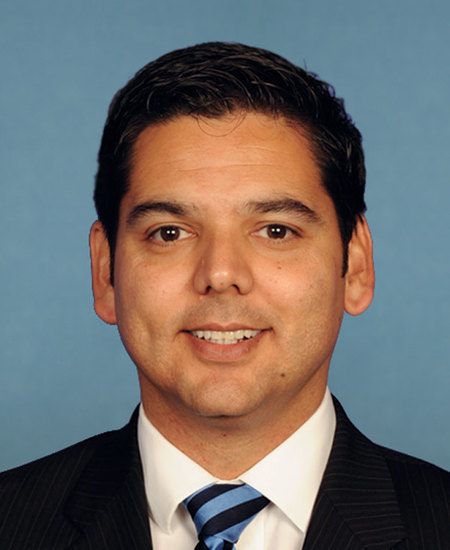
Rep. Raul Ruiz
Sponsored bills
School Food Recovery Act of 2021 This bill directs the Department of Agriculture (USDA) to provide competitive grants and technical assistance for local educational agencies to implement food waste measurement and reporting, prevention, education, and reduction projects. In awarding grants, USDA must give priority to agencies that agree to use grant funds for carrying out specific projects, including (1) experiential education activities that encourage children enrolled in such agencies to participate in food waste measurement and education; and (2) the establishment of food waste measurement, prevention, and reduction projects with long-term sustainability. The federal share of project costs may not exceed 75% of the total cost of carrying out such projects. All projects must comply with the nutrition requirements of the National School Lunch Program or the School Breakfast Program, including by offering no less than the minimum quantities of required food components.
This bill requires the Department of Defense (DOD) to conduct outreach to build awareness among former members of the Armed Forces of the process established for the review of discharge characterizations related to sexual orientation (i.e., on the basis of Don't Ask, Don't Tell or a similar policy). DOD must also provide for specified relief for former members of the Armed Forces who were impacted by the discharge characterizations and ensure that DOD oral historians review related facts and receive testimony from affected individuals.
Israel Relations Normalization Act of 2021 This bill requires the Department of State to take certain actions promoting the normalization of relations between Israel, Arab states, and other relevant countries and regions. Specifically, the State Department must develop a strategy on expanding and strengthening the Abraham Accords (the term used to refer collectively to agreements between Israel and the United Arab Emirates and between Israel and Bahrain marking the public normalization of relations between the two Arab countries and Israel). The strategy must include a description of how the U.S. government will encourage further normalization of relations with Israel. In addition, the State Department must report on options for U.S. international efforts to promote the strengthening of ties between Israel, Arab states, and other relevant countries and regions. The State Department must also report on the status of the normalization of relations with Israel, including information on (1) laws that punish individuals for people-to-people relations with Israelis (i.e., anti-normalization laws), and (2) evidence of steps taken by Arab governments toward permitting or encouraging normalized relations between their citizens or residents and Israeli citizens.
Disaster Assistance Equity Act of 20 21 This bill makes common interest communities, such as housing cooperatives (co-ops) and condominiums, eligible for the same assistance from the Federal Emergency Management Agency (FEMA) as other homeowners. Specifically, the bill adds definitions of residential common interest community, condominium, and housing cooperative to the Robert T. Stafford Disaster Relief and Emergency Assistance Act; requires FEMA to issue rules for the removal of debris or wreckage from real estate owned by a residential common interest community resulting from a major disaster and deems such removal to be in the public interest when a state or local government determines in writing that such debris or wreckage constitutes a threat to life, public health or safety, or the economic recovery of such community; and provides for the repair of essential common elements of a condominium or co-op damaged by a disaster under FEMA's Federal Assistance to Individuals and Households Program.
John R. Lewis Voting Rights Advancement Act of 2021 This bill establishes new criteria for determining which states and political subdivisions must obtain preclearance before changes to voting practices may take effect. Preclearance is the process of receiving preapproval from the Department of Justice (DOJ) or the U.S. District Court for the District of Columbia before making legal changes that would affect voting rights. A state and all of its political subdivisions shall be subject to preclearance of voting practice changes for a 10-year period if 15 or more voting rights violations occurred in the state during the previous 25 years; 10 or more violations occurred during the previous 25 years, at least 1 of which was committed by the state itself; or 3 or more violations occurred during the previous 25 years and the state administers the elections. A political subdivision as a separate unit shall also be subject to preclearance for a 10-year period if three or more voting rights violations occurred there during the previous 25 years. States and political subdivisions that meet certain thresholds regarding minority groups must preclear covered practices before implementation, such as changes to methods of election and redistricting. Further, states and political subdivisions must notify the public of changes to voting practices. Next, the bill authorizes DOJ to require states or political subdivisions to provide certain documents or answers to questions for enforcing voting rights. The bill also outlines factors courts must consider when hearing challenges to voting practices, such as the extent of any history of official voting discrimination in the state or political subdivision.
This resolution expresses the sense of the House of Representatives that the United States shall recognize kind actions in our country, encourage kindness, spread love, and foster a culture of being kind to one another.
Grandparent-Grandchild Medical Leave Act This bill provides leave for an eligible employee, including a federal employee, to care for an adult child, grandparent, or grandchild (as well as for a spouse, child, or parent), if that individual has a serious health condition.
Panama Canal Zone Veterans Act of 2021 This bill establishes a presumption of service-connection for specified conditions associated with active duty service in or near the Panama Canal Zone (zone) from January 1, 1958, through the latter of December 31, 1999, or the date on which the last service member departed from duty in the zone. Under a presumption of service-connection, specific conditions diagnosed in certain veterans are presumed to have been caused by the circumstances of their military service. Health care benefits and disability compensation may then be awarded. The presumption of service-connection applies to illnesses listed in the bill (e.g., Hodgkin's disease) or those that (1) have a positive association with exposure to an herbicide agent that is known or presumed to be associated with service in the zone during the specified time period, and (2) become manifest in a veteran who served in the zone during the specified time period and was exposed to an herbicide agent during such service. The Department of Veterans Affairs must prescribe regulations providing for a presumption of service-connection whenever there is a determination that a positive association exists between the exposure to an herbicide agent known or presumed to be associated with service in or near the zone and the occurrence of an illness in humans.
Supporting Expanded Review for Veterans In Combat Environments Act of 2021 or the SERVICE Act of 2021 This bill expands eligibility for Veterans Health Administration mammography screenings to veterans who served in certain locations during specified periods, including those who were exposed to toxic substances at such locations. The specified locations and corresponding time periods include Iraq between August 2, 1990, and February 28, 1991, and from March 19, 2003, until burn pits (areas used for burning solid waste in open air without equipment) are no longer used in Iraq; the Southwest Asia theater of operations, including Kuwait, Saudi Arabia, Oman, and Qatar, from August 2, 1990, until burn pits are no longer used in such locations; and Afghanistan, Djibouti, Syria, Jordan, Egypt, Lebanon, and Yemen from September 11, 2001, until burn pits are no longer used in such locations; and other locations and time periods as determined by the Airborne Hazards and Open Burn Pit Registry. The bill specifies that the listed locations do not include bodies of water around or airspace above such locations.