

Maddy summaryHR 1788, the "Goldie’s Act," strengthens USDA enforcement of the Animal Welfare Act. It requires annual inspections of all regulated animal businesses (like dealers, research facilities, and exhibitors) and mandates immediate, humane confiscation of animals suffering due to violations, while prohibiting owners from destroying animals during this process. The bill increases civil penalties to $10,000 per violation, requires hearing panels including veterinarians, and mandates that penalties consider business size and violation severity. It also requires USDA to share violation records with local animal control within 24 hours.
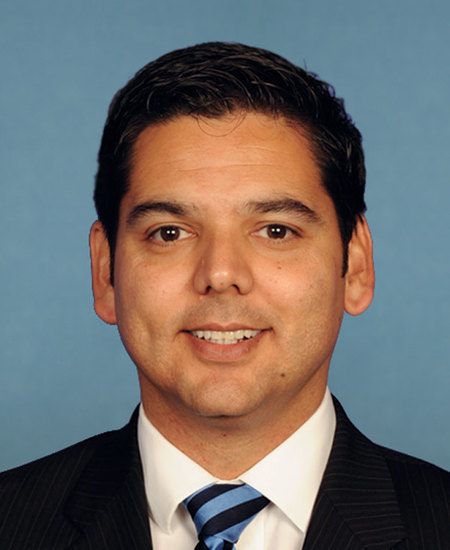
Rep. Raul Ruiz
Sponsored bills
Maddy summaryThe Water Affordability, Transparency, Equity, and Reliability Act of 2023 establishes a new trust fund funded by increasing the corporate tax rate from 21% to 24.5% to support water infrastructure and affordability programs. It allocates funds to clean water programs (42%), safe drinking water funding (42.5%), household water wells (1%), colonias assistance (0.5%), Indian health services (3%), and water operator job training (0.5%). The bill requires the EPA to conduct a study and submit a report on water affordability, discrimination in water services, public participation in regionalization, and data collection related to service disconnections. It includes specific provisions for colonias, household water wells, and job training programs for water system operators to improve water access and equity.
Maddy summaryHR 2802, the Improving Mental Health Access for Students Act, requires colleges and universities to include suicide prevention contact information on student identification cards. Specifically, institutions must list the National Suicide Prevention Lifeline, Crisis Text Line, and their campus mental health center on new ID cards. Schools that don't issue ID cards must post this information on their websites instead. The requirement takes effect one year after the bill's enactment.
Maddy summaryThe Armenian Genocide Education Act (HR 2803) establishes a Library of Congress program to support U.S. schools in teaching about the Armenian Genocide of 1915-1923. The program will develop educational resources, provide teacher training, and maintain an online resource center to help schools incorporate accurate historical information into curricula. It prioritizes schools without existing Armenian Genocide education programs, with $2 million authorized annually for five years. The Librarian of Congress will report yearly on the program’s activities to Congress.
Support our Services to Veterans Caregivers Act or the S.O.S. Veterans Caregivers Act This bill expands eligibility for assistance under the Department of Veterans Affairs Program of Comprehensive Assistance for Family Caregivers. Specifically, the bill expands eligibility for such assistance to caregivers of veterans who have a serious illness that was incurred or aggravated during active military, naval, or air service. Under current law, such assistance is already provided to caregivers of veterans who sustained serious injuries in the course of their military, naval, or air service. The bill also requires the provision of an annual multidimensional assessment to measure burdens felt by family caregivers who are designated as the primary providers of personal care services to such veterans.
Maddy summaryThis bill reauthorizes annual funding for teaching health centers that train doctors through graduate medical education programs. It sets specific funding levels from 2011 through 2034, gradually increasing over time (e.g., $582.7 million annually for 2033), with future years adjusted for inflation based on medical care costs. The funding directly supports community-based teaching hospitals and clinics that provide both patient care and physician training. Key provisions include fixed annual amounts for specific fiscal years and an inflation adjustment mechanism starting in 2034. This is a procedural funding measure affecting healthcare training institutions, not a new policy.
Maddy summaryThis bill reauthorizes $150 million annually in federal funding for diabetes prevention and treatment programs serving American Indian and Alaska Native communities, extending the existing program through fiscal year 2028. It directly affects tribal health programs and Native American communities by ensuring continued access to critical diabetes care services. The key provision adds a new funding allocation of $150 million per year for 2024-2028 to the Public Health Service Act, with funds remaining available until fully spent. This maintains current program levels without altering eligibility or service requirements.
Maddy summaryThe No Child Left Inside Act of 2023 provides federal funding to states for implementing environmental literacy plans in K-12 education. It authorizes grants for states to support partnerships between schools and environmental organizations to create outdoor learning opportunities, integrate environmental education into curricula, and provide teacher professional development. The bill prioritizes funding for high-need schools and requires states to develop plans that include field experiences, assessment of student environmental literacy, and strategies to improve academic achievement. A separate pilot program funds residential outdoor school programs that connect classroom learning to real-world environmental experiences. States receiving funds must report annually on program implementation and outcomes to ensure accountability.
Homeland and Cyber Threat Act or the HACT Act This bill allows claims in federal or state court against foreign states that conduct or participate in cyberattacks against U.S. nationals.
Maddy summaryHRES 269 is a non-binding resolution passed by the U.S. House of Representatives on March 30, 2023. It recognizes the federal government's duty to develop and implement a Transgender Bill of Rights to protect transgender and nonbinary people. The resolution outlines key provisions, including ensuring access to gender-affirming medical care, ending discrimination in employment and housing, and improving legal recognition of gender identity on government documents. It also calls for addressing systemic barriers in education, safety, and economic security faced by transgender and nonbinary individuals.