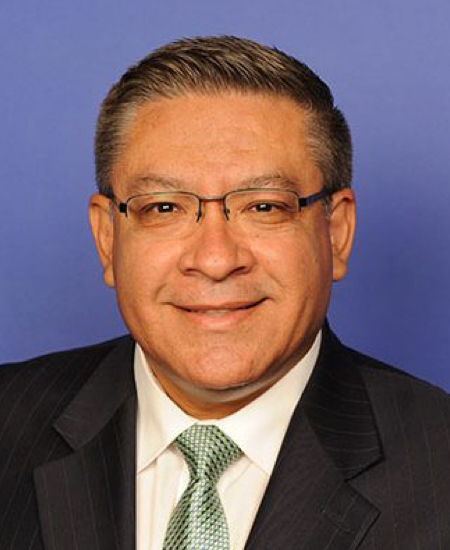
Photo of Salud O. Carbajal
D United States House · District 24 · California On the 2026 ballot

Rep. Salud O. Carbajal

Compare
Total votes
2,837
all sessions
Attendance
100%
12 missed
Higher than 78% of chamber peers
With party
98%
of cast votes
Near the chamber average
Bipartisan score
1%
crosses aisle rarely
Near the chamber average
Sponsored
1,972
bills & resolutions
Higher than 92% of chamber peers
Committees
8
assignments
1,972 bills and resolutions

Sponsored bills

Total
1,972
Primary
95
Co-sponsor
1,877
This page
1,972
matching current filters
Co-sponsor HR 1684
In committee · United States House · Co-sponsor
PAST Act of 2025

Maddy summaryThe PAST Act of 2025 amends the Horse Protection Act to ban harmful practices known as "soring," which deliberately cause pain to horses to exaggerate their gait for shows. It specifically prohibits devices like action devices (e.g., boots causing friction) and weighted shoes on Tennessee Walking Horses, Racking Horses, and Spotted Saddle Horses at events. The bill increases penalties, including escalating disqualifications for repeat offenses (180 days → 1 year → 3 years) and raises fines for violations to $5,000 per offense. It also requires stricter licensing for inspectors and mandates public posting of violation records to help event organizers enforce rules.

In committee Feb 27, 2025 1 co-sponsor
Co-sponsor HR 1589
In committee · United States House · Co-sponsor
American Dream and Promise Act of 2025

Maddy summaryThe American Dream and Promise Act of 2025 would create pathways to permanent residency for certain immigrant youth who entered the U.S. as children (Dream Act component) and for individuals from countries with Temporary Protected Status or Deferred Enforced Departure (American Promise Act component). To qualify, applicants must meet continuous physical presence requirements (since January 1, 2021 for Dream Act applicants, and for 3+ years for American Promise applicants), pass background checks, and satisfy educational or employment criteria. Conditional permanent resident status would be granted initially, with the option to convert to full permanent residency after meeting additional requirements like earning a degree, serving in the military for two years, or demonstrating three years of earned income. The bill includes fee exemptions for low-income applicants, establishes a grant program to assist applicants with legal help, and creates specific procedures for background checks and appeals.

In committee Feb 27, 2025 1 co-sponsor
Co-sponsor HRES 166
In committee · United States House · Co-sponsor
Expressing support for the Iranian people's desires for a democratic, secular, and nonnuclear Republic of Iran, and condemning the Iranian regime's terrorism, regional proxy war, internal suppression, and for other purposes.

Maddy summaryHRES 166 is a non-binding House resolution expressing U.S. support for the Iranian people's desire for a democratic, secular, and nonnuclear republic. It condemns the Iranian regime's terrorism, regional proxy wars, internal suppression of ethnic and religious minorities, and human rights abuses - including executions and repression of women-led protests. The resolution calls for holding the regime accountable through sanctions, supports the Ten-Point Plan for Iran’s democratic transition, and urges protection for Iranian political refugees in Albania. It does not create new laws but affirms U.S. policy alignment with Iranian protesters' demands.

In committee Feb 26, 2025 1 co-sponsor
Co-sponsor HR 1628
In committee · United States House · Co-sponsor
761st Tank Battalion Congressional Gold Medal Act

Maddy summaryThis bill awards a Congressional Gold Medal to the 761st Tank Battalion (known as the "Black Panthers"), the first predominantly Black armored unit in World War II's European Theater. It recognizes their combat service from 1944-1946, including key roles in the Battle of the Bulge and breaking the Siegfried Line, despite facing racial prejudice during and after the war. The medal will be displayed at the National Museum of African American History and Culture, with bronze duplicates available for sale to cover costs. The bill commemorates the battalion's 130,000 enemy casualties inflicted, 50% casualty rate, and their 1978 Presidential Unit Citation. It does not create new laws or affect current policies.

In committee Feb 26, 2025 1 co-sponsor
Co-sponsor HR 1637
In committee · United States House · Co-sponsor
Protect Veteran Jobs Act

Maddy summaryHR 1637, the Protect Veteran Jobs Act, allows veterans who were involuntarily dismissed without cause from federal civil service positions between January 20, 2025, and the bill’s enactment date to seek reinstatement to their former role or a qualified position. It directly affects eligible veterans dismissed during this period and requires federal agencies to report quarterly on veteran removals, including the number and reasons for each dismissal. Agencies must submit these reports to specified congressional committees until January 20, 2029, when the reporting requirement ends. The bill aims to restore employment opportunities for affected veterans while increasing transparency around federal hiring and dismissal practices.

In committee Feb 26, 2025 1 co-sponsor
Co-sponsor HR 1584
In committee · United States House · Co-sponsor
Democracy in Design Act

Maddy summaryThe Democracy in Design Act requires the General Services Administration (GSA) to ensure all new federal public building designs follow the 1962 "Guiding Principles for Federal Architecture" report. Within 180 days of enactment, the GSA must create binding regulations establishing minimum design standards for federal buildings, after publishing draft rules for public feedback. This law directly affects the GSA and federal agencies responsible for designing or constructing public buildings. It mandates adherence to historical design guidelines without altering existing building codes or funding mechanisms.

In committee Feb 25, 2025 1 co-sponsor
Co-sponsor HR 1564
In committee · United States House · Co-sponsor
Ethan's Law

Maddy summaryEthan's Law requires gun owners to store firearms securely in homes where minors live or where residents are legally prohibited from owning guns. It makes it unlawful to leave firearms unsecured if a minor or ineligible person could access them, with fines of $500 per violation and harsher penalties if injury or death occurs. The bill creates a federal grant program to help states implement similar secure storage laws and treats unsafe storage as negligence in legal cases. It directly affects households with children or residents who cannot legally possess firearms, aiming to reduce accidental shootings and unauthorized access.

In committee Feb 25, 2025 1 co-sponsor
Co-sponsor HR 1585
In committee · United States House · Co-sponsor
Conrad State 30 and Physician Access Reauthorization Act

Maddy summaryThe Conrad State 30 and Physician Access Reauthorization Act extends and reauthorizes a program that allows foreign medical graduates to work in underserved U.S. communities after completing their training. It extends the program through 2021 (with retroactive effect), adds protections for physicians who have completed service requirements, and makes changes to visa requirements to better support physicians working in underserved areas. The bill requires states to maintain a 90% utilization rate of waivers to keep receiving the full allocation, and adds reporting requirements for the program. This bill directly affects foreign physicians seeking to work in underserved areas and the health care facilities that employ them.

In committee Feb 25, 2025 1 co-sponsor
Co-sponsor HR 1542
In committee · United States House · Co-sponsor
Pay Our Coast Guard Parity Act of 2025

Pay Our Coast Guard Parity Act of 2025 This bill provides continuing appropriations to the Coast Guard for pay and benefits when there is a Coast Guard-specific funding lapse. Under the bill, a  Coast Guard-specific funding lapse occurs when (1) a bill providing appropriations for the Coast Guard for a fiscal year has not been enacted before the beginning of that fiscal year, and no joint resolution providing continuing appropriations for the Coast Guard is in effect; and (2) a bill providing appropriations for the Department of Defense (DOD) for the fiscal year has been enacted before the beginning of the fiscal year, or a joint resolution providing continuing appropriation for DOD is in effect.  If a Coast Guard-specific funding lapse occurs, the bill provides appropriations to the Coast Guard for pay and allowances for military members of the Coast Guard who perform active service or inactive-duty training; pay and benefits for certain civilian employees and contract employees; the payment of a death gratuity; payments for travel related to funerals, the dignified transfer of remains, and unit memorial services; and the temporary continuation of the basic allowance for housing for dependents of members of the Coast Guard dying on active duty. The bill generally provides the appropriations to the Coast Guard until the earlier of the enactment of specified Coast Guard appropriations legislation, the termination of the availability of appropriations for DOD, or two weeks after the beginning of the Coast Guard-specific funding lapse.

In committee Feb 24, 2025 1 co-sponsor
Co-sponsor HR 1464
In committee · United States House · Co-sponsor
MODERN WIC Act of 2025

More Options to Develop and Enhance Remote Nutrition in WIC Act of 2025 or the MODERN WIC Act of 2025 This bill permanently allows individuals to remotely certify their eligibility for, and receive benefits through, the Special Supplemental Nutrition Program for Women, Infants, and Children (WIC). Specifically, the bill requires that a state agency allow an individual seeking a WIC certification, recertification, or a nutritional risk evaluation to do so by phone or through video teleconference, in addition to the in-person option. A state agency has 90 days to collect data for a nutritional risk evaluation for a remotely certified individual. Further, a state agency may consider an applicant who meets the income eligibility standards to be temporarily eligible on an interim basis to participate in the program and may certify the individual for immediate participation without waiting for a nutritional risk evaluation. The bill also allows states to provide benefits on WIC electronic benefit transfer cards through mail or remote issuance instead of requiring participants to pick up or reload benefits in person at a WIC office. Further, the Department of Agriculture must report to Congress about the use of remote technologies and other digital tools in the WIC program. Currently, individuals are generally required to be physically present to certify their WIC eligibility and receive benefits, with exceptions. The Food and Nutrition Service  has temporarily waived these requirements and allowed remote certification and benefits using authorities that were provided by laws that were enacted to address COVID-19.

In committee Feb 21, 2025 1 co-sponsor
Showing 581 to 590 of 1,972 bills
Previous 1 … 58 59 60 … 198 Next