

Maddy summaryHR 7297, the "ICE and CBP Constitutional Accountability Act," creates a direct legal path for individuals harmed by ICE or CBP officers to sue the U.S. government for constitutional violations. The bill amends the Federal Tort Claims Act to allow lawsuits when officers violate rights like due process, privacy, or free speech - without requiring proof that a government policy caused the harm. Monetary damages would come from specific federal appropriations, and the government waives its usual immunity from such lawsuits. This directly affects people subjected to unlawful immigration enforcement actions by these agencies. The bill does not change agency operations but provides a new civil remedy for victims.
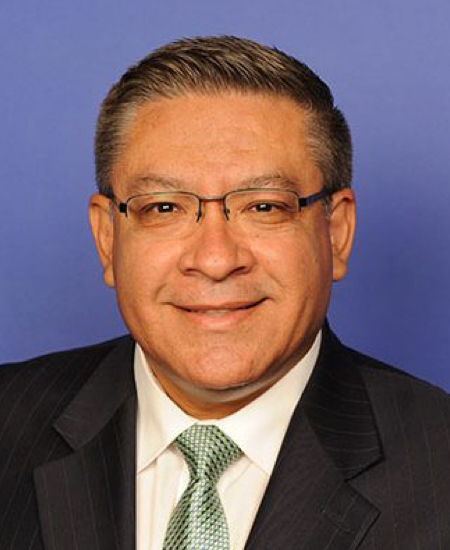
Rep. Salud O. Carbajal
Sponsored bills
Maddy summaryHJRES 144 is a congressional disapproval resolution targeting a specific rule issued by the Department of Veterans Affairs (VA) on December 31, 2025, which addressed "Reproductive Health Services" (90 Fed. Reg. 61310). This resolution directs Congress to disapprove the VA rule under Chapter 8 of Title 5, U.S. Code, meaning the rule would have no legal effect if passed. The bill directly affects the VA's implementation of reproductive health services for veterans, as it seeks to nullify the agency's existing policy. This is a procedural measure, not a substantive policy change, aimed solely at blocking the VA's rule through congressional action.
Maddy summaryHRES 1018 is a resolution calling for the U.S. government and international partners to prioritize women's rights in Haiti's crisis response. It specifically demands ensuring at least 30% of Haiti's leadership positions (including security, humanitarian, and election roles) are held by women, funding services for gender-based violence survivors, and requiring gender-disaggregated data collection in all aid programs. The resolution also urges rebuilding U.S. Women, Peace, and Security programs and mandates that all policies address women's distinct needs in Haiti's transition. This resolution directly affects U.S. foreign policy implementation and Haiti's transitional government, emphasizing that women's inclusion is critical for stability.
Maddy summaryThis bill creates a tax credit for businesses selling products made with U.S.-grown cotton. The credit equals 24% of the cotton's market value if processed only in the U.S. or in countries with U.S. trade deals, or 18% for other processing locations. To qualify, cotton must be digitally traced from U.S. farms to finished products and certified by the USDA as meeting origin requirements. It directly affects clothing and textile manufacturers selling qualifying products in the U.S. market.
Maddy summaryHR 7206, the Farm and Family Relief Act, provides direct financial assistance to agricultural producers facing market challenges during the 2025 crop year. It establishes one-time payments for eligible crop producers (including wheat, corn, soybeans, and cotton) when expected costs exceed expected returns, with payment limits based on farming income (capping at $125,000 or $250,000 depending on farming income percentage). The bill allocates $5 billion for specialty crop producers, $500 million for timber industry assistance, and $330 million for sugar beet producers through cooperative block grants. Additionally, it delays certain cost-shift provisions in food assistance programs and terminates specific tariff-imposing executive orders.
Maddy summaryThe Ensuring Access to General Surgery Act of 2026 directs the Health Resources and Services Administration to study how to better identify areas with insufficient general surgeons, particularly in rural and underserved communities. The study will evaluate current shortage designations and test a new methodology using hospital service areas and surgeon-to-population ratios to set accurate thresholds for shortage levels (e.g., critical shortage, adequate supply). Within one year, the Secretary must submit a report to Congress and publish data on surgeon availability, with annual updates to any designated shortage areas. This process aims to improve the accuracy of shortage identification to inform future resource allocation for surgical care access.
Maddy summaryHR 7166, the Stop Online Ammunition Sales Act of 2026, requires all ammunition sales to occur in person with identity verification, directly affecting licensed ammunition dealers and unlicensed buyers. The bill mandates that dealers verify a buyer’s identity using a photo ID during every transaction and prohibits online or remote sales. It also creates new recordkeeping rules requiring dealers to report multiple sales of over 1,000 ammunition rounds to an unlicensed person within 5 business days. These provisions update existing federal firearms laws to apply specifically to ammunition transactions.
Maddy summaryThis bill amends a federal program to promote pollinator-friendly vegetation along roadsides and highway rights-of-way. It expands eligibility to include 501(c)(3) nonprofits managing such projects and requires consultation with the Fish and Wildlife Service before finalizing plans. The bill increases annual funding from $150,000 to $500,000 for program administration and raises the annual funding cap for projects from $2 million to $5 million (for fiscal years 2026-2031). These changes directly affect state transportation departments, federal land agencies, and qualifying nonprofit organizations managing roadside vegetation. The key policy shift is broadening partnership opportunities while increasing funding and clarifying consultation requirements.
Maddy summaryHR 7137, the Shutdown Fairness Act, requires federal agencies to pay covered employees (including most federal workers and military personnel) and covered contractors their regular pay during government shutdowns. It appropriates funds from the Treasury to cover standard employee compensation and contractor payments for work performed during a lapse in regular appropriations, ensuring pay continues without delay (within 7 days if a shutdown is ongoing at enactment) and aligns with regular pay schedules. The bill applies only to individuals employed or with accepted offers before the shutdown began and mandates that these payments be charged to future appropriations. It does not change agency obligations under existing contracts or authorize new spending beyond the specified shutdown period.
This bill designates a portion of Interstate Route 680 in Omaha, Nebraska, as the Hal Daub Freeway. Harold John Daub Jr. served in the House of Representatives from 1981-1989 and as the mayor of Omaha, Nebraska, from 1995-2001.