

Resilient Ports Act This bill revises the Port Infrastructure Development Program with respect to port and intermodal improvement grants. Specifically, the bill authorizes the Department of Transportation (DOT) to provide grants for projects that will be used to improve the safety, efficiency, or reliability of emissions mitigation measures directly related to reducing the overall carbon footprint from port operations. Additionally, the bill increases from 18% to 25% the set-aside that DOT must reserve for grants for port projects that request the lesser of (1) 10% of the grant amounts made available for a fiscal year, or (2) $10 million. In selecting projects for funding, the bill requires DOT to give substantial weight to projects that increase the port's resilience to sea-level rise, flooding, and extreme weather events, including events related to climate change.
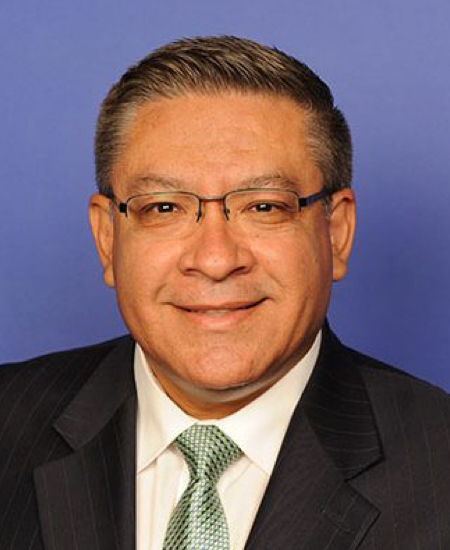
Rep. Salud O. Carbajal
Sponsored bills
Public Health Service Ready Reserve Improvement Act of 2021 This bill entitles members of the Ready Reserve Corps of the Public Health Service to certain rights and benefits concerning leave and pay that are provided to members of the Army Reserve and the National Guard who are employed by the federal government or the government of the District of Columbia. The Ready Reserve Corps provides trained personnel to respond to health emergencies and improve access to health services.
Transit to Trails Act of 2021 This bill directs the Department of Transportation (DOT) to establish the Transit to Trails Grant Program to award grants to certain governmental and private entities for projects that increase transportation access and mobility to public lands, inland and coastal waters, parkland, or monuments for critically underserved communities. For example, DOT must (1) prioritize approving certain projects, such as projects that use low-or zero-emission vehicles and those that provide free or discounted rates for low-income riders; (2) develop transportation planning procedures for projects conducted under the program that are consistent with metropolitan and statewide planning processes; and (3) ensure that all new transportation connectors and routes developed under the program are accessible to people with disabilities. The bill requires grant awards to be at least $25,000 and not more than $500,000. Further, the bill requires publicized schedules and routes for transportation systems that are developed after the receipt of a grant under the program.
Mark Takai Atomic Veterans Healthcare Parity Act This bill includes veterans who participated in the cleanup of Enewetak Atoll in the Marshall Islands between January 1, 1977, and December 31, 1980, as radiation-exposed veterans for purposes of the Department of Veterans Affairs presumption of service-connection for specified cancers. Under a presumption of service-connection, specific conditions diagnosed in certain veterans are presumed to have been caused by the circumstances of their military service. Health care benefits and disability compensation may then be awarded.
This joint resolution proposes a constitutional amendment declaring that women shall have equal rights in the United States and every place subject to its jurisdiction. The amendment prohibits the United States or any state from denying or abridging equal rights under the law on account of sex.
This resolution condemns and denounces all forms of anti-Asian sentiment, including those related to COVID-19 (i.e., coronavirus disease 2019), and calls on federal law enforcement officials, working with state and local agencies, to take specified steps. The resolution calls on federal officials to expeditiously investigate and document all credible reports of hate crimes, harassment, bullying, and threats against the Asian American and Pacific Islander communities; the Attorney General to work with state and local agencies and Asian American and Pacific Islander community-based organizations to prevent discrimination and to expand culturally competent and linguistically appropriate education campaigns on public reporting of hate crimes; and the Department of Health and Human Services to issue guidance describing best practices to mitigate racially discriminatory language in describing the pandemic. The resolution recommits the United States to serving as a world leader in building more inclusive, diverse, and tolerant societies by (1) prioritizing language access and inclusivity in communication practices, and (2) combating misinformation and discrimination that put Asian Americans and Pacific Islanders at risk.
Sergeant First Class Javier J. Gutierrez Purple Heart Survivor Naturalization Fee Relief Act of 2021 The bill requires the Department of Homeland Security to waive fees for naturalization and certain immigration-related benefits for the immediate relatives of a Purple Heart recipient. Generally, the children, spouses, and parents of a Purple Heart recipient shall qualify as an immediate relative.
Mental Health Justice Act of 2021 This bill creates a grant program for states and local governments to train and dispatch mental health professionals to respond, instead of law enforcement officers, to emergencies that involve people with behavioral health needs. The Substance Abuse and Mental Health Services Administration (SAMHSA) must manage the program in consultation with the Department of Justice (DOJ). SAMHSA may cancel grants that increase incarceration or institutionalization. Grantees must use funds for purposes including de-escalation and anti-racism training. The Department of Health and Human Services and the DOJ must evaluate this program.
Do No Harm Act This bill prohibits the application of the Religious Freedom Restoration Act of 1993 (RFRA) to specified federal laws or the implementation of such laws. Currently, RFRA prohibits the government from substantially burdening a person's exercise of religion even if the burden results from a rule of general applicability, except in furtherance of a compelling governmental interest when using the least restrictive means. Under the bill, RFRA is inapplicable to laws or the implementation of laws that protect against discrimination or the promotion of equal opportunity (e.g., the Civil Rights Act of 1964); require employers to provide wages, other compensation, or benefits, including leave; protect collective activity in the workplace; protect against child labor, abuse, or exploitation; or provide for access to, information about, referrals for, provision of, or coverage for, any health care item or service. The bill prevents RFRA from being used to deny (1) goods or services the government has contracted, granted, or made an agreement to provide to a beneficiary of or participant in a program or activity funded by such government contract, grant, agreement, or other award; or (2) a person's full and equal enjoyment of a government-provided good, service, benefit, facility, privilege, advantage, or accommodation. In order for a person to assert a RFRA claim or defense in a judicial proceeding, the government must be a party to the proceeding.
Protect the Youth Vote Act of 2021 This bill outlines specific practices that violate the Twenty-Sixth Amendment to the Constitution, identifies actions that are voting offenses, and provides for the enforcement of the amendment. The Twenty-Sixth Amendment sets the voting age at 18 and prohibits states or the federal government from denying or restricting the right to vote based on age. First, the bill specifies those actions by a state or political subdivision that qualify as a violation of the right to vote based on age, including laws that reduce or restrict the ability of students who attend an institution of higher education and reside in the jurisdiction of the institution to register to vote in that jurisdiction. It also provides for (1) criminal penalties for such violations, and (2) preventive relief such as an injunction or a restraining order. Next, the bill allows for the appointment of federal observers to enforce voting rights related to age. The Department of Justice may monitor and enforce such voting rights whenever federal observers are appointed. Further, the bill specifies other actions that are voting offenses. It also establishes criminal penalties for certain voting offenses, including those related to duplicative voting and the deprivation of voting rights. The bill also sets forth requirements for a state or political subdivision to notify the public about changes with respect to the voting procedures for federal elections.