

Coronavirus Provider Protection Act This bill generally exempts health care professionals and related health care entities (e.g., hospitals and medical clinics) from liability for harm caused in the course of arranging or providing health care services during the COVID-19 public health emergency. To be exempt from liability, professionals and entities must provide these services in good faith, even if a service is outside a professional's normal area of practice, or withhold these services for reasons related to the COVID-19 public health emergency. However, this exemption does not apply (1) if the act or omission constitutes willful or criminal misconduct, gross negligence, reckless misconduct, or a conscious flagrant indifference to the rights or safety of the individual harmed; or (2) if the professional provides the services while under the influence of alcohol or certain drugs.
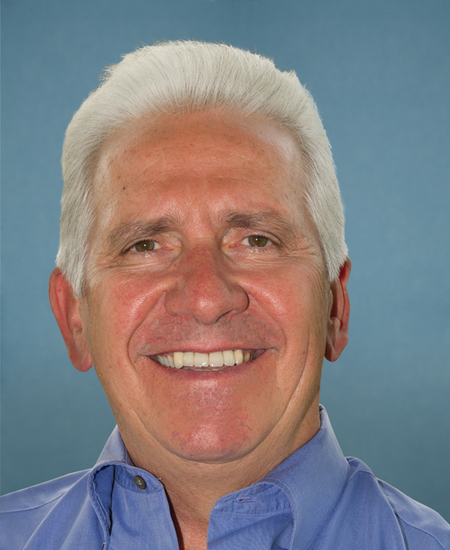
Rep. Jim Costa
Sponsored bills
Raise the Age Act This bill establishes new restrictions on the sale or transfer of certain semiautomatic firearms to individuals under 21 years of age. Specifically, this bill makes it unlawful for a licensed gun dealer, importer, manufacturer, or collector to sell or deliver a semiautomatic center-fire rifle that has (or has the capacity to accept) an ammunition feeding device with a capacity of more than five rounds to an individual who the licensee knows or has reasonable cause to believe is under age 21. The prohibition does not apply if the individual under age 21 is a full-time law enforcement officer or active-duty member of the Armed Forces. The bill also requires the Federal Bureau of Investigation to report on the operation of its public access line, including a description of information sharing protocols and recommendations for improving such protocols.
Biomass and Biogas for Electric Vehicles Act This bill requires the Environmental Protection Agency to, with respect to electricity from renewable biomass used as a transportation fuel, (1) provide for the generation of Renewable Identification Numbers under the renewable fuel program (in accordance with certain maximum quotas), and (2) allow only the operator of a registered facility to generate Renewable Identification Numbers with respect to such electricity.
This resolution supports the goals and ideals of National STEM Day. The resolution acknowledges the many individuals currently involved in the science, technology, engineering, and mathematics (STEM) fields, as well as those individuals interested in pursuing STEM careers. The resolution also recognizes the important role women and people of color have played in STEM fields. Finally, the resolution appreciates the role STEM continues to play in contributing to innovative changes to improve society.
Maddy summaryHR 5904, the Deepavali Day Act, would add "Deepavali Day" to the list of recognized days in federal law, specifically amending the U.S. Code section that lists federal holidays. It recognizes Deepavali - a festival celebrated by over six million Americans, including Hindu, Buddhist, Sikh, Jain, and Indo-Caribbean communities - as a day symbolizing the victory of light over darkness. The bill does not create a paid holiday or change government operations; it simply adds Deepavali Day to the existing federal holiday schedule. This recognition aligns with Congress's acknowledgment of Deepavali's cultural significance and its shared values with U.S. democratic principles.
Fiscal State of the Nation Resolution This concurrent resolution requires the congressional budget committees to conduct an annual joint hearing to receive a presentation from the Comptroller General regarding (1) the Government Accountability Office's audit of the financial statement of the executive branch, and (2) the financial position and condition of the federal government.
Commission to Study the Stigmatization, Criminalization, and Ongoing Exclusion and Inequity for LGBTQ Servicemembers and Veterans Act This bill establishes the Commission to Study the Stigmatization, Criminalization, and Ongoing Exclusion and Inequity for LGBTQ Servicemembers and Veterans. The Commission must identify and compile information about the history of military policy regarding homosexuality from 1778 onward, including regarding lesbian, gay, bisexual, transgender, and queer (LGBTQ) sexual orientation and gender identity. The Commission must hold public hearings, gather public testimony, examine lasting and disparate impacts of the discriminatory policies on the physical and mental well-being of members of the Armed Forces, and make recommendations on appropriate remedies.
Ending the Monopoly of Power Over Workplace Harassment through Education and Reporting Act or the EMPOWER Act This bill makes it an unlawful labor practice for an employer to enter into, or attempt to enforce, a contract with an employee or job applicant that contains a nondisparagement or nondisclosure clause that covers workplace or sexual harassment, including retaliation for participating in a workplace harassment proceeding. The bill exempts certain settlement or separation agreements from such prohibition. The bill also requires the Securities and Exchange Commission to promulgate a regulation that requires any issuer of securities to submit a report for the most recent five-year period with respect to workplace and sexual harassment. The commission must provide for the development and dissemination of training programs and information regarding workplace and sexual harassment. The bill denies a tax deduction for amounts related to judgments and expenses in connection with litigation related to workplace or sexual harassment. It also excludes from gross income, for income tax purposes, any amount received in connection with a claim or settlement related to workplace or sexual harassment, or other unlawful discrimination.
White House Conference on Food, Nutrition, Hunger, and Health Act This bill directs the President to convene a conference to make policy recommendations for ending hunger, creating sustainable markets for agricultural producers, and improving nutrition and the resiliency of the food system. The bill also requires specified congressional committees to hold hearings on the conference recommendations and on the status of hunger, nutrition security, and food systems.
Tim Hart Wildland Firefighter Classification and Pay Parity Act or Tim's Act This bill addresses the pay and benefits of federal wildland firefighters and related issues. Federal wildland firefighter is defined as any temporary, seasonal, or permanent position at the Department of Agriculture (USDA) or the Department of the Interior that maintains certain group, emergency incident management, or fire qualifications and primarily engages in or supports wildland fire management activities. Specifically, (1) the Office of Personnel Management (OPM) must establish one or more classification series for federal wildland firefighter positions, and (2) USDA and the Department of the Interior shall determine each position within USDA and Interior that qualifies as a federal wildland firefighter position. The bill, among other requirements (1) establishes a pay scale for such positions, with annual adjustments; and (2) provides for hazardous duty pay. The OPM must establish guidelines for work schedules. The bill addresses issues regarding wages, unpaid leave to care for a family member, recruitment and retention bonuses, and housing allowances. USDA and Interior shall (1) establish, maintain, coordinate, and operate a voluntary tuition assistance program; (2) establish and maintain a publicly accessible, searchable Federal Wildland Firefighter Cancer and Cardiovascular Disease Database; and (3) establish and carry out a program for mental health awareness and support. Additionally, the bill provides for continuation of firefighters pension coverage in case of disability and pay parity for federal structural firefighters.