Rural Area Opioid Prevention Pilot Program Act This bill expands the allowable uses of grant funds under the Comprehensive Opioid Abuse Grant Program administered by the Department of Justice. Specifically, the bill allows grants to be used for pilot programs for rural areas to implement community response programs that focus on alternatives to incarceration and reducing opioid overdose deaths. The bill also requires at least 10% of grants under the program to be awarded to rural areas.
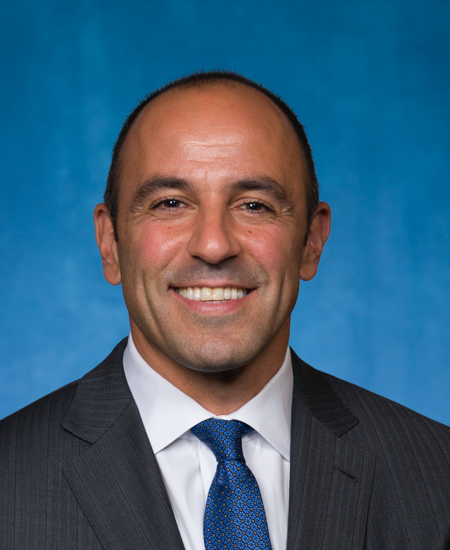
Rep. Jimmy Panetta
Sponsored bills
Freedom for Families Act This bill prohibits using federal funds for facilities used to detain noncitizen families and addresses related issues. Specifically, no funds made available may be used to operate or construct a family detention center, whether operated by U.S. Immigration and Customs Enforcement or a contractor. This prohibition shall also apply to funds made available before this bill's enactment. Funds obligated to operate such centers must instead be used for implementing and developing nondetention programs that are community-based and consistent with international best practices. The Department of Homeland Security (DHS) may place an apprehended noncitizen family into such a nondetention program if DHS makes an individualized determination that doing so will facilitate the family's compliance with immigration laws. The programs must provide to participants a legal orientation and meaningful access to counsel.
Fiscal State of the Nation Resolution This concurrent resolution requires the congressional budget committees to conduct an annual joint hearing to receive a presentation from the Comptroller General regarding (1) the Government Accountability Office's audit of the financial statement of the executive branch, and (2) the financial position and condition of the federal government.
Justice for ALS Veterans Act of 2021 This bill extends increased dependency and indemnity compensation to the surviving spouse of a veteran who dies from amyotrophic lateral sclerosis (ALS or Lou Gehrig's disease) regardless of how long the veteran had such disease prior to death. Under current law, such compensation is paid for a service-connected disability that was rated totally disabling for a continuous period of at least eight years immediately preceding death. For purposes of this bill, a surviving spouse is a person who was married to the veteran for a continuous period of eight years or longer prior to the veteran's death.
Tim Hart Wildland Firefighter Classification and Pay Parity Act or Tim's Act This bill addresses the pay and benefits of federal wildland firefighters and related issues. Federal wildland firefighter is defined as any temporary, seasonal, or permanent position at the Department of Agriculture (USDA) or the Department of the Interior that maintains certain group, emergency incident management, or fire qualifications and primarily engages in or supports wildland fire management activities. Specifically, (1) the Office of Personnel Management (OPM) must establish one or more classification series for federal wildland firefighter positions, and (2) USDA and the Department of the Interior shall determine each position within USDA and Interior that qualifies as a federal wildland firefighter position. The bill, among other requirements (1) establishes a pay scale for such positions, with annual adjustments; and (2) provides for hazardous duty pay. The OPM must establish guidelines for work schedules. The bill addresses issues regarding wages, unpaid leave to care for a family member, recruitment and retention bonuses, and housing allowances. USDA and Interior shall (1) establish, maintain, coordinate, and operate a voluntary tuition assistance program; (2) establish and maintain a publicly accessible, searchable Federal Wildland Firefighter Cancer and Cardiovascular Disease Database; and (3) establish and carry out a program for mental health awareness and support. Additionally, the bill provides for continuation of firefighters pension coverage in case of disability and pay parity for federal structural firefighters.

Main Street Growth Act This bill allows for the registration of national venture securities exchanges for the purpose of trading the securities of certain small companies, such as startups and emerging growth companies. Individuals and existing national securities exchanges may apply to the Securities and Exchange Commission for approval to register such an exchange, or to register a listing tier within an existing exchange. The bill sets forth requirements for these venture exchanges, including required disclosures, trading limits, and trading privileges.
Pyrolysis Innovation Grants Act This bill requires the National Institute of Food and Agriculture to award grants for pilot projects with the potential to reduce or sequester greenhouse gas emissions by converting and valorizing tree nut harvest by-products into higher value biocarbon products. Eligible grantees include, among others, certain colleges or universities and agricultural business entities.
This resolution expresses that the House of Representatives applauds the Biden administration for reaffirming the U.S. commitment to the Paris Agreement on climate change and to our collective responsibility to globally combat climate change; encourages the Biden administration to implement measures to ensure global climate change remains a top priority for this and future administrations and to cement the United States as a global leader in the fight to mitigate its most severe consequences; voices strong commitment as legislators toward achieving the climate goals of the Paris Agreement, fulfilling the forthcoming pledges from the COP26 in Glasgow, Scotland, and advancing other international efforts to keep global warming to no more than 1.5 degrees Celsius and realize global net-zero carbon emissions by 2050 using a whole-of-government approach; and recognizes the critical responsibility of the United States and other developed nations to ensure all societies have the capabilities to transition to a clean energy economy, the resources to protect against climate-induced disasters, and the necessary assistance to endure climate-related challenges to food security, regional migration, and public health.
Disaster Equity and Fairness Act This bill makes changes in the provision of federal disaster assistance to underserved communities and other specified recipients. Underserved community means populations sharing a particular characteristic and geographic communities that have been systematically denied a full opportunity to participate in aspects of economic, social, and civic life. Specifically, the bill increases the federal cost share to a local government or Indian tribal government in connection with a second or subsequent major disaster during any three-year period. The Federal Emergency Management Agency (FEMA) may provide assistance to a state, local government, or Indian tribal government to reimburse the cost of coordinating food delivery, production, and distribution in the event of a major disaster. FEMA must provide direct technical assistance to eligible entities for applications and prioritize specified categories of communities, including underserved communities, those that have demonstrated a compelling need, and those that are exposed to increased hazards or vulnerabilities. The bill increases the federal cost share for a recipient (1) that will use the assistance in, or for the benefit of persons who are members of, an undeserved community; or (2) who is in, or who is a member of, an underserved community.
FEMA Improvement, Reform, and Efficiency Act of 2021 or the FIRE Act This bill addresses the federal government's approach to wildfires. Specifically, the bill authorizes a public mitigation assistance applicant to relocate an eligible structure upon demonstrating that the structure is at risk from future damage and the relocation reduces the risk to the structure, is cost effective, and does not increase risk to adjacent structures. The Federal Emergency Management Agency (FEMA), in coordination with the National Weather Service, must conduct a study on Red Flag Warnings and similar weather and notification methods to implement plans and actions prior to a wildfire that can limit the impact, duration, or severity of the fire. The President must ensure that those providing counseling or case management services to victims of a major disaster are trained to address cultural competency. FEMA must (1) conduct a study and develop a plan to address providing housing assistance to survivors of major disasters or emergencies when presented with challenges such as the lack of proof of ownership, and (2) seek to contract with the National Academy of Sciences to study solutions to address the availability and affordability of insurance for wildfire perils and other related matters. The bill allows Indian tribal governments to apply for grants for equipping, upgrading, and constructing state and local emergency operations centers.