

Maddy summary# Summary of "Protecting Communities from Plastics Act" (Title II) This comprehensive legislation addresses the environmental, health, and environmental justice impacts of plastics production and use. Key provisions include: ## Environmental Justice Protections - Requires environmental justice assessments for permits of "covered facilities" (plastics manufacturing facilities) - Mandates consultation with "fenceline communities" (communities near facilities) including: * Prompt notification in multiple languages * Public hearings with translation services * Community benefit agreements - Establishes a 45-day waiting period before approving permits after public hearings ## Regulatory Requirements - Amends Clean Air Act to establish new source performance standards for plastics facilities - Requires continuous monitoring of air emissions (benzene, nitrogen oxides, etc.) - Amends Clean Water Act to prohibit discharge of plastic pellets in wastewater - Requires financial assurance for facility closure and emergency response - Prohibits new facility permits within 5 miles of community buildings (schools, hospitals, etc.) ## Research and Monitoring - Requires study of microplastics in food (including fish, meat, fruits, vegetables) - Mandates research on microplastics in human bodies (urine, breastmilk, stool) - Establishes a pilot program to test technologies for microplastic removal - Requires inventory of plastics manufacturing and distribution ## Additional Provisions - Temporary permitting moratorium on new plastics facilities (during "temporary pause period") - Requires listing of discarded polyvinyl chloride as hazardous waste - Limits National Recycling Strategy to exclude chemical recycling technologies - Creates grants to reduce single-use plastics in agricultural packaging - Requires biodegradable alternatives to plastic weed barriers The legislation aims to address the disproportionate environmental and health impacts of plastics production on vulnerable communities while establishing comprehensive regulatory frameworks for plastics manufacturing and disposal.
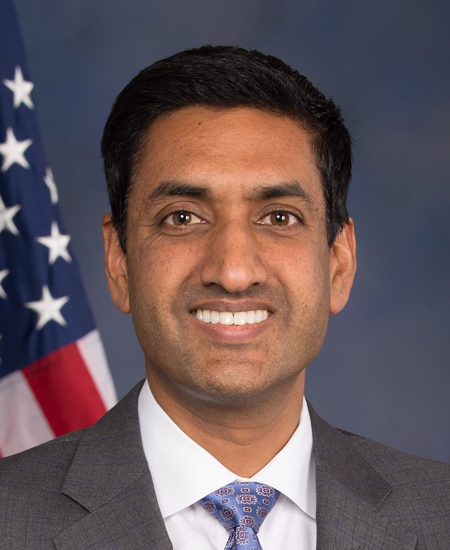
Rep. Ro Khanna
Sponsored bills
Maddy summaryHCONRES 82 is a symbolic resolution recognizing and supporting the New Heights Bid Committee's effort to secure the 2027 FIFA Women's World Cup for a joint U.S.-Mexico bid. It directs Congress to encourage the President and federal agencies to assist the committee in meeting hosting requirements and to consider future legislation if the bid is successful. The resolution does not create new laws or funding but formally expresses congressional backing for the bid committee's work. It directly affects the New Heights Bid Committee by affirming congressional support for their efforts to host the tournament.
Maddy summaryThis bill restores visa eligibility for immigrants who had diversity visas allocated for fiscal years 2017-2022 but were denied entry due to specific travel restrictions (like Executive Orders 13769/13780 or related proclamations) or pandemic-related delays. The State Department must notify affected individuals within 90 days of the bill’s enactment, giving them one year to confirm they wish to proceed with their visa applications. Unused visas from those years can be reallocated without counting against current annual limits, and applicants who fail to respond or are denied for standard reasons (like education requirements) lose eligibility. The policy directly affects individuals impacted by these specific past barriers to immigration.
Maddy summaryHRES 963 is a symbolic resolution honoring Korean American Day, which commemorates the January 13, 1903 arrival of the first large wave of Korean immigrants to the U.S. It recognizes Korean Americans' contributions to U.S. society, including their economic, cultural, and military impacts, and marks the 121st anniversary of this historic migration. The resolution urges all Americans to observe Korean American Day to appreciate these contributions. As a commemorative measure, it does not create new policies or affect specific groups beyond this ceremonial recognition.
Maddy summaryHR 6946 establishes a Military Firefighters Compensation Fund to provide timely compensation for current and former military firefighters (including contractors) who develop illnesses due to PFAS exposure during their duties. The bill presumes PFAS exposure occurred if the firefighter worked at a military installation or National Guard facility during periods when PFAS was present, unless contradicted by substantial evidence. Survivors of affected firefighters - such as spouses, children, parents, or other relatives - receive compensation based on specific family relationships outlined in the bill. This fund, authorized for necessary funding, directly supports firefighters and their families impacted by PFAS-linked health issues.
Maddy summaryThe Affordable Connectivity Program Extension Act of 2024 allocates $7 billion in funding for the Affordable Connectivity Program (ACP) during fiscal year 2024. The ACP provides subsidies to low-income households to help cover the cost of internet service and connected devices like laptops or tablets. This funding ensures the program can continue supporting eligible households throughout the year, with the money remaining available until fully spent. The bill extends existing program funding without changing eligibility criteria or service requirements.
Maddy summaryThe PFAS Action Act of 2023 establishes federal regulations to address PFAS contamination across multiple environmental and health domains. It requires the EPA to designate specific PFAS (like PFOA and PFOS) as hazardous substances, set drinking water standards for PFAS, and mandate testing and reporting by manufacturers. The bill provides $500 million for community water systems to install PFAS treatment systems, $100 million for school water testing and filtration, and creates a website to help homeowners test well water. It also establishes labeling requirements for PFAS-free products and mandates better public communication about PFAS risks.
Maddy summaryHCONRES 81 is a symbolic concurrent resolution recognizing the anniversaries of multiple United Nations-designated international days focused on peace, such as the International Day of Peace (September 21), International Day of Non-Violence (October 2), and others. It commemorates specific milestones, including the 42nd anniversary of the International Day of Peace and the 5th anniversary of the International Day of Living Together in Peace. The resolution encourages U.S. citizens to observe these days and supports activities promoting peace, nonviolence, and cooperation throughout the year. As a non-binding resolution, it does not create new laws or requirements but expresses congressional support for global peace efforts.
Maddy summaryHRES 938 is a symbolic resolution expressing the House's support for a comprehensive political reform plan. It endorses five specific proposals: banning PAC contributions to congressional candidates, prohibiting stock trading by lawmakers, imposing 12-year term limits on Congress, requiring a Supreme Court ethics code, and implementing 18-year term limits for justices. The resolution does not create new laws but formally recognizes these reform efforts. It reflects public support for these measures, citing polls showing majority agreement on each point. This is a non-binding expression of support, not a legislative action.
Maddy summaryHR 6822, the National Archives and Records Administration Modernization Act, updates the language of Title 44 of the U.S. Code to modernize references to NARA leadership roles. It replaces gendered pronouns like "his" with neutral terms such as "the Archivist" or "the Director" throughout NARA's governing statutes. These changes clarify that decisions (e.g., about records custody, concurrence, or disposal) are made by the Archivist or agency heads, not by unspecified individuals. The bill directly affects NARA staff, federal agencies managing records, and the legal framework for federal record-keeping. It makes no substantive policy changes - only linguistic updates to ensure clarity and inclusivity in NARA's operations.