

Maddy summaryThe Fair Representation Act would require states to use ranked choice voting for elections of Senators and Representatives, allowing voters to rank candidates in order of preference rather than selecting just one candidate. It would mandate multi-member districts for states with six or more representatives (with 3-5 representatives per district) and establish nonpartisan redistricting criteria prioritizing population equality, voting rights protections, and minimizing partisan gerrymandering. The bill would provide federal funding to help states implement these changes, with requirements applying to elections held in 2026 or later for Senators and after the 2030 census for Representatives. This legislation aims to create more representative congressional elections by reducing the impact of gerrymandering and expanding voter choice.
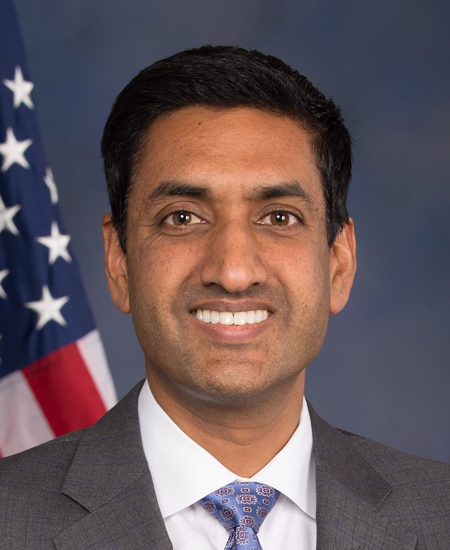
Rep. Ro Khanna
Sponsored bills
Maddy summaryThis resolution (HRES 149) is a symbolic congressional statement condemning Russia's actions in Ukraine, specifically the forcible transfer and abduction of Ukrainian children. It directly addresses the Russian government, citing evidence including Ukrainian reports of over 2,300 children kidnapped and Russia's policy granting citizenship to children born in occupied territories after February 24, 2022. The resolution formally declares these actions violate the Genocide Convention (Article II(e)) and claims Russia is attempting to erase Ukrainian identity by targeting children. As a non-binding resolution, it holds no legal force but expresses the House's official stance against these practices.
Maddy summaryThis bill establishes federal support for worker-owned cooperative businesses - entities owned and controlled by their employees. It creates the United States Council on Worker Cooperatives (under the Department of Labor) to coordinate agency efforts, identify regulatory barriers, and develop a national strategy. Covered agencies (like the SBA, Treasury, and Agriculture) must remove obstacles, provide capital access, offer education, and integrate cooperatives into federal programs. The bill also expands a small business lending pilot program for cooperatives with increased funding ($60 million annually through 2034) and requires multilingual outreach materials. The Council will operate for 10 years, reporting annually to Congress on progress and challenges.
Maddy summaryThe Housing ACCESS Act requires the federal government to issue guidance within one year to help states connect Medicaid beneficiaries with housing services. It directs states to align eligibility processes, streamline service coordination between health and housing agencies, and track outcomes like housing stability - disaggregated by race. The bill also mandates a national study to set fair reimbursement rates for housing services, aiming to ensure living wages for providers and a 1:15 case manager-to-client ratio. States must report on progress within two years, with the guidance intended to simplify how health and housing providers access each other's systems.
Maddy summaryHRES 1079 is a symbolic House resolution condemning Russia's claimed suspension of the New START nuclear arms control treaty, which the U.S. considers legally invalid. It calls on Russia to immediately return to full compliance with New START, including resuming inspections and data sharing, and emphasizes the importance of arms control for global stability. The resolution urges the Biden administration to continue arms control talks with Russia and China to prevent a nuclear arms race. As a non-binding resolution, it does not change U.S. policy but expresses congressional support for maintaining the New START framework, which limits Russia's nuclear arsenal to 1,550 warheads.
Maddy summaryThis concurrent resolution (HCONRES 97) recognizes the gender wage gap, noting that women working full-time earn 84 cents for every dollar earned by men. It highlights racial disparities (e.g., Latinas earn 57 cents, Black women 69 cents) and the economic impact of the gap, including $965 billion in annual lost wages for women. As a symbolic resolution, it does not create new laws or policies but formally acknowledges the issue and reaffirms Congress’s commitment to addressing wage inequality.
Maddy summaryHRES 1074 is a symbolic House resolution reaffirming congressional support for a two-state solution to the Israel-Palestine conflict. It explicitly states the House supports Israel's right to exist as a Jewish, democratic state and recognizes Palestinians' right to sovereignty through a separate state. The resolution identifies a two-state solution as the best path to lasting peace and condemns efforts opposing this approach. As a non-binding resolution, it does not create new law or policy but formally expresses the House's position on this issue. It was introduced by multiple House members on March 12, 2024.
Maddy summaryThis bill establishes a Federal Advisory Panel to analyze climate change risks to federal retirement investments and advise on transitioning toward low-carbon portfolios. It directly affects the Federal Retirement Thrift Investment Board (which manages retirement funds for over 5 million federal employees) by requiring the panel to assess fossil fuel investments, examine other pension funds' climate strategies, and produce a report within one year. Key mechanisms include creating a new "Climate Choice Stock Index Fund" that excludes fossil fuel companies (if the Board determines fossil fuel investments aren't financially sound), and mandating annual climate cost reports from the Federal Reserve and SEC. The bill focuses on aligning retirement fund investments with climate risk management while maintaining financial responsibility, without mandating immediate divestment.
Maddy summaryThis bill requires states to immediately stop Medicaid recovery claims against beneficiaries' estates. Specifically, it mandates that states withdraw all existing liens within 90 days of enactment and notify affected individuals or their estates about the withdrawal. The law also prohibits states from initiating, maintaining, or collecting any future Medicaid recovery claims for benefits correctly paid. It directly affects Medicaid recipients and their heirs who were previously subject to state recovery efforts. The key mechanism is the 90-day deadline for states to remove existing liens and cease all new recovery actions.
Maddy summaryThe ZEVs Act of 2024 requires automakers selling over 100 new passenger vehicles annually in the U.S. to gradually increase sales of zero-emission vehicles (ZEVs), starting with 43% of new passenger vehicle sales in 2027 and reaching 100% by 2035. Manufacturers must meet these targets using a credit system: they earn credits for each ZEV sold or can purchase credits from others, with unused credits bankable for up to five years. The bill sets annual, increasing percentage targets (e.g., 51% in 2028, 88% in 2033) and imposes civil penalties for noncompliance, including fines equal to twice the value of missing credits. After 2035, manufacturers must sell only ZEVs, with the EPA enforcing these requirements through penalties and potential injunctions.