

Maddy summaryHR 10531, the Gasoline Export Ban Act of 2024, would require the President to ban U.S. gasoline exports when domestic prices average $3.12 per gallon or higher for seven consecutive days. The ban would automatically end once prices fall below $3.12 per gallon for seven consecutive days. This policy directly affects U.S. gasoline producers and refiners who export fuel, aiming to increase domestic supply during high-price periods. The bill sets a specific price trigger and allows limited presidential exemptions only for national interest, but does not specify additional implementation details.
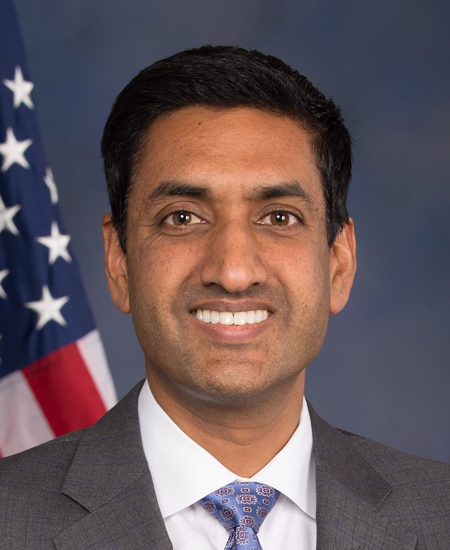
Rep. Ro Khanna
Sponsored bills
Maddy summaryThe Modernizing Government Technology Reform Act updates a federal fund to help agencies modernize outdated information technology systems. It reduces annual funding from $250 million to $50 million for fiscal years 2024-2030 and requires agencies to repay the fund for any money used, ensuring the fund remains operational until 2030. Agencies must annually list high-risk legacy systems (like outdated security or operational software), and the Federal Chief Information Officer must compile a national inventory to prioritize systems posing the greatest security, privacy, or operational risks. The bill also mandates annual reports to Congress on agency progress toward modernizing these systems.
Maddy summaryThis bill establishes federal governance requirements for artificial intelligence systems used by government agencies. It requires agencies to create detailed AI governance charters for high-risk systems, including information about development, training data, and how the system is used. Agencies must provide plain language notifications to individuals affected by AI-driven decisions and maintain public inventories of AI systems through a Federal AI System Inventory. The bill creates a new oversight role within the Office of Management and Budget and mandates regular evaluations of agency AI governance practices. These requirements apply to all federal agencies and their contractors using AI systems that make decisions affecting individuals.
Maddy summaryThis bill directs the Secretaries of the Interior and Agriculture to identify at least 10 existing long-distance bike trails (80+ miles, natural surfaces) and 10 new development areas for such trails on federal lands within 18 months. It requires public comment on trail identification, ensures new trails don’t conflict with existing uses like hiking or wilderness designations, and mandates maps, signage, and a public report within two years. The law specifically applies to mountain biking on federal recreational lands managed by these departments. It focuses on facilitating existing and planned trails without altering current land use rules or funding new construction.
Maddy summaryThis bill codifies and expands existing U.S. sanctions targeting Chinese entities involved in fentanyl-related activities. It authorizes the President to impose financial sanctions on foreign persons - including Chinese government entities, ports, ships, manufacturers, and online marketplaces - that facilitate the international flow of illicit synthetic narcotics or their precursors. Key provisions include blocking U.S. financial transactions with targeted entities, requiring congressional reporting on enforcement, and excluding intelligence/law enforcement activities from sanctions. The bill directly affects Chinese entities operating in Hong Kong, Macau, or mainland China that contribute to fentanyl proliferation, with sanctions applying to property or transactions within U.S. jurisdiction.
Maddy summaryHR 10456, the SAFE SEX Workers Study Act, requires the Department of Health and Human Services and the Department of Justice to study the impacts of the SESTA/FOSTA law on sex workers and human trafficking investigations. The HHS study will examine how the loss of online platforms (like Backpage) affected sex workers' health, safety, economic stability, and access to harm reduction services. The Justice Department will assess how SESTA/FOSTA changed human trafficking investigations, prosecutions, and law enforcement practices. Both reports must be completed within one year of the bill's enactment and made publicly available.
Maddy summaryHR 10459 establishes a federal Joint Task Force to Counter Illicit Synthetic Narcotics (JTF-ISN) to coordinate agency efforts against synthetic opioid trafficking. The task force, led by a presidentially appointed Director reporting to the Attorney General, includes members from Justice (DEA, FBI), Treasury (FinCEN, IRS), Homeland Security (CBP, ICE), State, Commerce, Defense, and intelligence agencies. It requires regular congressional reports on operations, funding needs, and efforts to disrupt trafficking networks - particularly those linked to foreign entities like China - while explicitly limiting the task force to targeting large-scale trafficking, not personal use or low-level dealing. The bill does not create new agency powers but mandates better interagency coordination to address the opioid crisis through strategic operations and information sharing.
Maddy summaryThis bill requires Chinese shipping companies to properly declare fentanyl precursors and related chemicals on all shipments to the U.S., with strict customs reporting rules. It imposes civil penalties of up to $250,000 or 0.025% of a vessel’s cargo value for non-compliance, doubling for falsified records and escalating for repeated violations. The penalties collected fund U.S. drug enforcement efforts targeting fentanyl trafficking. It directly affects Chinese entities (including those with significant Chinese ownership) involved in shipping these chemicals to the U.S. or cooperating jurisdictions.
Maddy summaryThe Steel Modernization Act of 2024 provides financial assistance and tax credits to U.S. steel manufacturers adopting technologies that reduce greenhouse gas emissions from steel production. It requires recipients to produce "near-zero emissions intensity steel" by 2035, report emissions data, and implement community benefits plans that address local environmental and economic concerns. The bill also imposes a tariff on imported steel based on its emissions intensity, with revenues funding clean energy programs and administrative costs. This affects steel manufacturers, workers, and communities near steel facilities by promoting cleaner production while supporting domestic steel industry competitiveness.
Maddy summaryThe ASSET Act eliminates asset limits for low-income households applying for federal assistance programs like Temporary Assistance for Needy Families (TANF), SNAP (food assistance), and LIHEAP (energy help). This means families can save money in bank accounts or build financial resources without risking loss of benefits. The bill also updates Supplemental Security Income (SSI) resource limits to $20,000 for individuals and $10,000 for couples in 2024, with future annual inflation adjustments. The changes take effect 30 days after the bill's enactment, with states given up to two years to implement if new legislation is needed.