This resolution condemns Russia's nuclear escalatory rhetoric and implied threats on the potential use of nuclear weapons in the context of its invasion of Ukraine. The resolution also (1) condemns Russia's purported suspension of participation in the New START Treaty, (2) emphasizes the value of arms control agreements between the United States and Russia, and (3) calls on the administration to continue pursuing nuclear arms control and risk reduction with Russia and China.
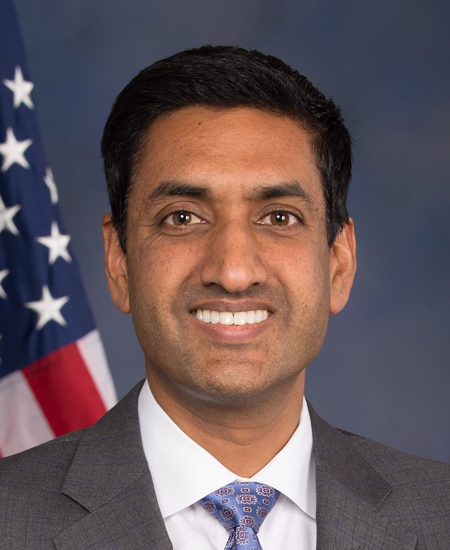
Rep. Ro Khanna
Sponsored bills
Stop the Wait Act of 2025 This bill phases out the initial waiting period for Social Security Disability Insurance (SSDI) benefits and eliminates the waiting period for certain disabled individuals to become eligible for Medicare. Under current law, individuals generally must wait five months after the onset of disability to begin receiving SSDI benefits. The bill would gradually reduce this waiting period before eliminating it entirely in the year 2030. Further, the bill would eliminate the 24-month waiting period for certain disabled workers and other individuals to become eligible for Medicare. Under current law, individuals under the age of 65 may generally enroll in Medicare after they have been eligible for SSDI or Social Security child’s, widow’s, or widower’s benefits by reason of disability for 24 months. The bill would eliminate this waiting period for individuals for whom the annual cost of certain medical insurance would exceed a specified percentage of their household income (i.e., those who cannot afford minimum essential coverage). Medicare eligibility for these individuals must be available retroactively to the first month that an individual qualified for SSDI or Social Security child’s, widow’s, or widower’s benefits by reason of disability.
Maddy summaryHR 959 creates a new Office within the U.S. Department of State to monitor and address Islamophobia abroad. The bill requires the State Department to include specific, detailed reports on Islamophobia in its annual human rights and religious freedom reports. These reports must describe incidents like violence against Muslims or mosques, government propaganda promoting hatred, and how foreign governments respond to such issues. The law directly affects how the U.S. government documents religious discrimination in foreign countries, mandating new reporting requirements for the State Department starting 180 days after enactment.
National Origin-Based Antidiscrimination for Nonimmigrants Act or the NO BAN Act This bill imposes limitations on the President's authority to suspend or restrict aliens from entering the United States. It also prohibits religious discrimination in various immigration-related decisions, such as whether to issue an immigrant or nonimmigrant visa, unless there is a statutory basis for such discrimination. The President may temporarily restrict the entry of any aliens or class of aliens after the Department of State determines that the restriction would address specific and credible facts that threaten U.S. interests such as public safety. The bill also imposes limitations on such restrictions, such as requiring the President, State Department, and the Department of Homeland Security (DHS) to (1) only issue a restriction when required to address a compelling government interest, and (2) narrowly tailor the suspension to use the least restrictive means to achieve such an interest. Before imposing a restriction, the State Department and DHS shall consult with Congress. The State Department and DHS shall report to Congress about the restriction within 48 hours of the restriction's imposition. If such a report is not made, the restriction shall immediately terminate. Individuals or entities present in the United States and unlawfully harmed by such a restriction may sue in federal court. The bill transfers the authority to suspend the entry of aliens traveling to the United States on a commercial airline that failed to comply with regulations related to detecting fraudulent travel documents from the Department of Justice to DHS.

This bill provides for the presentation of a Congressional Gold Medal to the Freedom Riders, in recognition of their contribution to civil rights by fighting for equality in interstate travel.
Maddy summaryHR 944, the Access to Counsel Act, requires U.S. immigration officials to provide certain immigrants a meaningful opportunity to consult with legal counsel during key immigration processes. It directly affects U.S. nationals, lawful permanent residents returning from travel, visa holders, refugees, asylees, and parolees subject to secondary or deferred inspection at ports of entry. The bill mandates that officials ensure access to counsel (including via phone) within one hour of inspection starting, allow counsel to present evidence, and accommodate in-person meetings when possible. It also requires officials to provide counsel access before accepting Form I-407 abandonment forms from lawful permanent residents, unless waived in writing. The law takes effect 180 days after enactment and preserves existing rights to counsel under other immigration laws.
Maddy summaryHR 854, the DERAIL Act, requires the Transportation Secretary to update federal regulations defining "high-hazard flammable train" to include any train carrying flammable liquids or gases in tank cars. It also mandates that rail carriers report all toxic-by-inhalation materials on such trains to emergency responders within 24 hours after a derailment. The bill directly affects rail companies transporting hazardous materials and emergency agencies responding to train accidents. These changes aim to improve safety communication and response during incidents involving dangerous goods.
Maddy summaryHR 897, the Aviation-Impacted Communities Act, makes communities located near airports but outside the current FAA noise standard (65 DNL) eligible for noise mitigation funding and establishes a process for these communities to formally seek designation. It requires the FAA to partner with the National Academy of Sciences to study aviation impacts at major airports, develop a diagnostic tool for community assessments, and create community boards to represent residents. These boards can request assessments, collaborate on action plans to address noise or emissions, and access grants for solutions like sound insulation, air filtration, or flight path changes. The bill authorizes $750 million for noise mitigation funding over 10 years, targeting residential areas, schools, hospitals, and other facilities affected by aircraft noise and emissions.
Medicare Patient Access and Practice Stabilization Act of 2025 This bill increases certain payment adjustments under the Medicare physician fee schedule for services furnished between April 1, 2025, and January 1, 2026.
Maddy summaryHR 903, the Smoke and Heat Ready Communities Act of 2025, creates federal grant programs to help communities prepare for wildfire smoke and extreme heat events. It funds air pollution control agencies to monitor air quality, deploy monitoring equipment, equip public buildings with air filtration, and distribute protective gear like N95 masks. The bill also establishes university research centers to study health impacts and develop community response strategies, and provides competitive grants for local governments, tribes, and Native Hawaiian organizations to create collaborative community plans. These programs target communities most vulnerable to poor air quality from wildfire smoke and extreme heat, with priority given to areas impacted by these events.