

Filipino Veterans Family Reunification Act of 2021 This bill exempts from worldwide or numerical limitations certain family-sponsored immigrant visas for the sons and daughters of Filipino World War II veterans who were naturalized under certain laws providing for naturalization for service during World War II.
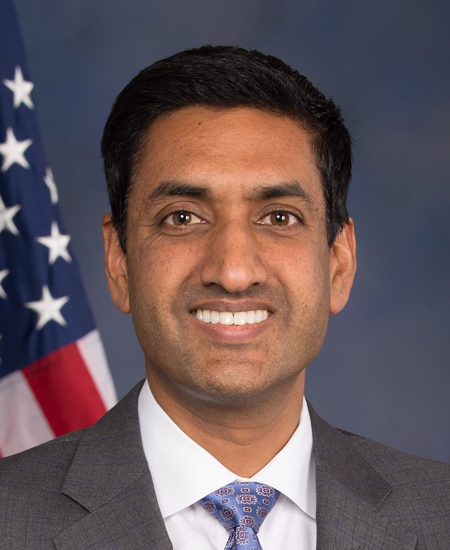
Rep. Ro Khanna
Sponsored bills
Protecting Our Communities Act This expands the types of parts, weapons, and devices that are subject to regulation under federal firearms laws. The bill also establishes a notification requirement following a firearms-related background check that results in a denial. Specifically, the bill includes as a firearm any combination of parts designed or intended to be used to convert a device into a firearm and from which a firearm may be readily assembled; adds armor-piercing, concealable weapons to the list of firearms subject to regulation under federal firearms laws; and provides statutory authority for the regulation issued by the Bureau of Alcohol, Tobacco, Firearms and Explosives to classify bump-stock devices as machine guns for the purposes of federal firearms laws. Additionally, the bill requires the Department of Justice to notify state and local law enforcement authorities following a firearms-related background check that results in a denial.
Temporary Family Visitation Act This bill establishes a new nonimmigrant visa classification for an alien temporarily entering the United States to visit a relative who is a U.S. citizen or lawful permanent resident. The maximum period of stay for a family visitor visa shall be 90 days. An alien seeking such a visa must have health insurance for the duration of the stay. An alien who holds such a visa may not change to another nonimmigrant visa classification except in certain limited instances. If an alien has been approved for a family-based immigrant visa and is waiting for one to become available, the alien may obtain a family visitor visa if the alien meets the eligibility requirements.
Untraceable Firearms Act of 2021 This bill establishes a federal statutory framework to regulate the manufacture, sale, offer to sell, transfer, purchase, and receipt of ghost guns (i.e., guns without serial numbers). Additionally, the bill revises the federal statutory framework regulating the manufacture, possession, sale, import, shipment, delivery, receipt, and transfer of undetectable firearms. Among the revisions, the bill defines undetectable firearm as a firearm without a major component wholly made of detectable material.
Raise the Age Act This bill establishes new restrictions on the sale or transfer of certain semiautomatic firearms to individuals under 21 years of age. Specifically, this bill makes it unlawful for a licensed gun dealer, importer, manufacturer, or collector to sell or deliver a semiautomatic center-fire rifle that has (or has the capacity to accept) an ammunition feeding device with a capacity of more than five rounds to an individual who the licensee knows or has reasonable cause to believe is under age 21. The prohibition does not apply if the individual under age 21 is a full-time law enforcement officer or active-duty member of the Armed Forces. The bill also requires the Federal Bureau of Investigation to report on the operation of its public access line, including a description of information sharing protocols and recommendations for improving such protocols.
Vietnam Human Rights Act This bill requires actions related to human rights in Vietnam and addresses related issues. The Department of State must assist eligible individuals and entities working to secure the release of political and religious prisoners in Vietnam. The Office of Internet Freedom within the U.S. Agency for Global Media and the Bureau of Democracy, Human Rights, and Labor within the State Department shall prioritize (1) the immediate distribution of censorship circumvention tools for computers and smartphones in Vietnam; and (2) projects to ensure the safety and privacy of bloggers, journalists, and human rights defenders in Vietnam. Foreign assistance may not be used to assist any unit of the Vietnamese government engaged in cyberespionage activities. The State Department may establish programs to (1) monitor and halt sex trafficking of women from Vietnam and other Asian countries, and (2) address Vietnam's growing sex-ratio disparity. The bill also requires various reports to Congress, including reports on (1) persons subject to U.S. sanctions for human rights violations in Vietnam, (2) a strategy to promote internet freedom in Vietnam, and (3) cyberespionage activities sanctioned by the Vietnamese government targeting Vietnamese dissidents and human rights advocates living outside of Vietnam.
Fair and Clear Campaign Transparency Act This bill directs the Federal Communications Commission to require certain online public inspection files to be made available to the public in a machine-readable format that supports automated searching, bulk downloading, aggregation, manipulation, sorting, and analysis. Online public inspection files (including political files that contain records of requests to purchase broadcast time by or on behalf of candidates for public office or to communicate a message relating to a political matter of national importance) are files that must be uploaded to the internet by certain television broadcast stations and television systems, AM or FM radio broadcast stations, cable operators, direct broadcast satellite service providers, or satellite digital audio radio service providers.
Sgt. Isaac Woodard, Jr. and Sgt. Joseph H. Maddox GI Bill Restoration Act of 2021 This bill expands eligibility for Post-9/11 GI bill educational assistance benefits and the Department of Veterans Affairs (VA) home loan program. Specifically, the bill explicitly includes the following persons as eligible veterans: Black veterans who served on active duty during World War II who can certify they were denied a specific benefit on the basis of race; and the living surviving spouses, children, grandchildren, or other direct descendants of such veterans described above who can certify the veteran was denied a specific benefit on the basis of race. Such veterans described above must apply for educational or home loan benefits within the five-year period after the passage of this bill to be eligible for benefits. The Government Accountability Office must report on the number of individuals who received educational or housing loan benefits and the total value of such benefits administered by the VA due to the amendments made by the bill. Finally, the VA must appoint a panel of independent experts to develop recommendations regarding additional benefits and assistance for female and minority members of the Armed Forces.
Maddy summaryHR 5904, the Deepavali Day Act, would add "Deepavali Day" to the list of recognized days in federal law, specifically amending the U.S. Code section that lists federal holidays. It recognizes Deepavali - a festival celebrated by over six million Americans, including Hindu, Buddhist, Sikh, Jain, and Indo-Caribbean communities - as a day symbolizing the victory of light over darkness. The bill does not create a paid holiday or change government operations; it simply adds Deepavali Day to the existing federal holiday schedule. This recognition aligns with Congress's acknowledgment of Deepavali's cultural significance and its shared values with U.S. democratic principles.
This resolution expresses the sense of the House of Representatives that it is the duty of the Department of Defense (DOD) to reduce the overall environmental impact of military activities and missions and to monitor and report greenhouse gas emissions from all of its operations. The resolution also suggests that DOD take other environmentally conscious actions, including committing to annual greenhouse gas emission reporting mechanisms and repurposing and managing its properties to promote carbon sequestration and biodiversity.