Dignity for People with Disabilities in the Foreign Service Act This bill replaces several references to handicapping condition with disability in the Foreign Service Act of 1980. For example, an existing provision requiring the Department of State to prescribe regulations to ensure that Foreign Service members and applicants are free from discrimination on the basis of a handicapping condition is amended to require regulations to ensure that Foreign Service members and individuals are free from discrimination on the basis of a disability.
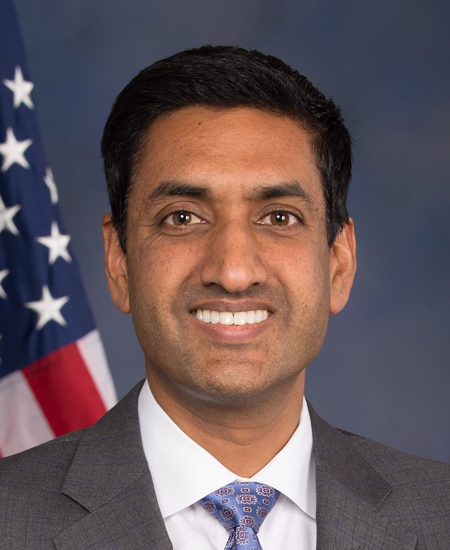
Rep. Ro Khanna
Sponsored bills
Protecting Our Kids Act This bill makes various changes to federal firearms laws, including to establish new criminal offenses and to expand the types of weapons and devices that are subject to regulation. Among the changes, the bill generally prohibits the sale or transfer of certain semiautomatic firearms to individuals who are under 21 years of age; establishes new federal criminal offenses for gun trafficking and related conduct; establishes a federal statutory framework to regulate ghost guns (i.e., guns without serial numbers); establishes a framework to regulate the storage of firearms on residential premises at the federal, state, and tribal levels; subjects bump stocks to regulation under federal firearms laws; generally prohibits the import, sale, manufacture, transfer, and possession of large capacity ammunition feeding devices; and requires the Department of Justice to report on the demographic data of persons who are determined to be ineligible to purchase a firearm based on a background check performed by the national instant criminal background check system.
Federal Extreme Risk Protection Order Act of 2022 This bill authorizes and establishes procedures for federal courts to issue federal extreme risk protection orders. Additionally, the bill establishes grants to support the implementation of extreme risk protection order laws at the state and local levels, extends federal firearms restrictions to individuals who are subject to extreme risk protection orders, and expands related data collection. Extreme risk protection order laws, or red flag laws, generally allow certain individuals (e.g., law enforcement officers or family members) to petition a court for a temporary order that prohibits an at-risk individual from purchasing and possessing firearms. Among its provisions, the bill authorizes a family or household member, or a law enforcement officer, to petition for a federal extreme risk protection order with respect to an individual who poses a risk to themselves or others; directs the Department of Justice to establish a grant program to help states, local governments, Indian tribes, and other entities implement extreme risk protection order laws; extends federal restrictions on the receipt, possession, shipment, and transportation of firearms and ammunition to individuals who are subject to extreme risk protection orders; and requires the Federal Bureau of Investigation to compile records from federal, tribal, and state courts and other agencies that identify individuals who are subject to extreme risk protection orders.

This resolution condemns in the strongest terms the great replacement theory, which it describes as a white supremacist conspiracy theory that has been used to falsely justify racially motivated, violent acts of terrorism domestically and internationally.
This bill requires the Department of Agriculture to support and incentivize domestic activities to address fertilizer shortages and deficiencies, diversify fertilizer sources, and reduce dependency on foreign sources for fertilizer, including by increasing the availability of innovative fertilizer and fertilizer alternatives.
Maddy summaryHR 301 would amend U.S. law to officially designate "Lift Every Voice and Sing" as the national hymn of the United States. This change would add the song's full composition (words and music) to Title 36 of the U.S. Code, replacing the current designation of "The Star-Spangled Banner" as the sole national anthem for formal recognition purposes. The bill directly affects federal law and official government ceremonies where the national hymn is performed, though it does not alter the status of "The Star-Spangled Banner" as the national anthem. The policy change is purely procedural, establishing a new official designation without impacting any other laws or rights.
This joint resolution directs the President to remove U.S. Armed Forces from hostilities against the Houthis in Yemen within 30 days of the enactment of this joint resolution unless Congress authorizes a later withdrawal date, issues a declaration of war, or specifically authorizes the use of the Armed Forces. Prohibited activities include sharing intelligence or providing logistical support to enable offensive strikes by the coalition led by Saudi Arabia. This joint resolution shall not affect any military operations directed at Al Qaeda or associated forces.
This resolution supports the goals and ideals of an International Day Against Homophobia, Transphobia, Biphobia, and Intersexphobia. The resolution encourages (1) health care providers to offer culturally and clinically competent care to the lesbian, gay, bisexual, transgender, queer, questioning, intersex, asexual, and agender (LGBTQIA+) community; (2) schools to support the creation of gender and sexuality alliances; (3) individuals to learn about national resources for those who identify as LGBTQIA+; and (4) funding organizations, aid efforts, and governments to prioritize the health and human rights of LGBTQIA+ people.
This resolution encourages the people of the United States to observe Menstrual Hygiene Day, and recognizes the need to raise awareness with respect to menstrual hygiene and to increase research on access to menstrual health management.
Affordability is Access Act This bill establishes several requirements relating to health insurance coverage of, and access to, over-the-counter contraceptives. Specifically, the bill requires the Department of Health and Human Services, the Department of Labor, and the Department of the Treasury to specify that private health insurance plans must cover over-the-counter contraceptives that are approved by the Food and Drug Administration (FDA), even without a prescription. Under current law, private health insurance plans (with some exceptions) must cover FDA-approved prescription contraceptives, without cost-sharing requirements. The bill also prohibits retailers from interfering with an individual's access to oral contraceptives that are meant for routine, daily use and are FDA-approved for use without a prescription.