

Stop Wall Street Landlords Act of 2022 This bill denies certain tax and other benefits to large investors whose assets exceed $100 million in a taxable year for investment in single-family housing (i.e., real property including at least one dwelling unit and not more than four units). It denies such investors a tax deduction for interest paid on a single-family home mortgage, for insuring such homes, and for the depreciation of such homes. The bill imposes an excise tax on the sale or transfer of a single-family home by a large investor equal to the price of such home. It allows a tax credit for home sellers equal to the lesser of either the excess of reasonable development costs paid over the sale price, or 35% of the lesser of eligible development costs paid by the taxpayer, or 80% of the national median sale price for homes. The bill prohibits large investors from obtaining certain federal mortgage assistance.
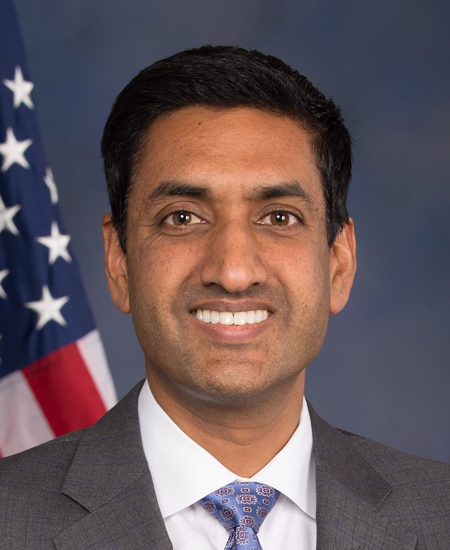
Rep. Ro Khanna
Sponsored bills
Military Family Nutrition Act of 2022 This bill excludes military housing allowances from income when determining eligibility for the Supplemental Nutrition Assistance Program (SNAP).
Filipino Veterans Fairness Act of 2022 This bill expands eligibility for certain Department of Veterans Affairs (VA) benefits to the surviving spouse and children of individuals who served in the organized military forces of the Philippines and the Philippine Scouts. In determining eligibility under this bill, the VA must take into account any alternative documentation regarding such service, other than the recognized guerilla rosters stored at the National Personnel Records Center.
Major Richard Star Act This bill provides that combat-disabled uniformed services retirees with fewer than 20 years of creditable service may concurrently receive, without reduction, veterans' disability compensation and retired pay or combat-related special compensation.
Keep Americans Safe Act This bill establishes a new criminal offense for the import, sale, manufacture, transfer, or possession of a large capacity ammunition feeding device (LCAFD). The bill does not prohibit certain conduct with respect to an LCAFD, including the following: importation, sale, manufacture, transfer, or possession related to certain law enforcement efforts, or authorized tests or experiments; importation, sale, transfer, or possession related to securing nuclear materials; and possession by a retired law enforcement officer. The bill permits continued possession of, but prohibits sale or transfer of, a grandfathered LCAFD. Newly manufactured LCAFDs must display serial number identification and the date of manufacture. Additionally, the bill allows a state or local government to use Edward Byrne Memorial Justice Assistance Grant Program funds to compensate individuals who surrender an LCAFD under a buy-back program.
Global Malnutrition Prevention and Treatment Act of 2021 This act sets out programs and otherwise directs the U.S. Agency for International Development (USAID) to carry out activities to prevent and treat malnutrition globally. Specifically, USAID may leverage resources to address malnutrition through the Global Nutrition Coordination Plan (an interagency effort to strengthen the impact of U.S. investments in nutrition) and its role on the board of directors of the U.S. International Development Finance Corporation. USAID must also select countries based on specified malnutrition-related indicators for purposes of targeting malnutrition prevention and treatment programs and update the selection within five years. Additionally, USAID may establish the Nutrition Leadership Council to coordinate federal government activities to prevent and treat malnutrition; and target resources and nutrition interventions to the populations most susceptible to severe malnutrition and otherwise support efforts to prevent and treat malnutrition globally. The act also requires USAID to provide to Congress an implementation plan and annual reports concerning its programs for treating and preventing malnutrition. The act's provisions terminate seven years after its enactment.
This concurrent resolution commemorates the 50th anniversary of the enactment of the Federal Water Pollution Control Act Amendments of 1972, commonly known as the Clean Water Act.
Save Medicare Act This bill renames Medicare Advantage (MA) as the Alternative Private Health Plan program. It also establishes civil penalties for entities that continue to advertise MA plans with Medicare in the title.
Electric Vehicle Freedom Act or the EV Freedom Act This bill requires the Department of Transportation to devise a plan to create a network of publicly available electric vehicle supply equipment along public roads that are part of the National Highway System.
Maddy summaryHRES 1430 is a symbolic House resolution recognizing the 1971 atrocities against ethnic Bengalis and Hindus in East Pakistan (now Bangladesh) as genocide under the UN definition. It directly affects the historical memory of victims and Bangladeshis by formally condemning the Pakistani military’s actions - including massacres, mass rape, and forced displacement - which killed an estimated 3 million people. The resolution calls on the U.S. President to acknowledge these events as genocide and urges Pakistan to formally apologize and prosecute perpetrators, while reaffirming U.S. support for democratic values in the region. As a non-binding resolution, it has no legal effect but aims to document historical accountability.