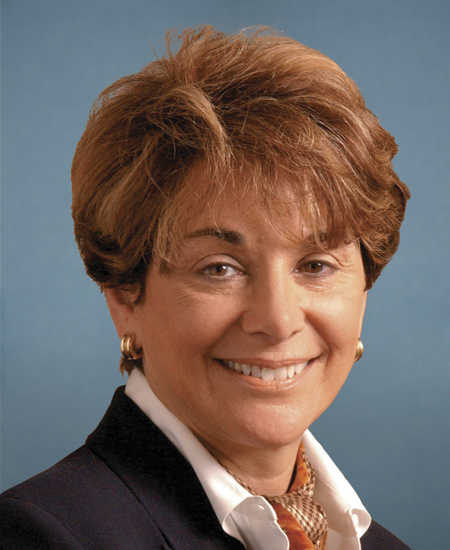
Photo of Anna G. Eshoo
D United States House · District 16 · California

Rep. Anna G. Eshoo

Compare
Total votes
2,168
all sessions
Attendance
99%
24 missed
Near the chamber average
With party
98%
of cast votes
Higher than 89% of chamber peers
Bipartisan score
1%
crosses aisle rarely
Lower than 92% of chamber peers
Sponsored
863
bills & resolutions
Near the chamber average
Committees
0
assignments
863 bills and resolutions

Sponsored bills

Total
863
Primary
63
Co-sponsor
800
This page
863
matching current filters
Co-sponsor HR 1357
In committee · United States House · Co-sponsor
Pandemic Heroes Compensation Act of 2021

Pandemic Heroes Compensation Act of 2021 This bill allows essential workers and their family members to file claims and receive compensation for harm or death suffered as a result of COVID-19 (i.e., coronavirus disease 2019). A Special Master appointed by the Department of Justice must review claims submitted and determine if a claimant is eligible for compensation, the extent of the harm to the claimant, and the amount of compensation to be awarded.

In committee Apr 28, 2021 1 co-sponsor
Co-sponsor HR 1378
In committee · United States House · Co-sponsor
Do No Harm Act

Do No Harm Act This bill prohibits the application of the Religious Freedom Restoration Act of 1993 (RFRA) to specified federal laws or the implementation of such laws. Currently, RFRA prohibits the government from substantially burdening a person's exercise of religion even if the burden results from a rule of general applicability, except in furtherance of a compelling governmental interest when using the least restrictive means. Under the bill, RFRA is inapplicable to laws or the implementation of laws that protect against discrimination or the promotion of equal opportunity (e.g., the Civil Rights Act of 1964); require employers to provide wages, other compensation, or benefits, including leave; protect collective activity in the workplace; protect against child labor, abuse, or exploitation; or provide for access to, information about, referrals for, provision of, or coverage for, any health care item or service. The bill prevents RFRA from being used to deny (1) goods or services the government has contracted, granted, or made an agreement to provide to a beneficiary of or participant in a program or activity funded by such government contract, grant, agreement, or other award; or (2) a person's full and equal enjoyment of a government-provided good, service, benefit, facility, privilege, advantage, or accommodation. In order for a person to assert a RFRA claim or defense in a judicial proceeding, the government must be a party to the proceeding.


In committee Apr 28, 2021 1 co-sponsor
Co-sponsor HR 1334
In committee · United States House · Co-sponsor
DISCLOSE Act of 2021

Democracy Is Strengthened by Casting Light On Spending in Elections Act of 2021 or the DISCLOSE Act of 2021 This bill addresses campaign finance, including by expanding the prohibition on campaign spending by foreign nationals, requiring additional disclosures of campaign expenditures, and requiring additional disclosures regarding certain political advertisements. First, the bill prohibits foreign nationals from participating in the decision-making process regarding an election expenditure. Additionally, the bill expands existing foreign money prohibitions to include disbursements for paid web-based or digital communications and federal judicial nomination communications. It also prohibits foreign nationals from contributing to campaigns related to ballot initiatives and referenda. The Federal Election Commission (FEC) must conduct an audit after each federal election cycle to determine the incidence of illicit foreign money. Next, the bill makes it unlawful to establish or use a corporation, company, or other entity with the intent to conceal an election contribution or donation by a foreign national. A violator is subject to criminal penalties—a fine, a prison term of up to five years, or both. Covered organizations (e.g., corporations, labor organizations, and political organizations) must, within 24 hours, file reports with the FEC to disclose campaign expenditures of more than $10,000 during an election cycle. Finally, the bill requires organizations to provide additional disclosures regarding political advertisements, including the donors who contributed the most money to that organization in the last year.

In committee Apr 28, 2021 1 co-sponsor
Co-sponsor HR 1347
In committee · United States House · Co-sponsor
Eric Garner Excessive Use of Force Prevention Act of 2021

Eric Garner Excessive Use of Force Prevention Act of 2021 This bill modifies the criminal civil rights statute that prohibits the deprivation of rights under color of law. Currently, the second prong of the prohibition bars the application of different punishments, pains, or penalties based on an individual's alien status, color, or race. This bill specifies that the application of any pressure to a person's throat or windpipe, the use of maneuvers that restrict blood or oxygen flow to the brain, or carotid artery restraints that prevent or hinder breathing or reduce intake of air (e.g., a chokehold) constitute a punishment, pain, or penalty.

In committee Apr 28, 2021 1 co-sponsor
Co-sponsor HR 1266
In committee · United States House · Co-sponsor
Duty to Report Act

Duty to Report Act This bill requires political committees, candidates for federal office, and other individuals to report to the Federal Election Commission (FEC) and the Federal Bureau of Investigation (FBI) any offers of prohibited contributions, including offers of nonpublic information regarding other candidates, by foreign nationals. Specifically, political committees and candidates must report to the FEC within 24 hours any (1) offers of prohibited contributions from foreign nationals, and (2) meetings with foreign governments or their agents. In addition, the bill requires political committees, candidates, immediate family members of candidates, and individuals affiliated with a campaign (e.g., employees and independent contractors) to report to the FBI within 24 hours any offers of prohibited contributions from foreign nationals. Further, the bill establishes a new criminal offense for knowingly and willfully failing to comply with this reporting requirement. A violator is subject to criminal penalties—a fine, a prison term of up to two years, or both. Such reported information may not be used to enforce certain immigration provisions related to the removal of undocumented aliens.

In committee Apr 28, 2021 1 co-sponsor
Co-sponsor HR 1198
In committee · United States House · Co-sponsor
END Child Exploitation Act

Eliminate Network Distribution of Child Exploitation Act or the END Child Exploitation Act This bill modifies the reporting requirements for electronic communication service providers and remote computing service providers (providers) that report information to the CyberTipline of the National Center for Missing and Exploited Children on crimes involving the sexual exploitation of children. Specifically, the bill increases the amount of time—from 90 days to 180 days—that a provider must preserve the contents of a report. Additionally, the bill permits a provider to voluntarily retain the contents for longer than 180 days to reduce the proliferation of or to prevent the online sexual exploitation of children.

In committee Apr 28, 2021 1 co-sponsor
Co-sponsor HR 1177
In committee · United States House · Co-sponsor
U.S. Citizenship Act

U.S. Citizenship Act This bill establishes a path to citizenship for certain undocumented individuals. The bill also replaces the term alien with noncitizen in the immigration statutes and addresses other related issues. Specifically, the bill establishes a new status of lawful prospective immigrant . This status shall be available to an applying noncitizen who meets certain requirements, including being continually present in the United States from January 1, 2021, and passing background checks. After at least five years with this status, an eligible noncitizen may apply for and receive permanent resident status. The bill also provides permanent resident status to certain applying noncitizens, specifically for eligible noncitizens who (1) entered the United States as a minor, (2) were eligible for temporary protected status or deferred enforced departure on January 1, 2017, or (3) worked a certain amount of agricultural labor in the five years prior to applying. Among other things, the bill also redefines for immigration purposes the term conviction to exclude convictions that have been expunged or vacated, requires the Department of State to implement a strategy to advance reforms in Central America and address key factors contributing to migration from the region to the United States, requires the State Department to establish refugee processing centers in Central America, requires Customs and Border Patrol sectors and stations to have a certain number of employees with certain qualifications such as paramedic training, generally prohibits religious discrimination in granting or denying immigration benefits, and establishes grant programs for providing training and services to immigrants.

In committee Apr 28, 2021 1 co-sponsor
Co-sponsor HR 2854
In committee · United States House · Co-sponsor
Utility Resilience and Reliability Act

Utility Resilience and Reliability Act This bill addresses the reliability of electric energy provided by the bulk-power system, which includes facilities and control systems necessary for operating an interconnected electric energy transmission network. Specifically, the Electric Reliability Organization must file with the Federal Energy Regulatory Commission a proposed reliability standard that addresses the resilience of the bulk-power system. For example, the standard must address the system's ability to withstand and rapidly recover from disruptions, such as extreme weather conditions. The standard must take into account regional differences. In addition, the Department of Energy (DOE) must establish a program to provide information and recommendations to states and electric utilities on how to improve the resilience of electric grids. DOE must also post on its website a report that provides recommendations on how to minimize the need for, effects of, and duration of planned electric power outages that are due to extreme weather conditions.

In committee Apr 27, 2021 1 co-sponsor
Co-sponsor HRES 346
In committee · United States House · Co-sponsor
Expressing support for honoring Earth Day, and for other purposes.

This resolution urges (1) the President to issue a proclamation recognizing Earth Day; and (2) governments and people to continue building upon the Paris Agreement and other efforts to ensure that future generations inherit a livable, sustainable, and ecologically rich planet. The resolution reaffirms that immediate action is needed to reduce greenhouse gas emissions and ameliorate environmental injustices in order to protect our planet, public health, and overall well-being of all people and wildlife. In addition, it encourages the American people to mark Earth Day by working to address environmental challenges, educate others about the need for year-round action, and honor the stewardship ethic for which Senator Gaylord Nelson stood.

In committee Apr 23, 2021 1 co-sponsor
Co-sponsor HR 2764
In committee · United States House · Co-sponsor
Community Solar Consumer Choice Act of 2021

Community Solar Consumer Choice Act of 2021 This bill supports the expansion of community solar energy and doubles the allowable time period for a long-term contract between the General Services Administration (GSA) and a public utility. Specifically, the bill requires the Department of Energy (DOE) to establish a program for expanding community solar energy options, including options for low-income and moderate-income individuals. In addition, DOE must expand existing grant, loan, and financing programs to include community solar projects as specified by the bill. Further, the bill revises requirements for electric utilities, including by requiring each electric utility to offer a community solar program. Finally, the bill allows the GSA to make a public utility contract for a period of up to 30 years. Currently, the GSA may make a public utility contract for up to 10 years.

In committee Apr 23, 2021 1 co-sponsor
Showing 721 to 730 of 863 bills
Previous 1 … 72 73 74 … 87 Next