

Commercial Advertisement Loudness Mitigation Modernization Act of 2022 or the CALM Modernization Act of 2022 This bill applies certain requirements concerning the volume of commercials to video streaming services that are supported by advertisements (e.g., Hulu). It also modifies enforcement related to those requirements. Current law requires commercials transmitted via broadcast, cable, and satellite television to have the same average volume as the underlying programming. Under this bill, the Federal Communications Commission must apply through rulemaking similar requirements to ad-supported video streaming services. The bill also modifies enforcement of requirements for moderating the volume of commercials. The commission currently uses a complaint-driven enforcement process. Under this bill, the commission must treat violations of the requirements as violations of the Communications Act of 1934. Additionally, the bill makes rebuttable a presumption that deems a broadcast television station, cable operator, or other multichannel video programming distributor in compliance with the requirements if it appropriately installs and uses certain equipment and software to moderate the volume of commercials. The Government Accountability Office must report on the effectiveness of the requirements, and the commission's enforcement of them, in moderating the volume of commercials.
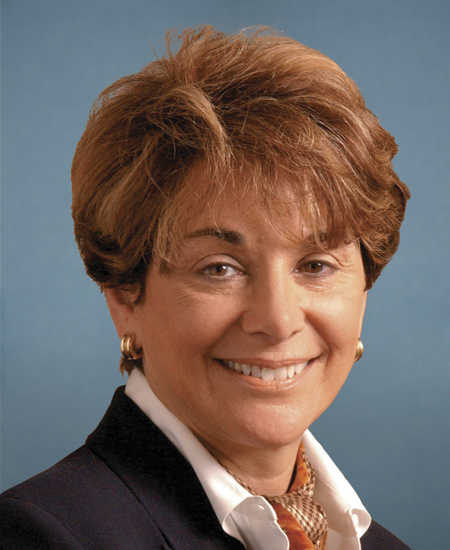
Rep. Anna G. Eshoo
Sponsored bills
Supporting American Printed Circuit Boards Act of 2022 This bill establishes a business tax credit for the purchase of printed circuit boards manufactured in the United States. It also provides financial incentives for entities that invest in facilities and equipment in the United States for manufacturing (or research and development of) printed circuit boards.
School Shooting Safety and Preparedness Act This bill requires the Department of Education (ED) to publish an annual report on indicators of school crime and safety. The report must collect specified information, including the number of school shootings that have taken place nationwide and the number of those that were mass shootings; the number of people killed or injured in each school shooting; the age, gender, race, ethnicity, and nationality of each victim; the motivation of the shooter; how the shooting was stopped; the number and type of firearms and ammunition used in each shooting; and the response time of law enforcement. ED must direct the National Center for Education Statistics to collect and publish specified data on school shootings. The center must collect information on the existence or absence of specified measures at the time of the shooting, including physical and other types of security measures, a communication plan with local law enforcement, a response plan that includes coordination with local agencies, an active shooter response plan, and a trauma response plan.
United States Innovation and Competition Act of 2021 This bill addresses U.S. technology and communications, foreign relations and national security, domestic manufacturing, education, trade, and other matters. Among other provisions, the bill provides funding for FY2022-FY2026 to support U.S. semiconductor manufacturing, research and development, and supply chain security; provides funding for wireless supply chain innovation; establishes a Directorate for Technology and Innovation in the National Science Foundation; extends through 2025 the authority of the National Aeronautics and Space Administration (NASA) to lease its non-excess real property and related personal property; authorizes various programs and policies related to space exploration; authorizes various international affairs programs and activities, including foreign assistance for the Indo-Pacific region; requires federal infrastructure programs to provide for the use of materials produced in the United States; imposes sanctions on China for cybersecurity and human rights abuses; requires the Department of Health and Human Services to consider national security risks associated with sensitive genetic information; includes initiatives related to elementary and secondary education, including those to increase computer science education; contains provisions related to higher education, including those reauthorizing through FY2027 international education programs and addressing China's influence on institutions of higher education; modifies and expands the schedule for graduated merger filing fees; prohibits federal funding for the Wuhan Institute of Virology; requires the U.S. Trade Representative to take certain actions related to digital trade and censorship practices; and extends through 2027 the Generalized System of Preferences.
This resolution recognizes the significance of Asian/Pacific American Heritage Month as an important time to celebrate the contributions of Asian Americans, Native Hawaiians, and Pacific Islanders to the history of the United States. The resolution also recognizes that the Asian American, Native Hawaiian, and Pacific Islander communities enhance the rich diversity of the United States.
This resolution supports (1) the goals of Wildfire Preparedness Week; and (2) resources and educational initiatives that communicate how affected communities can take preventative measures such as instituting early warning systems and reducing unplanned human ignitions, as well as how to safely and efficiently evacuate people and their animals.
This resolution urges (1) the President to issue a proclamation recognizing Earth Day; and (2) governments and people to continue building upon the Paris Agreement and other efforts to ensure that future generations inherit a livable, sustainable, and ecologically rich planet. The resolution reaffirms that immediate action is needed to reduce greenhouse gas emissions and ameliorate environmental injustices in order to protect our planet, public health, and overall well-being of all people and wildlife. In addition, it encourages the American people to mark Earth Day by working to address environmental challenges, uplift indigenous environmental knowledge and stewardship practices, educate others about the need for year-round action, and honor the stewardship ethic for which Senator Gaylord Nelson stood.
National Discovery Trails Act This bill amends the National Trails System Act to include national discovery trails as part of the national trails system. Such trails (1) shall be extended, continuous, interstate trails located to provide for outstanding outdoor recreation and travel and to connect representative examples of America's trails and communities; (2) shall provide for the conservation and enjoyment of significant natural, cultural, and historic resources and be so located as to represent metropolitan, urban, rural, and back country regions of the Nation; and (3) may be designated on federal lands and, with the owner's consent, on nonfederal lands. The 6,000-mile American Discovery Trail extending from Cape Henlopen State Park in Delaware, to Point Reyes National Seashore in California, splitting into northern and southern routes near Cincinnati, Ohio, and rejoining at Denver, Colorado, is designated as a national discovery trail. The bill sets forth requirements for designation of a trail as a national discovery trail. The appropriate federal department for each national discovery trail shall (1) administer the trail in cooperation with at least one competent trailwide volunteer-based organization; and (2) submit a comprehensive plan for the trail's protection, management, development, and use.
Securing Semiconductor Supply Chains Act of 2022 This bill requires the SelectUSA program to solicit comments from state economic development organizations regarding federal efforts to increase foreign direct investment in semiconductor-related manufacturing and production. SelectUSA must then report to Congress on such comments and the strategies that SelectUSA may employ to increase such investment and to secure the U.S. semiconductor supply chain. SelectUSA is a Department of Commerce program established to coordinate federal efforts to attract and retain business investment in the United States.
Health Equity and Middle Eastern and North African Community Inclusion Act of 2022 or the Health Equity and MENA Community Inclusion Act of 2022 This bill adds Middle Easterners and North Africans to the definition of racial and ethnic minority group for purposes of activities carried out by the Office of Minority Health and federally supported health care and public health programs.