

Afghan and Iraqi Allies Resettlement Improvement Act This bill addresses the settlement of Afghan and Iraqi special immigrant visa (SIV) holders. (Generally, SIV holders are individuals who received visas due to their work with the U.S. Armed Forces in Iraq or Afghanistan.) The Department of Health and Human Services must survey long-term outcomes, such as employment, housing, and educational attainment, of SIV holders as part of its annual survey of refugees. The Department of State must implement additional ways to deliver information in certain languages (i.e., Dari, Pashto, or Urdu) to prospective SIV holders about resettlement in the United States to assist with their adjustment process. The State Department and the Department of Defense must jointly establish a temporary program to offer SIV holders employment as translators, interpreters, and cultural awareness instructors.
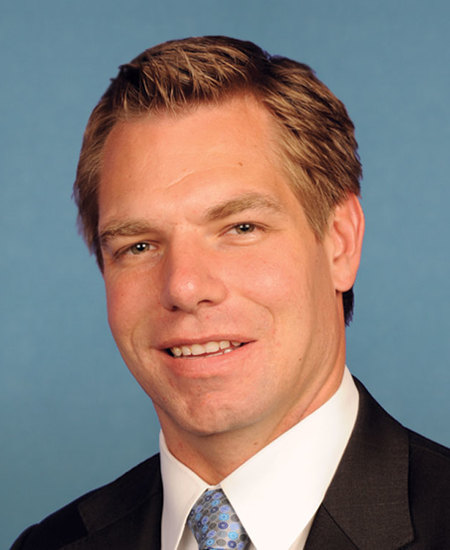
Rep. Eric Swalwell
Sponsored bills
Preventing Presidential Election Interference Act This bill expands the prohibition on engaging in election interference and increases criminal penalties for violations. In particular, the bill prohibits the President and Vice President from using their authority to interfere with or affect an election.
Protecting Election Administration from Interference Act of 2021 This bill revises preservation and retention requirements for federal election records. It also revises criminal penalties related to election records and the voting process. Under current law, election officials must, for a period of 22 months from the federal election, retain and preserve all election-related records and papers. This bill extends the requirement to electronic records and electronic equipment. Next, the bill directs the Cybersecurity and Infrastructure Security Agency to issue minimum standards and best practices for retaining and preserving records (including electronic records), papers, and electronic equipment, including protocols for observing their preservation, security, and transfer by the Department of Justice (DOJ) and a representative of each political party. In addition, the bill revises the federal criminal offense related to election records or papers to include reckless disregard of election record requirements resulting in the theft, destruction, concealment, mutilation, or alteration of a record, paper, or electronic equipment. Further, the bill allows DOJ to demand electronic records and electronic equipment for inspection and generally prohibits DOJ from disclosing this information. The bill allows DOJ and candidates for federal office to bring an action in a district court to compel compliance with election record requirements. Finally, the bill extends criminal penalties related to voting interference to include intimidating, threatening, or coercing (or attempting to do so) an individual for processing or scanning ballots, tabulating, canvassing, or certifying voting results.
Havana Syndrome Attacks Response Act This bill requires the President to sanction foreign persons and governments for carrying out clandestine attacks on U.S. personnel that have caused brain injury. Specifically, the President must impose visa- and asset-blocking sanctions on any foreign person that has directed or carried out such an attack. If the President determines a foreign government carried out such an attack, the President must notify Congress and sanction that country by terminating any foreign assistance (except for humanitarian aid or food or agricultural commodities or products) and arms transactions, restricting commercial exports, and denying access to U.S. credit or other financial assistance. The President must remove these sanctions after 12 months, provided that (1) the country's government gives reliable assurances that it will not conduct future attacks, and (2) the executive branch does not have persuasive information indicating an attack occurred in the preceding six months. The bill also requires a congressional briefing and report about suspected clandestine attacks on U.S. personnel that have caused brain injury, including hypotheses concerning the identity of the perpetrators and the technical methods used to carry out the attacks.
Private Student Loan Bankruptcy Fairness Act of 2019 [ sic ] This bill modifies the treatment of certain student loans in bankruptcy. Specifically it allows private education loans to be discharged in bankruptcy regardless of whether a debtor demonstrates undue hardship. Under current law, student loans may be discharged in bankruptcy only if the loans impose an undue hardship on the debtor.
Hold Accountable and Lend Transparency on Campus Sexual Violence Act of 2021 or the HALT Campus Sexual Violence Act of 2021 This bill addresses dating violence, domestic violence, sexual assault, or stalking incidents on college campuses, including by expanding requirements governing the disclosure of such incidents and efforts to prevent them. Specifically, the bill requires the Department of Education (ED) to make available an online survey tool regarding student experiences with domestic violence, dating violence, sexual assault, harassment, and stalking. ED must publish a biennial report that includes campus-level data for each institution of higher education (IHE). The bill permits ED to impose civil penalties on IHEs that have violated a law under the jurisdiction of its Office for Civil Rights. In addition, the bill directs ED, the Department of Health and Human Services, and the Department of Justice to create a task force on sex-based harassment and violence in education.
District Court Judgeships Act of 2021 This bill requires the appointment of additional U.S. district court judges and converts certain temporary district court judgeships into permanent judgeships. Specifically, the bill requires the appointment of 203 district court judges in specified judicial districts in Arkansas, Arizona, California, Colorado, Delaware, Florida, Georgia, Idaho, Illinois, Indiana, Louisiana, Maryland, Michigan, Minnesota, Missouri, North Carolina, Nebraska, Nevada, New Jersey, New Mexico, New York, Ohio, Oregon, Pennsylvania, South Carolina, Tennessee, Texas, Utah, Virginia, Washington, Wisconsin, and West Virginia. Additionally, the bill converts certain temporary district court judgeships to permanent judgeships in specified judicial districts in Alabama, Arizona, California, Florida, Kansas, Missouri, New Mexico, North Carolina, and Texas.
Journalist Protection Act This bill establishes new criminal offenses for intentional acts (or attempts to commit acts) that cause bodily injury to a journalist.
Restoring Justice for Workers Act This bill prohibits predispute arbitration agreements that require arbitration of an employment dispute. It allows a postdispute arbitration agreement if the employee enters into it voluntarily without coercion and is informed in writing of rights and protections under such agreement. An employer may not retaliate against an employee for refusing to enter into an agreement for arbitrating an employment dispute.
Supreme Court Ethics Act This bill establishes a new statutory requirement for the Judicial Conference of the United States to issue a judicial code of conduct for judges and justices of U.S. courts, including Justices of the Supreme Court. Currently, the Judicial Conference issues a code of conduct for judges of U.S. courts (but not for Justices of the Supreme Court).