

Women in Criminal Justice Reform Act This bill establishes programs and requirements to address the health and wellness of women in the criminal justice system. For example, the bill requires the Bureau of Prisons to (1) ensure that all incarcerated women have access to basic standards of health care specific to their needs, and (2) develop and implement gender-responsive training for its officers and employees.
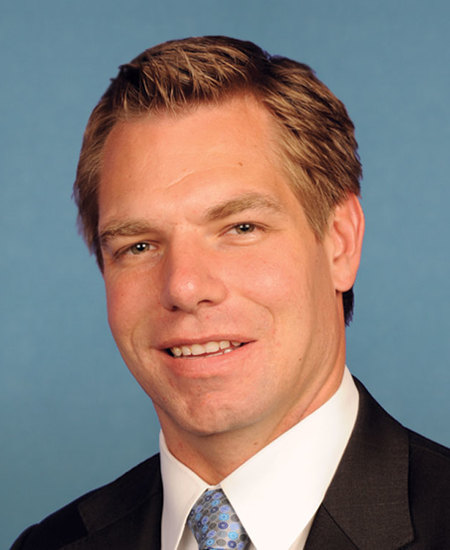
Rep. Eric Swalwell
Sponsored bills
Jumpstart Our Legal Immigration System Act or the Jumpstart Act This bill makes unused employment-based and family-based immigrant visas from FY1992 through FY2021 available in subsequent fiscal years. It also makes diversity immigrant visas available to individuals who were selected for such a visa between FY2017-FY2021 but were unable to receive the visa due to certain (1) executive actions, or (2) limitations related to COVID-19. The bill also establishes supplemental fees for certain immigration-related applications.
Dark Web Interdiction Act of 2022 This bill establishes enhanced criminal penalties for distributing controlled substances via the dark web. It also establishes other programs and requirements to address the use of the dark web for illicit drug activities. ( Dark web means the portions of the internet with hidden sites and services that (1) are not generally searchable, and (2) can only be accessed with specialized devices or services that conceal the identities and locations of users.) Specifically, the bill provides an enhanced criminal penalty for delivering, distributing, or dispensing controlled substances via the dark web. The bill also provides statutory authority for the Joint Criminal Opioid and Darknet Enforcement Task Force, which supports the investigation and prosecution of drug offenses committed via the dark web domestically and internationally. In addition, the Department of Justice must report on how and to what extent virtual currencies are used for opioid distribution via the dark web.
Stopping Harmful Image Exploitation and Limiting Distribution Act of 2022 or the SHIELD Act of 2022 This bill establishes a new criminal offense related to the distribution of intimate visual depictions. Specifically, it makes it a crime to knowingly distribute (or intentionally threaten to distribute) an intimate visual depiction of an individual (1) with knowledge of or reckless disregard for the individual's lack of consent and reasonable expectation of privacy, and (2) without a reasonable belief that distributing the depiction touches a matter of public concern. A violator is subject to criminal penalties—a fine, a prison term of up to two years for each individual victim depicted, or both.
Latonya Reeves Freedom Act of 2022 This bill prohibits government entities and insurance providers from denying community-based services to individuals with disabilities that require long-term service or support that would enable such individuals to live in the community and lead an independent life. Specifically, these entities may not discriminate against such individuals in the provision of community-based services by such actions as imposing prohibited eligibility criteria, cost caps, or waiting lists or failing to provide a specific community-based service. Additionally, community-based services must be offered to individuals with such disabilities prior to institutionalization. Institutionalized individuals must be notified regularly of community-based alternatives. The bill requires the Department of Justice to issue regulations requiring government entities and insurance providers to offer community-based long-term services to individuals with such disabilities who would otherwise qualify for institutional placement. Government entities must ensure sufficient availability of affordable, accessible, and integrated housing that is not a disability-specific residential setting or a setting where services are tied to tenancy. Regulations shall also (1) require government entities and insurance providers to perform self-evaluation on current services, policies, and practices and concerning compliance with requirements of this bill; and (2) require government entities to submit a transition plan. The bill provides funds for FY2022 for the Department of Health and Human Services to provide technical assistance with respect to transition plans. The bill allows civil actions by individuals subjected to, or about to be subjected to, a violation of its requirements.
Election Worker and Polling Place Protection Act This bill addresses certain protections for election workers and polling places. In particular, the bill prohibits, with enhanced penalties for certain types of threats and harms (1) intimidation of poll watchers, election officials, and election agents, vendors, and contractors involving violence or threats of harm; and (2) physical damage to or threats to physically damage a polling place, tabulation center, or other election infrastructure.
Russian Travel Sanctions for a Democratic Ukraine Act This bill imposes visa-blocking sanctions on certain citizens of Russia. Specifically, the President must impose such sanctions on citizens of Russia who are (1) Russian oligarchs, (2) employees of Russia's government, or (3) employees of companies that are owned by or receive funding from Russia's government. The President must also impose the sanctions on family members of such individuals. The President must coordinate with allies, including NATO member states, on the imposition of such sanctions. The President may waive the application of such sanctions in certain instances.
Strengthening Citizenship Services for Veterans Act This bill directs U.S. Citizenship and Immigration Services (USCIS) to ensure that various naturalization-related services are available at a U.S. port of entry, embassy, or consulate that is accessible to noncitizen veterans. Specifically, USCIS must ensure that naturalization examinations, biometric collections, and naturalization ceremonies are available at such locations for noncitizen veterans. Such services must be available to a noncitizen veteran who has been removed from the United States or is inadmissible.
Fresh Start Act of 2022 This bill establishes a federal statutory process to expunge records related to certain nonviolent criminal offenses. The bill defines the nonviolent offenses eligible for expungement; it establishes qualifications for an eligible offender; and it sets forth procedures for filing an expungement petition.
Trafficking Reduction And Criminal Enforcement (TRACE) Act This bill modifies provisions related to firearms tracing. First, the bill directs the Department of Justice to promulgate regulations that require each firearm manufactured in the United States to be marked with a serial number that is located inside the firearm's receiver or that is visible only in infrared light, in addition to the serial number mark otherwise required. Next, it requires National Instant Criminal Background Check System records to be maintained for at least 180 days. The bill also requires each licensed firearms dealer to conduct a physical check of their firearms business inventory. Finally, it removes certain limitations on the use of firearms tracing data.