

Maddy summaryThe JUDGES Act of 2024 authorizes new federal district court judgeships across multiple states to address rising case backlogs in the federal judiciary. It specifies new permanent judgeships for districts including California (multiple districts), Florida, Texas, Delaware, Indiana, Iowa, New Jersey, and New York, with implementation phased through 2035, and creates temporary judgeships for Oklahoma districts with specific vacancy rules. The bill authorizes funding for these positions and requires reports on judicial caseloads and detention space needs, while mandating public access to the Judicial Conference's judgeship recommendations. The bill directly affects federal district courts in the specified locations by increasing judicial staffing to handle growing case volumes.
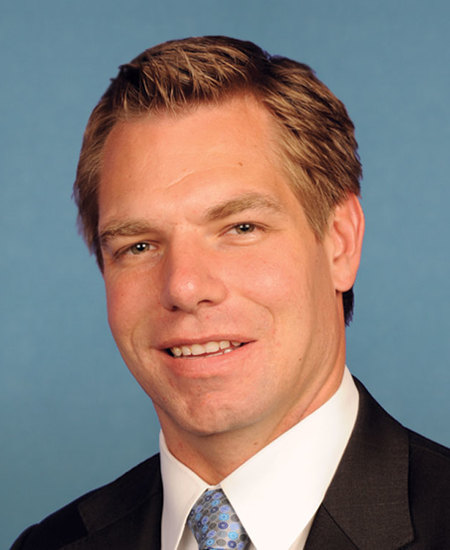
Rep. Eric Swalwell
Sponsored bills
Maddy summaryHRES 1448 is a non-binding House resolution stating that the House believes every person has the right to emergency health care, including abortion care, during medical emergencies. It specifically addresses concerns that abortion restrictions force medical providers to choose between treating patients in life-threatening situations or risking criminal charges. The resolution highlights that such restrictions disproportionately harm Black, Indigenous, people of color, immigrants, low-income individuals, and LGBTQI+ patients. It does not change existing laws but expresses congressional support for ensuring access to emergency care without legal barriers. The resolution was introduced by multiple House members and referred to the Energy and Commerce Committee.
Maddy summaryHRES 1437 is a ceremonial resolution designating the week beginning September 9, 2024, as "National Hispanic-Serving Institutions Week." It recognizes Hispanic-serving institutions (HSIs) - colleges and universities with at least 25% Hispanic enrollment - and their role in educating low-income students, advancing economic mobility, and serving 31.7% of all undergraduate students. The resolution calls for the public and organizations to observe this week with ceremonies and activities during Hispanic Heritage Month. It does not create new laws, allocate funding, or change existing policies - it is purely a symbolic gesture of recognition.
Maddy summaryThis bill designates the U.S. Postal Service facility at 130 South Patterson Avenue in Santa Barbara, California, as the "Brigadier General Frederick R. Lopez Post Office Building." It updates all official U.S. government references to the building to reflect this new name, with no policy changes or funding impacts.
Maddy summaryHRES 1432 designates September 10, 2024, as "National Firearm Suicide Prevention Day" to raise public awareness about firearm suicides and promote safe storage practices. The resolution encourages healthcare professionals to discuss safe firearm storage with patients and supports the day's goals of reducing firearm suicides through education. It directly affects the general public and healthcare providers by highlighting evidence that safe storage lowers suicide risk, referencing statistics like 54.6% of U.S. suicides in 2022 involving firearms. The bill is symbolic, with no new legal requirements, and aligns with existing awareness efforts like Firearm Suicide Prevention Day.
Maddy summaryHRES 1436 is a symbolic resolution (not a law) introduced in the U.S. House of Representatives. It recognizes suicide as a preventable public health crisis by citing statistics from the CDC, VA, and SAMHSA showing rising suicide rates across age groups, including veterans and adolescents. The resolution formally supports designating September as "National Suicide Prevention Month" and September 10, 2024, as "World Suicide Prevention Day." It does not create new policies, allocate funding, or directly affect any individuals - its purpose is solely to express congressional support for suicide prevention awareness and efforts.
Maddy summaryHR 9299, the IRAN Act, requires the U.S. Secretary of State to lead federal efforts promoting internet freedom and access to information in Iran. It amends a 2012 law to mandate specific strategy updates, including evaluating how activists use virtual private networks (VPNs) and satellite tech, developing guidance to prevent sanctions from blocking internet tools for Iranians, and planning to bypass government internet blackouts. The bill directs the State Department to coordinate with Treasury, Commerce, USAID, and intelligence agencies to implement these updates. This affects U.S. government agencies' coordination and aims to improve internet access for Iranian civil society activists.
Maddy summaryThe Active Shooter Alert Act of 2024 establishes a national coordination system for active shooter alerts by designating a Department of Justice Coordinator. The Coordinator will work with federal agencies (FEMA, FCC, Transportation) and state/local governments to develop voluntary best practices for alert systems, including geotargeted notifications, multilingual messaging, and training for transportation authorities. The bill requires annual reports to Congress on state adoption of protocols and mandates a Comptroller General study on state response times to active shooter alerts, funded by $2 million for the Department of Justice. It does not mandate state adoption but encourages coordination to improve alert effectiveness.
Maddy summaryThe NO BAN Act (HR 9244) prohibits U.S. immigration authorities from denying visas or entry based on national origin, religion, or sex. It amends immigration law to explicitly ban such discrimination in visa decisions and tightens restrictions on the president’s power to suspend entry of certain groups under Section 212(f). The bill requires specific evidence, narrow tailoring, time limits, and congressional notification for any entry restriction, while mandating public reports on visa denials and waivers. It directly affects nonimmigrant visa applicants (e.g., students, workers) and federal agencies administering immigration policy.
Maddy summaryHR 9253, the National Gun Violence Research Act, repeals longstanding restrictions that blocked federal funding for gun violence research, including the 1996 Dickey Amendment. It establishes a National Gun Violence Research Program to support scientific studies on gun-related injury and death, with $200 million authorized over six years (2025-2030). The program directs agencies like the CDC, NIH, and National Institute of Justice to fund research, train researchers, develop safety standards, and share gun trace data with researchers through new protocols. This bill directly affects federal research institutions and public health agencies by enabling evidence-based study of gun violence causes and prevention strategies.