

Maddy summaryHR 612, the Health Care Providers Safety Act of 2025, provides federal funding to help health care facilities improve safety. It authorizes the Secretary to award grants to hospitals, clinics, and other health care providers to cover costs for physical security (like structural improvements) and cyber security (such as data privacy tools and video surveillance systems). These grants directly help health care providers protect their facilities, staff, and patients from security threats. The bill creates a new funding mechanism under the Public Health Service Act, making specific security upgrades eligible for federal support.
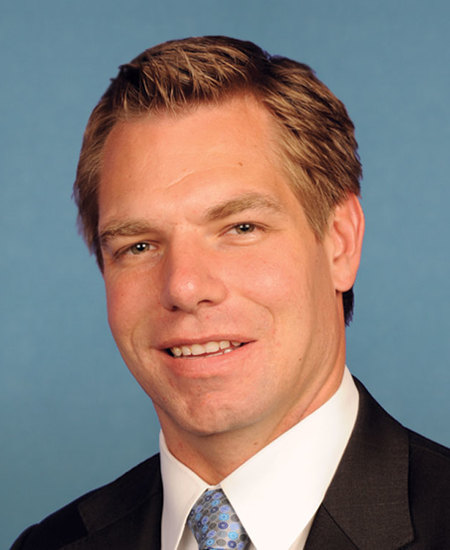
Rep. Eric Swalwell
Sponsored bills
Supporting Accurate Views of Emergency Services Act of 2025 or the 911 SAVES Act This bill requires the Office of Management and Budget to categorize public safety telecommunicators as a protective service occupation under the Standard Occupational Classification system no later than 30 days after the enactment of this bill. (The Standard Occupational Classification system is a federal statistical standard used by federal agencies to classify workers into occupational categories for the purpose of collecting, calculating, or disseminating data.)
Maddy summaryThis bill clarifies the definition of "numismatic material" to explicitly include coins, tokens, paper money, medals, and related objects under U.S. import rules. It requires importers to provide sworn declarations confirming such items were lawfully acquired, are of a known type (as documented in published numismatic references), and are not linked to illicit excavations. Customs officers must accept this documentation alone unless they have probable cause to suspect fraud, preventing unnecessary additional requirements. The changes primarily affect collectors, dealers, and importers of numismatic items by streamlining lawful import procedures.
Maddy summaryHR 566, the Cleaner Air Spaces Act of 2025, provides federal grants to air pollution control agencies to establish local programs targeting low-income households with vulnerable residents (such as those with health conditions or elderly members) in wildfire smoke-prone areas. The bill authorizes $30 million over three years to fund programs that must establish accessible clean air centers, distribute at least 1,000 free, certified air filtration units per program (with replacements), provide educational materials, and partner with community organizations. Agencies must track unit types and costs, survey participants on program effectiveness, and report results to Congress within three years. The program directly affects covered households by improving access to clean air during smoke events through tangible, funded support.
Maddy summaryHRES 52 is a symbolic resolution recognizing community organizations and individuals who create and maintain services and educational programs for LGBTQIA+ communities. It does not establish new laws, funding, or policy changes, but formally honors their work in fostering safe spaces and resilience. The resolution cites historical examples like Stonewall and ACT UP, along with statistics on declining LGBTQIA+ venues and hate violence, to underscore the importance of these efforts. It calls for Congress to acknowledge this work through non-binding statements of support.
Maddy summaryThe Prevent Tariff Abuse Act amends the International Emergency Economic Powers Act to prohibit the President from using emergency powers to impose tariffs or import quotas on goods entering the U.S. It adds a specific provision stating the President cannot impose duties, tariffs, or quotas under this law. This directly limits the executive branch's authority during emergencies, preventing the use of emergency powers for trade restrictions. The bill does not affect other trade policies or the President's other emergency authorities.
Maddy summaryHR 429, the Rosie the Riveter Commemorative Coin Act, authorizes the U.S. Treasury to mint and sell three types of commemorative coins ($5 gold, $1 silver, and half-dollar) to honor women who worked on the U.S. home front during World War II. The coins will be sold at face value plus surcharges ($35 for gold, $10 for silver, $5 for half-dollar), with all surcharge revenue directed to the Rosie the Riveter Trust to support the Rosie the Riveter WWII Home Front National Historical Park and related educational programs. The coins must be issued between January 1, 2028, and December 31, 2028, in specified quantities (50,000 gold, 400,000 silver, 750,000 half-dollar), with all costs covered by the sales revenue to avoid net government expense.
Maddy summaryHR 423 would change bankruptcy law to allow private student loan debt to be discharged (forgiven) in bankruptcy cases. It amends a section of the Bankruptcy Code that currently makes most student loans non-dischargeable, specifically removing the exception for private loans by revising the language around loan programs. This change would directly affect borrowers with private student loans who file for bankruptcy after the law takes effect. The bill applies only to bankruptcy cases filed on or after its enactment date, not to existing cases.
Maddy summaryThis bill amends the Robert T. Stafford Disaster Relief Act to prioritize disaster resilience funding for vulnerable communities. It defines "environmental justice communities" (communities of color, low-income, or Tribal areas facing higher environmental risks) and "small impoverished communities" (under 50,000 people, economically disadvantaged), requiring FEMA to prioritize these groups for assistance. The bill increases federal funding coverage to 90% for mitigation projects in these communities (up from 75%) and mandates that projects account for future climate risks in design. It also creates a new federal database to track disaster spending and requires FEMA to provide outreach support to help eligible communities apply for funding.
Maddy summaryThis resolution expresses the House's support for Korean American Day, commemorating January 13, 1903 - the arrival of the first large wave of Korean immigrants to the U.S. It urges all Americans to observe the day to recognize Korean Americans' contributions to U.S. society, including their economic, cultural, and military service. The resolution honors the 122nd anniversary of this historical arrival, acknowledging the resilience of early Korean immigrants and their descendants. As a symbolic gesture, it does not create new laws or affect any specific group directly.