

Maddy summaryThis bill repeals longstanding restrictions on federal funding for gun violence research that have been in place since 1996. It establishes a National Gun Violence Research Program coordinated by the Office of Science and Technology Policy, authorizing $200 million over six years ($200,000 annually from 2026-2031) to fund research across multiple agencies including the National Institutes of Health, Centers for Disease Control, and National Institute of Justice. The bill requires sharing of gun trace data with researchers and creates an interagency working group and advisory committee to guide the research program. This legislation focuses on enabling research into the causes and prevention of gun violence without making changes to gun laws or regulations.
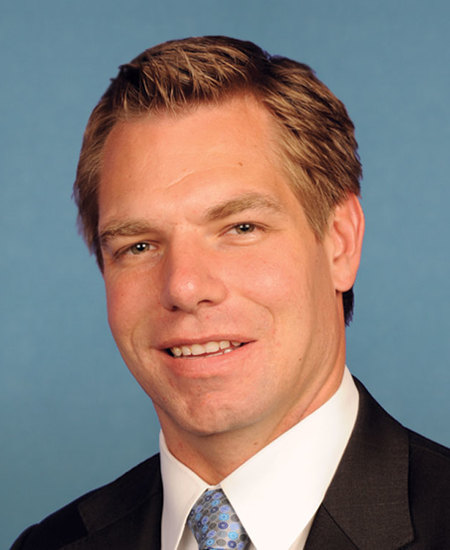
Rep. Eric Swalwell
Sponsored bills
Maddy summaryHR 5572, the Help FEDS Act, ensures federal employees who must work during government shutdowns (but aren't paid due to the shutdown) can access unemployment benefits through their state's program. The bill requires states to allow these "excepted" employees to apply for and receive unemployment compensation during fiscal years 2026-2027, while also mandating repayment if they later receive pay under a separate federal provision. The federal government will reimburse states 100% of the unemployment benefits paid to these employees plus related administrative costs, funded from the Unemployment Trust Fund. This directly affects federal workers performing emergency work during shutdowns and state unemployment systems managing these claims.
Maddy summaryHRES 760 is a symbolic House resolution supporting the designation of September 22-26, 2025, as "National Hazing Awareness Week." It does not create new laws or requirements but formally acknowledges the harm of hazing in college settings and encourages ongoing prevention efforts. The resolution references existing laws like the Stop Campus Hazing Act (2024) and highlights statistics on hazing prevalence and its deadly consequences, including listed cases of student deaths. It urges the public to observe the week by promoting hazing awareness and prevention. This resolution directly affects college communities and aims to foster safer campus environments through awareness, not policy change.
Maddy summaryThis resolution condemns the use of federal regulatory agencies (like the FCC) or lawsuits to suppress lawful speech critical of political parties or the President, specifically referencing concerns about tactics mirroring authoritarian practices. It does not create new laws but formally warns that such actions undermine First Amendment protections and democratic norms. The resolution directly affects media organizations, journalists, and public discourse by calling on government agencies to avoid using their power for political retaliation. It reaffirms the House’s commitment to protecting free expression and urges officials to refrain from pressuring media to silence criticism.
Maddy summaryThe Aviation Funding Stability Act of 2025 ensures continued operation of Federal Aviation Administration (FAA) programs during government funding gaps. It allows the FAA to use unspent funds from the Airport and Airway Trust Fund to maintain critical services - including air traffic control, airport infrastructure, and safety research - at the previous fiscal year's funding level if Congress fails to pass a new budget. This prevents shutdowns for up to 30 days or until a new budget is enacted, with spending limited to prior-year rates and subject to existing program rules. The bill directly affects all FAA operations, keeping airports and air traffic systems running during budget delays.
Maddy summaryHRES 746 is a non-binding resolution passed by the U.S. House of Representatives condemning all political violence - including attacks on elected officials, candidates, and public figures - and rejecting rhetoric that dehumanizes opponents. It specifically urges law enforcement to investigate and prosecute such violence, calls on public officials and media to avoid inflammatory language, and references recent incidents like the 2025 assassination of activist Charlie Kirk and targeted shootings of Minnesota legislators. The resolution does not create new laws but formally expresses the House’s commitment to protecting public servants and promoting peaceful political discourse. It directly affects the House’s public stance and serves as a call to action for officials, media, and communities to foster civil engagement.
Maddy summaryThe Tyler Clementi Higher Education Anti-Harassment Act of 2025 requires U.S. colleges and universities participating in federal financial aid programs to create and distribute clear anti-harassment policies covering harassment based on race, color, national origin, sex (including sexual orientation and gender identity), disability, or religion. These policies must explicitly prohibit harassment in all settings - including online, on campus, off-campus housing, and during school-sponsored activities - and outline reporting procedures and support services for victims. The bill also establishes a $50 million annual grant program to fund schools developing prevention programs, victim support services, or staff/student training on recognizing and addressing harassment. Grants are competitive, require annual reporting on effectiveness, and must be used to improve existing efforts without replacing existing civil rights laws like Title IX.
Maddy summaryThe Redistricting Reform Act of 2025 requires states to use independent redistricting commissions for congressional redistricting, banning partisan gerrymandering and requiring plans to comply with constitutional and Voting Rights Act standards. The bill establishes ranked criteria for redistricting, prioritizing population equality, voting rights protections, and community preservation over partisan advantage. It mandates multi-partisan commission composition with public input and transparency requirements, with states facing court-developed plans if they miss deadlines. The law would apply to redistricting after the 2030 census, affecting all 50 states' congressional district maps.
Maddy summaryThe RRLEF Act of 2025 requires applicants for Edward Byrne Memorial Justice Assistance Grant Program funds to certify they do not purchase firearms from "covered licensed dealers." A "covered dealer" is defined as one traced with 25+ firearms used in crimes within two of the last three years. The bill mandates the ATF publicly publish an annual list of these dealers and notify law enforcement if their transferred firearms are used in crimes. This directly affects state/local law enforcement agencies seeking federal grant funding by restricting their firearm purchasing options.
Maddy summaryThis bill creates a 70% tax credit for eligible small businesses to cover costs of installing diaper changing stations and dispensers in restrooms. It applies to businesses with annual gross receipts under $5 million or fewer than 100 full-time equivalent employees. To qualify, businesses must ensure both men’s and women’s restrooms at each location have accessible diaper changing stations (free to use) and diaper dispensers. The credit is capped at $10,000 per business location annually and applies to expenses like station installation, labor, and restroom renovations meeting the "family bathroom requirement." The credit begins for tax years starting after December 31, 2025.