Teacher Education for Computer Science Act or the Teach CS Act This bill authorizes the Department of Education to award grants to institutions of higher education for establishing and maintaining teacher education programs for computer science. It also includes computer science as an eligible education category with respect to receiving various teacher preparation grants and graduate fellowships.
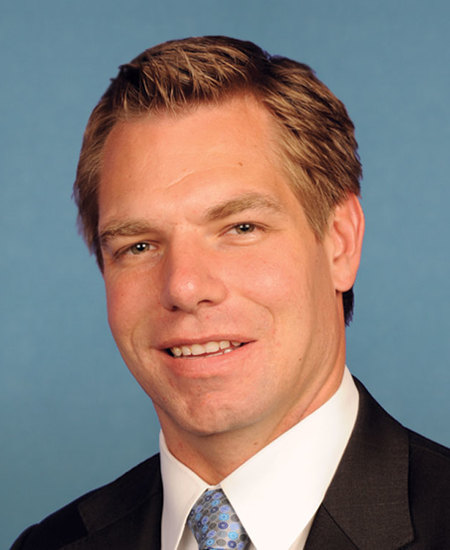
Rep. Eric Swalwell
Sponsored bills
LGBTQ Essential Data Act This bill directs the Centers for Disease Control and Prevention to more frequently collect information on the sexual orientation and gender identity of deceased individuals through the National Violent Death Reporting System.
This bill allows permanent expensing of property used in the mining, reclaiming, or recycling of certain critical minerals and metals within the United States and of nonresidential real property used in mining such minerals and metals. Expensing is the treatment of expenditures as operating costs deductible in full in the current taxable year. The bill allows a new tax deduction for 200% of the cost of purchasing or acquiring such critical minerals and metals extracted from deposits in the United States and a 22% rate of percentage depletion for such critical minerals and metals. The bill requires the Department of the Interior to establish a pilot project grant program for the development of critical minerals and metals in the United States. A grant awarded under such program may not exceed $10 million. In awarding grants, Interior must give priority to projects determined to be economically viable over the long term and must allot not less than 30% of grants funds to the secondary recovery of critical minerals and metals.
Promising Pathway Act This bill establishes a provisional approval pathway for medicines intended for serious or life-threatening diseases, including illnesses posing a threat of epidemic or pandemic. The period of the provisional approval is for two years and is potentially renewable. The Food and Drug Administration (FDA) must establish a priority review system to evaluate completed provisional approval applications within 90 days of receipt. A provisional approval application may be approved if the FDA determines that (1) there is substantial evidence of safety for the drug; and (2) there is relevant early evidence of efficacy, based on adequate and well-controlled investigations. During the COVID-19 (i.e., coronavirus disease 2019) pandemic, or another epidemic or pandemic, the FDA must accept and review various portions of a provisional approval application on a rolling basis. The manufacturer of a provisionally approved drug must require patients to participate in an observational registry. A manufacturer that fails to comply with registry requirements is subject to civil penalties. A provisionally approved drug must be labeled as such. If a drug that receives provisional approval status is not brought to market within 180 days of the approval, the approval must be rescinded. The bill also limits the liability of a manufacturer of a provisionally approved drug with respect to any claim under state law alleging that the drug is unsafe or ineffective. Private health insurers and federal health care programs shall not deny coverage of a provisionally approved drug on the basis of it being experimental.
Paycheck Fairness Act This bill addresses wage discrimination on the basis of sex, which is defined to include pregnancy, sexual orientation, gender identity, and sex characteristics. Specifically, it limits an employer's defense that a pay differential is based on a factor other than sex to only bona fide job-related factors in wage discrimination claims, enhances nonretaliation prohibitions, and makes it unlawful to require an employee to sign a contract or waiver prohibiting the employee from disclosing information about the employee's wages. The bill also increases civil penalties for violations of equal pay provisions. Additionally, the Equal Employment Opportunity Commission (EEOC) and the Office of Federal Contract Compliance Programs must train EEOC employees and other affected parties on wage discrimination. The bill directs the Department of Labor to (1) establish and carry out a grant program to provide training in negotiation skills related to compensation and equitable working conditions, (2) conduct studies to eliminate pay disparities between men and women, and (3) make available information on wage discrimination to assist the public in understanding and addressing such discrimination. The bill establishes the National Award for Pay Equity in the Workplace for an employer who has made a substantial effort to eliminate pay disparities between men and women. It also establishes the National Equal Pay Enforcement Task Force to address compliance, public education, and enforcement of equal pay laws. Finally, the bill requires the EEOC to issue regulations for collecting from employers compensation and other employment data according to the sex, race, and national origin of employees for use in enforcing laws prohibiting pay discrimination.

Nationwide Dig Once Act of 2021 This bill requires states to incorporate broadband infrastructure in construction projects that are supported with federal highway funds. It also establishes a task force to evaluate the costs of a nationwide dig once requirement (a requirement to minimize the number and scale of repeated excavations relating to the installation of broadband infrastructure in rights-of-way).
Improving Access to Medicare Coverage Act of 2021 This bill deems an individual receiving outpatient observation services in a hospital as an inpatient for purposes of satisfying the three-day inpatient hospital-stay requirement with respect to Medicare coverage of skilled nursing facility services.
United States Army Rangers Veterans of World War II Congressional Gold Medal Act This bill provides for the award of a single Congressional Gold Medal to the U.S. Army Rangers Veterans of World War II in recognition of their dedicated service during World War II.
Filing Relief for Natural Disasters Act This bill authorizes the Internal Revenue Service to postpone federal tax filing deadlines upon the written request of a governor of a state in which an emergency or disaster has been declared. The bill also extends current mandatory extensions from 60 to 120 days. For purposes of this bill, a state includes the District of Columbia, the Commonwealth of Puerto Rico, the U.S. Virgin Islands, Guam, American Samoa, and the Commonwealth of the Northern Mariana Islands.
Veteran Education Empowerment Act This bill reauthorizes through FY2029 and otherwise revises a Department of Education (ED) grant program for student veteran centers. Specifically, ED must make grants to institutions of higher education (IHEs) or consortia of IHEs to establish, maintain, improve, or operate a student veteran center. A student veteran center is a dedicated space on a campus that provides students who are veterans or members of the Armed Forces with (1) a lounge or meeting space for themselves, their spouses or partners, their children, and veterans in the community; and (2) a centralized office for student veteran services that serves as a single point of contact to coordinate comprehensive support services for student veterans.