

Department of Homeland Security Reform Act of 2021 or the DHS Reform Act of 2021 This bill makes extensive changes to the structure of the Department of Homeland Security (DHS) and to the responsibilities of DHS components. Specifically, the bill, among other things creates a new Associate Secretary responsible for overseeing DHS's law enforcement functions; modifies the responsibilities of the Office for Civil Rights and Civil Liberties, including to require engagement with individuals and communities whose civil rights and liberties may be affected by DHS programs and activities; establishes within DHS's Office of Intelligence and Analysis an analytic unit to serve as a focal point for intelligence and analysis of domestic terrorism threats; directs DHS to establish an employee engagement steering committee to identify factors that have a negative impact on employee engagement, morale, and communications within DHS; establishes within DHS a school security coordinating council; directs DHS to develop and disseminate a strategy with respect to biometric technology and identity management enterprise pilot programs and programs; requires DHS to develop, disseminate, and implement a DHS-wide directive to update or replace the strategic framework relating to countering terrorism and targeted violence; requires that DHS's use-of-force policy be updated to emphasize de-escalation; and requires DHS to issue a DHS-wide strategy to enhance partnerships with historically Black colleges and universities and minority-serving institutes that includes yearly goals.
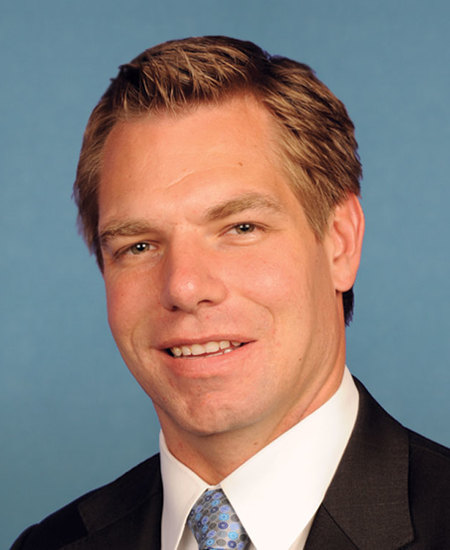
Rep. Eric Swalwell
Sponsored bills
Furthering Underutilized Technologies and Unleashing Responsible Expenditures for Western Water Infrastructure and Drought Resiliency Act or the FUTURE Western Water Infrastructure and Drought Resiliency Act This bill addresses water-related resources and infrastructure. Among other provisions, the bill reauthorizes through FY2026 the California Bay-Delta program, the Water Availability and Use Science Program, and a water desalination program; reauthorizes through FY2028 the Fisheries Restoration and Irrigation Mitigation program; creates various grants for water projects and expands the allowable uses of grants for water recycling and reuse projects; establishes a funding source for certain water resources development projects in western states; expands the tax exclusion for energy conservation subsidies provided by public utilities to include certain subsidies for water conservation or efficiency measures and stormwater management measures; establishes prizes for water technology applications; requires the U.S. Army Corps of Engineers to use specified funds for water control manual updates for forecast-informed water operations projects; and allows certain funding to be used for the remediation of land formerly used to cultivate marijuana. The Department of the Interior must, within 10 years, make certain streamgages operational. (Streamgages are fixed structures at streams, rivers, lakes, and reservoirs that measure water level and related streamflow.) The bill establishes programs related to ecosystem protection and restoration, including programs to (1) incentivize farmers to keep fields flooded during appropriate periods for waterbird habitat creation and maintenance, and (2) prepare drought plans to sustain critically important fisheries.
National Infrastructure Bank Act of 2021 This bill creates the National Infrastructure Bank to facilitate the long-term financing of infrastructure projects. Specifically, the bank must provide loans to public and private entities for financing, developing, or operating eligible infrastructure projects. An eligible project must have a public sponsor as well as local, regional, or national significance. The bill treats the bank as a government corporation exempt from tax and treats contributions to the bank as charitable contributions. The bill also provides for criteria and preferences for deciding whether to provide a loan, such as whether a project promotes job creation or provides environmental benefits. Projects that receive a loan must (1) pay all laborers and mechanics locally prevailing wages, and (2) use only certain U.S.-produced construction materials unless a waiver is secured from the bank. The bank shall issue stock and may also issue bonds and maintain a discount line of credit with the Federal Reserve System. The bank must apply for a national bank charter and, once chartered, accept deposits from individuals, corporations, and public entities and pay interest on those deposits. The bill imposes requirements related to the bank's operation, such as minimum reserve requirements and requirements for handling loan losses. In addition, the bank must facilitate the organization of at least seven regional economic accelerator planning groups to, among other activities, identify infrastructure needs and priorities. Within five years, the Government Accountability Office must report on the bank's activities.
National Community Violence De-Escalation Training Act of 2021 This bill establishes and expands grant programs for training on de-escalating violence and crisis situations involving individuals with behavioral health issues. Specifically, the Substance Abuse and Mental Health Services Administration (SAMHSA) must award grants to state and local governments, educational institutions, nonprofits, faith institutions, or small businesses for community-based training to de-escalate and avoid violence. As part of this grant program, SAMHSA must also establish an advisory board and develop relevant training standards. The training funded by the grants must apply evidence-based de-escalation and avoidance techniques to potentially violent scenarios that are regularly encountered by community members, including public safety officers, public transit operators, educators, and faith leaders. Additionally, the training must address implicit bias, crisis interventions for those experiencing mental health or substance use issues, and other specified topics. The bill also expands and extends through FY2027 mental health awareness training grants.
Medicare Dental, Vision, and Hearing Benefit Act of 2021 This bill provides for Medicare coverage of dental, vision, and hearing care. Coverage includes (1) routine dental cleanings and exams, basic and major dental services, emergency dental care, and dentures; (2) routine eye exams, eyeglasses, and contact lenses; and (3) routine hearing exams, hearing aids, and exams for hearing aids. With respect to such care, the bill establishes special payment rules, limitations, and coinsurance requirements.
Safe Schools Improvement Act of 2021 This bill requires states to direct their local educational agencies (LEAs) to establish policies that prevent and prohibit bullying and harassment of elementary and secondary school students. In particular, these policies must prohibit bullying and harassment based on race, color, national origin, sex, sexual orientation, gender identity, disability, or religion. Further, LEAs must provide (1) students, parents, and educational professionals with annual notice of the conduct prohibited in their disciplinary policies; (2) students and parents with grievance procedures that target such conduct; and (3) the public with annual data on the incidence and frequency of that conduct at the school and LEA level. The Department of Education must conduct and report on an independent biennial evaluation of programs and policies to combat bullying and harassment in elementary and secondary schools. The National Center for Education Statistics must collect state data to determine the incidence and frequency of the conduct prohibited by LEA disciplinary policies.
Student Food Security Act of 2021 This bill expands the Supplemental Nutrition Assistance Program (SNAP) and establishes programs to address food insecurity among college students. Specifically, the bill permanently modifies the eligibility requirements to allow additional college students to receive SNAP benefits, and it establishes a demonstration program to allow college students to use SNAP benefits on college campuses instead of meal plans. The bill also advances implementation of certain data-sharing agreements and notifications to help students who apply for federal financial aid to also apply for and receive other federal means-tested benefits (e.g., Section 8 tenant-based housing assistance, Medicaid, and Supplemental Security Income). In addition, the bill (1) requires questions about food and housing insecurity to be incorporated into the National Postsecondary Student Aid Study, and (2) establishes a grant program to support research and address incidences of food and housing insecurity among college students.
Rebuilding Communities After Disasters Act This bill requires the Small Business Administration (SBA) to increase the loan limits for the disaster loan program and to communicate certain information about the program following disasters. Specifically, the bill raises from $40,000 to $75,000 the loan amount for repair or replacement of household and personal effects and from $200,000 to $400,000 the loan amount for repair or replacement of a primary residence. Further, the bill requires the SBA to communicate through radio, television, print, and web-based outlets all relevant information needed by disaster loan applicants if a disaster is declared or the SBA declares eligibility for additional disaster assistance. (Currently, the SBA is only required to endeavor to communicate such information.) The SBA must submit a report on the disaster loan program that includes information such as the number and dollar value of program loans and the average estimated dollar value of damage sustained by borrowers.
Large-Scale Water Recycling Project Investment Act This bill requires the Department of the Interior to award grants to water or power delivery authorities for the planning, design, and construction of large-scale water recycling and reuse projects in drought-stricken regions of certain western states. Additionally, the Government Accountability Office must report on the selection process for each project.
Expand American Educational Opportunity Act of 2021 This bill replaces the Hope Scholarship and Lifetime Learning tax credits with a modified American Opportunity Tax Credit that (1) allows an income tax credit of up to $2,500 of the qualified tuition and related expenses of a student who is carrying at least one half of a normal course load, (2) allows a lifetime dollar limitation for the credit of $15,000 for all taxable years, and (3) increases the refundable portion of the credit to a maximum of $1,500. The bill defines qualified tuition and related expenses as tuition, fees, computer or peripheral equipment, child and dependent care expenses, and course materials for the taxpayer, the taxpayer's spouse, and dependents at certain postsecondary educational institutions. The bill also allows an exclusion from gross income, for income tax purposes, of any amount received as a Federal Pell Grant.