

Maddy summaryThe PILLAR Act reauthorizes the CISA State and local cybersecurity grant program through fiscal year 2035, expanding its scope to cover operational technology systems and systems using artificial intelligence. It requires grant recipients to adopt multi-factor authentication and other cybersecurity best practices, with higher federal funding rates (up to 75% for multi-entity groups) if these measures are implemented by October 2027. The bill also mandates outreach to rural and small local governments to ensure equitable access to cybersecurity resources and includes a requirement for GAO reviews of artificial intelligence adoption across funded programs.
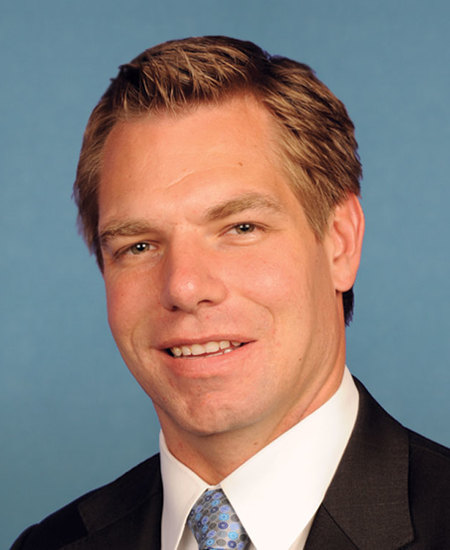
Rep. Eric Swalwell
Sponsored bills
Maddy summaryHR 6049, the No Payola Act, repeals a requirement that Senate staff notify the Senate when legal process seeks to disclose Senate data. It also requires Senators who received funds from private lawsuits under the repealed provision to repay those funds to the Treasury. The bill directly affects Senators who might have been involved in legal cases related to the repealed notification rules. This is a procedural change eliminating specific reporting obligations and financial penalties for certain Senate-related legal actions.
Maddy summaryHR 6056, the International Human Rights Defense Act of 2025, establishes a permanent Special Envoy at the State Department to lead U.S. foreign policy efforts addressing discrimination and violence against LGBTQI+ people globally. The bill requires the U.S. government to develop and update a biannual global strategy to prevent criminalization and violence against LGBTQI+ individuals, mandate detailed reporting on such abuses in annual country reports, and ensure all U.S. foreign assistance programs include inclusive nondiscrimination policies. This legislation directly affects U.S. foreign policy implementation, federal agencies receiving funding, and LGBTQI+ communities facing persecution worldwide. The bill aims to coordinate U.S. government efforts across departments and with international partners to advance LGBTQI+ rights globally through concrete policy mechanisms.
Maddy summaryThis resolution designates the week of November 10-16, 2025, as "National Caregiving Youth Week" to highlight young people under 18 who provide regular care for family members with health conditions, such as chronic illness, disability, or aging. It aims to raise public awareness and encourage recognition of these youth, who often balance caregiving with school while facing challenges like mental health risks and reduced educational opportunities. The resolution urges educators, policymakers, and community leaders to better support this group but does not create new programs or funding. It focuses on symbolic recognition, not legislative action.
Maddy summaryHRES 872 is a symbolic resolution supporting Creutzfeldt-Jakob Disease (CJD) Awareness Day, recognizing CJD as a rare, fatal brain disorder affecting approximately 1-2 people per million annually in the U.S. The resolution does not create new programs or policies but formally acknowledges the disease's impact and the importance of raising public awareness about CJD's rapid progression and challenges for patients and families. It specifically encourages recognition of CJD Awareness Day on November 12, 2025, as a way to highlight this condition. The resolution is non-binding and focuses solely on awareness, not medical research or funding.
Maddy summaryThis bill changes HUD housing rules to exclude veterans' disability and dependency benefits from being counted as income. It directly affects veterans receiving disability compensation (under 38 U.S.C. Chapter 11) or dependency compensation (under 38 U.S.C. Chapter 13) who apply for HUD housing assistance. The key provision ensures these benefits are not considered when determining eligibility, benefit amounts, or rent calculations under HUD housing programs. This is a concrete policy adjustment to simplify access to housing support for veterans.
Maddy summaryThis bill ensures continuous funding for SNAP (food assistance) and WIC (nutrition program for mothers/children) during government funding gaps. It authorizes emergency Treasury funds to cover SNAP/WIC benefits and reimburse states for costs if Congress fails to pass regular appropriations for the Department of Agriculture by September 30, 2025. The funding covers missed payments retroactively from September 30, 2025, through the bill’s enactment date, and continues until either regular appropriations pass or September 30, 2026. It directly affects low-income households relying on these programs and state agencies administering them during funding lapses.
Maddy summaryHRES 855 is a non-binding House resolution expressing support for National Adoption Day (November 22, 2025) and National Adoption Month (November). It promotes awareness about children in foster care awaiting adoption - highlighting that 49,994 U.S. children were waiting for adoptive families in 2023 - and encourages the public to consider adoption. The resolution recognizes that every child deserves a permanent, loving family and urges Americans to support this goal throughout November and the year. As a symbolic gesture, it does not create new laws or policies.
Maddy summaryHRES 846 is a symbolic resolution designating October 2025 as National Domestic Violence Awareness Month. It expresses the House's support for raising awareness about domestic violence and its impacts, and calls for continued congressional attention to ending domestic violence through existing programs. The resolution does not create new laws, allocate funding, or directly affect any specific groups - it is purely a statement of support. It references statistics on domestic violence prevalence but focuses on awareness rather than policy changes.
Maddy summaryHR 5849, the USCP Act, ensures Capitol Police officers continue receiving pay during government shutdowns. It directs funds from the Treasury to cover Capitol Police salaries and expenses if discretionary funding lapses after the bill's enactment. This directly affects U.S. Capitol Police employees, guaranteeing they are paid even when the federal government is partially closed. The bill provides a specific funding mechanism to prevent pay interruptions during shutdowns. It does not alter Capitol Police duties or create new requirements.