

Maddy summaryHRES 845 is a procedural resolution passed by the U.S. House of Representatives to remove Representative Lauren Boebert (Colorado) from two standing committees: the Committee on the Budget and the Committee on Natural Resources. The resolution directly affects Boebert's committee assignments, which are part of her official duties as a House member. It does not change laws or policies but alters her participation in specific legislative committees. This action was taken under House rules requiring members to "reflect creditably on the House," though the resolution itself only addresses committee membership. The resolution was submitted by multiple House members and referred to the Committee on Ethics.
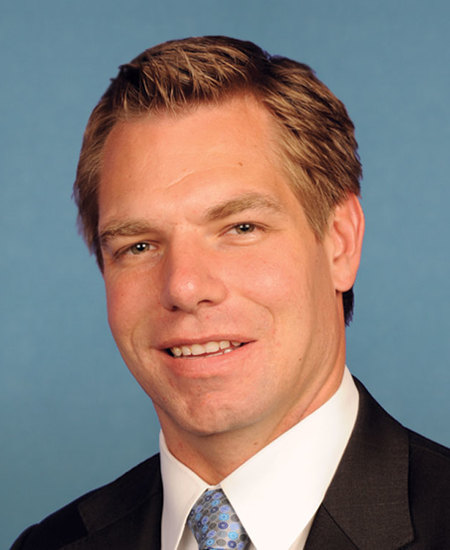
Rep. Eric Swalwell
Sponsored bills
Better Cybercrime Metrics Act This bill establishes various requirements to improve the collection of data related to cybercrime and cyber-enabled crime (cybercrime). Among the requirements the Department of Justice (DOJ) must enter into an agreement with the National Academy of Sciences to develop a taxonomy for categorizing different types of cybercrime faced by individuals and businesses; DOJ must establish a category in the National Incident-Based Reporting System for collecting cybercrime reports from federal, state, and local officials; DOJ's Bureau of Justice Statistics and the Bureau of the Census must include questions about cybercrime in the annual National Crime Victimization Survey; and the Government Accountability Office must assess the effectiveness of reporting mechanisms for cybercrime and disparities in reporting cybercrime data and other types of crime data.
Employee Retention Tax Credit Reinstatement Act This bill provides for a reinstatement of the employee retention tax credit through 2021. The credit was established to compensate employers whose businesses were negatively impacted by the COVID-19 pandemic for wages paid to their employees.
9/11 Memorial and Museum Act This bill directs the Department of Homeland Security (DHS) to award to the official organization that operates the National September 11 Memorial & Museum a one-time grant to be used solely for the purposes of the operation, security, and maintenance of the memorial and museum. As a condition on receipt of the grant, the organization must provide for free admission to all facilities and museums associated with the memorial and museum for active and retired members of the Armed Forces, individuals who were registered first responders to the terrorist attacks of September 11, 2001, and family members of victims of such attacks; provide for dedicated free admission hours for the general public at least once a week; and allow for annual federal audits of its financial statements.
This resolution expresses that the International Atomic Energy Agency (IAEA) plays an indispensable role in strengthening nuclear security and safety around the globe. The resolution also reaffirms that the United States has a vital interest in preventing the spread of nuclear weapons and securing nuclear materials.
Preventing Our Next Natural Disaster Act This bill modifies the pre-disaster mitigation grant program of the Federal Emergency Management Agency (FEMA). Specifically, the bill increases FEMA's set-aside for pre-disaster mitigation assistance from 6% to 15% of certain grant amounts; provides for a 2% set-aside for community planning and capacity building assistance; and authorizes FEMA to develop guidance regarding how to incorporate climate change into the National Risk Index, cost-benefit analyses, and improved codes, specifications, and standards to address natural hazards. FEMA must prioritize applicants for assistance with the highest hazard risk in coordination with FEMA's National Risk Index, environmental justice communities, and low-income communities (current law covers the latter though this bill modifies the number of individuals in such communities); provide community outreach; and establish a central federal database to consolidate funding data collected by all local, state, and federal agencies involved in post-disaster response and pre-disaster mitigation spending and categorize the data by type of project, funding source, and hazard types using a user-friendly database and interactive map.
Strength in Diversity Act of 2021 This bill establishes a program through which the Department of Education may award planning and implementation grants to specified educational agencies (e.g., local educational agencies) to improve diversity and reduce or eliminate racial or socioeconomic isolation in publicly funded early childhood education programs, public elementary schools, or public secondary schools.
Access to Birth Control Act This bill requires pharmacies to comply with certain rules related to ensuring access to contraceptives. Specifically, pharmacies must provide without delay a customer with any contraceptive or related medication that is in stock. If the contraceptive is not in stock, the pharmacy must immediately inform the customer and either order the contraceptive or refer the customer to a pharmacy that has it in stock. Laws in some states provide pharmacists with the right to refuse to dispense contraceptive-related drugs on religious or conscience grounds. Pharmacies may refuse to provide a contraceptive to a customer (1) if the customer lacks a valid prescription for a prescription contraceptive or is unable to pay for the contraceptive, or (2) based on a pharmacy employee's professional clinical judgment. The bill also establishes a private cause of action and civil monetary penalties for violations of the bill.
This resolution (1) censures Representative Paul Gosar for posting a certain video on his social media accounts that depicts violence against Representative Alexandria Ocasio-Cortez and President Joseph R. Biden , and (2) removes him from the Committee on Natural Resources and the Committee on Oversight and Reform.
Keep Innovation in America Act This bill modifies provisions enacted by the Infrastructure Investment and Jobs Act relating to the definitions of broker and digital assets and their reporting requirements. The bill redefines broker , for tax reporting purposes, to mean any person who (for consideration) stands ready in the ordinary course of business to effect sales of digital assets at the direction of their customers. The bill redefines digital asset to mean any digital representation of value which is recorded on a cryptographically secured distribution ledger (this revised definition eliminates the discretion of the Department of the Treasury to include similar technology in the definition of digital asset). The bill eliminates the cash reporting requirement for digital assets (i.e., receipt of more than $10,000) but requires Treasury to conduct a study of, and report on, the effect of expanding the definition of cash to include any digital asset.