

Protection from Abusive Passengers Act This bill addresses the banning of abusive passengers from commercial aircraft flights. Abusive passenger is defined as any individual who engages in behavior that results in a civil penalty or conviction for assaulting, threatening, or intimidating a crew member or passenger on an aircraft flight, or who takes any action to interfere with security screening personnel or any security system related to civil aviation security. It requires the Federal Aviation Administration or the Attorney General to provide the identity, including the full name and date of birth, and gender of all abusive passengers to the Transportation Security Administration (TSA). The TSA must maintain a list of abusive passengers and develop and make publicly available policies and procedures for handling individuals included on the list. Any individual on the list shall be prohibited from boarding any commercial aircraft flight until the individual is removed from such list. Additionally, all abusive passengers shall be permanently ineligible to participate in the TSA PreCheck or the U.S. Customs and Border Protection's Global Entry programs, with specified exceptions.
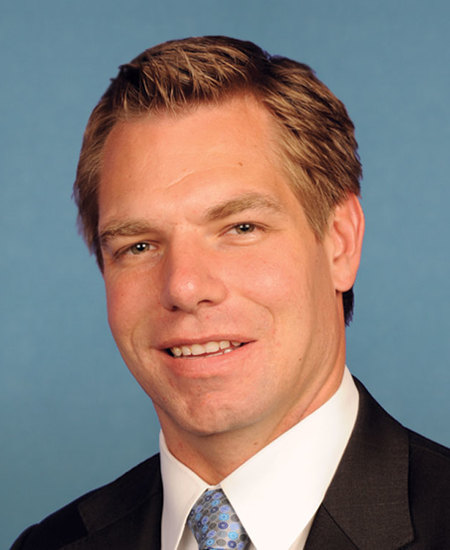
Rep. Eric Swalwell
Sponsored bills
Federal Contracting for Peace and Security Act This bill requires executive agencies to terminate their contracts with companies conducting business operations in Russia. This requirement ends when Russia takes steps to restore the safety, sovereignty, and condition of Ukraine. The bill shall not apply to the procurement of products or services for (1) the benefit, either directly or through the efforts of regional allies, of Ukraine; or (2) humanitarian purposes to meet basic human needs. The bill provides for a waiver where in the national interest of the United States.
Department of Homeland Security Inspector General Transparency Act This bill addresses reports conducted by the Office of Inspector General (OIG) of the Department of Homeland Security (DHS). Specifically, the bill requires the OIG to submit to Congress any report finalized on or after 30 days after the enactment of this bill that substantiates a violation of specified provisions regarding prohibited personnel practices, protected communications, or retaliatory personnel actions; a violation of Presidential Personnel Directive-19 (protecting whistleblowers with access to classified information); or an allegation of misconduct, waste, fraud, abuse, or a violation of policy within DHS involving a member of the Senior Executive Service or politically appointed official of DHS. The OIG must make each report publicly available on its website, with exceptions. The bill requires the OIG's semiannual reports to include specified information regarding ongoing audits, inspections, and evaluations; significant changes to the narrative description of each such audit, inspection, or evaluation; certain delays; and data with respect to tips and complaints made to the OIG Hotline or otherwise referred to DHS. The OIG must report within one year on the policies, procedures, and internal controls established that ensure compliance with the Quality Standards for Federal Offices of Inspector General from the Council of Inspectors General on Integrity and Efficiency. The Government Accountability Office must evaluate such report within one year after receipt of the report.
Ensuring Lasting Smiles Act This bill requires private health insurance plans to cover diagnosis and treatment of congenital anomalies and birth defects, such as reconstructive services and items. Coverage must include services and items that functionally improve, repair, or restore any body part that is medically necessary for normal bodily functions or appearance, as determined by the treating physician. Coverage limits and cost-sharing requirements for such services and items may not be more restrictive than those applicable to all medical and surgical benefits under the plan.
Supply Chain Disruptions Relief Act This bill modifies the treatment of liquidations of new motor vehicle inventory as qualified LIFO (last in first out accounting method) inventory. It allows new motor vehicle dealers to elect to wait until the end of 2025 to replace their inventory for purposes of determining income attributable to the sale of such inventory during 2020 and 2021.
Marijuana Opportunity Reinvestment and Expungement Act or the MORE Act This bill decriminalizes marijuana. Specifically, it removes marijuana from the list of scheduled substances under the Controlled Substances Act and eliminates criminal penalties for an individual who manufactures, distributes, or possesses marijuana. The bill also makes other changes, including the following: replaces statutory references to marijuana and marihuana with cannabis , requires the Bureau of Labor Statistics to regularly publish demographic data on cannabis business owners and employees, establishes a trust fund to support various programs and services for individuals and businesses in communities impacted by the war on drugs, imposes an excise tax on cannabis products produced in or imported into the United States and an occupational tax on cannabis production facilities and export warehouses, makes Small Business Administration loans and services available to entities that are cannabis-related legitimate businesses or service providers, prohibits the denial of federal public benefits to a person on the basis of certain cannabis-related conduct or convictions, prohibits the denial of benefits and protections under immigration laws on the basis of a cannabis-related event (e.g., conduct or a conviction), establishes a process to expunge convictions and conduct sentencing review hearings related to federal cannabis offenses, directs the Government Accountability Office to study the societal impact of state legalization of recreational cannabis, directs the National Highway Traffic Safety Administration to study methods for determining whether a driver is impaired by marijuana, directs the National Institute for Occupational Safety and Health to study the impact of state legalization of recreational cannabis on the workplace, and directs the Department of Education to study the impact of state legalization of recreational cannabis on schools and school-aged children.
This resolution recognizes the Islamic faith as one of the great religions of the world, acknowledges the onset of Ramadan (the holy month of fasting and spiritual renewal for Muslims), and expresses respect to Muslims in the United States and throughout the world on this occasion.
This bill excludes from the gross income of a taxpayer up to $10,200 in unemployment compensation issued to the taxpayer for calendar year 2020, but not received until 2021. This exclusion applies to taxable years beginning after December 31, 2020.
Strengthen Kids' Mental Health Now Act of 2022 This bill establishes several requirements to support the provision of behavioral health services under Medicaid and other programs, particularly for children. For example, the bill temporarily requires payment for pediatric mental, emotional, and behavioral health services under Medicaid to align with Medicare payments to providers. The bill provides for a 100% Federal Medical Assistance Percentage (i.e., federal matching rate) for any associated additional expenditures. The Centers for Medicare & Medicaid Services must issue guidance on how state Medicaid programs may expand the availability of telehealth services and mental, emotional, and behavioral health services. In addition, the Health Resources and Services Administration must award grants to support (1) pediatric behavioral health care integration in communities, (2) pediatric mental health and substance use disorder workforce training, and (3) the infrastructure of pediatric hospitals and rural health clinics with respect to behavioral health services.
Emmett Till Antilynching Act This bill makes lynching a federal hate crime offense. Specifically, the bill imposes criminal penalties—a fine, a prison term of up to 30 years, or both—on an individual who conspires to commit a hate crime offense that results in death or serious bodily injury or that includes kidnapping or an attempt to kidnap, aggravated sexual abuse or an attempt to commit aggravated sexual abuse, or an attempt to kill.