

This bill expresses the sense of Congress that (1) medication abortion is appropriately approved and regulated under federal law, and (2) federal law preempts any in-person dispensing requirements or telehealth restrictions with respect to medication abortion under state law.
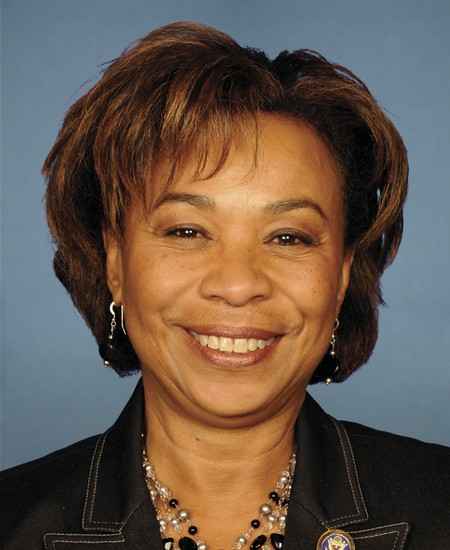
Rep. Barbara Lee
Sponsored bills
This resolution urges (1) the President to issue a proclamation recognizing Earth Day; and (2) governments and people to continue building upon the Paris Agreement and other efforts to ensure that future generations inherit a livable, sustainable, and ecologically rich planet.
Maddy summaryThis bill directs the U.S. government to support global nuclear disarmament by urging the U.S. to sign and ratify the Treaty on the Prohibition of Nuclear Weapons, contingent on ratification leading to verified worldwide elimination of nuclear weapons under international control. If the President certifies that all nuclear-armed nations have begun verified, irreversible elimination under the treaty, the U.S. must redirect funds currently used for nuclear weapons programs to: (1) develop clean energy and retrain nuclear industry workers; (2) address social needs like healthcare, housing, and environmental restoration (including radioactive waste monitoring); and (3) encourage other nations to join the treaty. It directly affects U.S. federal funding streams, nuclear weapons industry workers, and federal agencies managing defense resources. The bill focuses on policy shifts in resource allocation rather than creating new programs or mandating specific disarmament timelines.
Maddy summaryThe Dignity for Detained Immigrants Act establishes new standards for Department of Homeland Security detention facilities, requiring them to meet or exceed the American Bar Association's Civil Immigration Detention Standards. The bill mandates annual, unannounced inspections by the DHS Inspector General, public reporting on facility compliance, and a phased-out timeline for private detention facilities (phasing out by 3 years after enactment). It prohibits solitary confinement for all detainees, requires community-based alternatives to detention for vulnerable individuals, and mandates detailed public reporting on facility conditions, staffing, and detainee demographics. The legislation directly affects all immigrants held in DHS custody, including children, vulnerable persons, and primary caregivers, with specific protections for these groups in detention procedures.
Maddy summaryThe SAD Act prohibits crisis pregnancy centers (CPCs) from making deceptive claims about offering abortion services, contraception, or employing licensed medical personnel. It directly affects CPCs nationwide - over 2,500 of which operate under false pretenses, often outnumbering abortion clinics by 3:1 in many states. The Federal Trade Commission (FTC) would enforce this by imposing civil penalties up to $100,000 or 50% of a CPC’s annual revenue for violations. The law requires CPCs to provide accurate information about reproductive health services, aiming to prevent misleading patients from accessing abortion care.
Maddy summaryHRES 269 is a non-binding resolution passed by the U.S. House of Representatives on March 30, 2023. It recognizes the federal government's duty to develop and implement a Transgender Bill of Rights to protect transgender and nonbinary people. The resolution outlines key provisions, including ensuring access to gender-affirming medical care, ending discrimination in employment and housing, and improving legal recognition of gender identity on government documents. It also calls for addressing systemic barriers in education, safety, and economic security faced by transgender and nonbinary individuals.
Maddy summaryHR 2703, the Green Energy for Federal Buildings Act, requires the U.S. federal government to increase its use of renewable energy in buildings over time. It amends existing law to set specific renewable energy purchase targets: 7.5% for 2013-2019, rising to 35% (2030-2039), 75% (2040-2049), and 100% starting in 2050. The bill directs federal agencies to prioritize on-site, on Federal lands, or on tribal lands renewable energy where economically and technically feasible. This directly affects all federal agencies operating buildings by mandating progressively higher renewable energy consumption in their operations. The policy change focuses on concrete, phased targets for federal energy use without specifying outcomes or advocating for particular energy sources.
Maddy summaryHR 2715, the Keep Our PACT Act, mandates increased federal funding for two key education programs. It requires specific annual funding levels for Title I of the Elementary and Secondary Education Act (which supports high-poverty schools) and the Individuals with Disabilities Education Act (IDEA), guaranteeing students with disabilities access to a high-quality education. The bill sets mandatory funding amounts that rise each year, with IDEA funding gradually increasing to reach 40% of the national average per-pupil expenditure for students with disabilities by fiscal year 2033. This directly affects school districts receiving Title I funds and states administering IDEA services for students with disabilities. The bill fulfills a prior commitment made under the Individuals with Disabilities Education Improvement Act of 2004.
Maddy summaryHR 2725, the "Do No Harm Act," amends the Religious Freedom Restoration Act (RFRA) to clarify that RFRA does not apply when federal laws protect against discrimination or promote equal opportunity. It specifically exempts protections under the Civil Rights Act, Americans with Disabilities Act, workplace benefits like leave, child labor safeguards, and healthcare access from RFRA challenges. The bill also clarifies that RFRA does not block private lawsuits between individuals, applying only to cases involving government entities. This amendment ensures that existing federal civil rights and workplace protections remain enforceable under RFRA.
Maddy summaryThe Latonya Reeves Freedom Act of 2023 strengthens the Americans with Disabilities Act's requirement that individuals with disabilities receive long-term services and supports in community settings rather than institutions. It defines "community-based" services to include specific housing options where individuals with disabilities can live independently with maximum control over their lives, including access to integrated housing, employment, and community participation. The bill requires states to develop transition plans to move people from institutional settings to community-based services within 12 years, with measurable annual targets for reducing institutionalization. It establishes enforcement mechanisms through the Department of Justice and Department of Health and Human Services to ensure compliance with these requirements.