

George Floyd Justice in Policing Act of 2021 This bill addresses a wide range of policies and issues regarding policing practices and law enforcement accountability. It increases accountability for law enforcement misconduct, restricts the use of certain policing practices, enhances transparency and data collection, and establishes best practices and training requirements. The bill enhances existing enforcement mechanisms to remedy violations by law enforcement. Among other things, it does the following: lowers the criminal intent standard—from willful to knowing or reckless—to convict a law enforcement officer for misconduct in a federal prosecution, limits qualified immunity as a defense to liability in a private civil action against a law enforcement officer, and grants administrative subpoena power to the Department of Justice (DOJ) in pattern-or-practice investigations. It establishes a framework to prevent and remedy racial profiling by law enforcement at the federal, state, and local levels. It also limits the unnecessary use of force and restricts the use of no-knock warrants, chokeholds, and carotid holds. The bill creates a national registry—the National Police Misconduct Registry—to compile data on complaints and records of police misconduct. It also establishes new reporting requirements, including on the use of force, officer misconduct, and routine policing practices (e.g., stops and searches). Finally, it directs DOJ to create uniform accreditation standards for law enforcement agencies and requires law enforcement officers to complete training on racial profiling, implicit bias, and the duty to intervene when another officer uses excessive force.
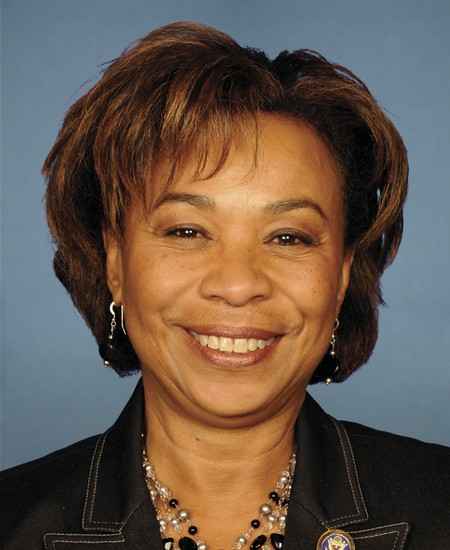
Rep. Barbara Lee
Sponsored bills
War Powers Amendments of 2021 This joint resolution revises the War Powers Resolution, a law that limits the President's power to introduce Armed Forces into hostilities. Changes include shortening the time that Armed Forces may be involved in hostilities without congressional action and providing for judicial enforcement. The President shall remove any Armed Forces introduced into hostilities without congressional approval within 30 days unless Congress (1) declares war, (2) enacts a joint resolution specifically authorizing such use of the Armed Forces, or (3) is unable to meet because of an attack on the United States. This 30-day period may be extended by up to 15 days under specified circumstances. Current law allows such use of the Armed Forces for 60 days from when the President first reports to Congress about the engagement and allows for a 60-day extension. If Congress takes no such actions, funds may not be used to continue Armed Forces involvement in the hostilities, except to withdraw. The bill removes a provision requiring the removal of such engaged Armed Forces if Congress passes a concurrent resolution requiring such removal. A member of Congress may sue in district court for an order directing the President to comply with this bill. A judgment in such an action shall be directly appealable to the Supreme Court. The bill also revises various provisions relating to (1) the President reporting to and consulting with Congress regarding the use of the Armed Forces without congressional authorization, and (2) procedures for the expedited handling of joint resolutions related to such use of force.
This resolution supports the goals of a feminist foreign policy (i.e., a foreign policy that requires analysis of and challenges to power structures and inequalities that are based on systems of discrimination), and it supports the adoption of policies that promote gender equity and women's participation in public life.
Public Service Loan Forgiveness Inclusion Act of 2021 This bill allows the first 60 monthly payments made by a borrower under a graduated repayment or extended repayment plan to become qualifying payments under the Public Service Loan Forgiveness (PSLF) program. However, the borrower must transfer to an eligible repayment plan, such as an income-based or standard repayment plan, for the remaining 60 monthly payments made under the PSLF program.
Capitol Remembrance Act This bill requires the Architect of the Capitol (AOC) to design and install in a prominent location in the U.S. Capitol a permanent exhibit that depicts the January 6, 2021, attack on the Capitol. To the extent possible, the AOC must preserve property that was damaged during the attack and include it in the exhibit. The AOC must also include (1) existing photographic records relating to the attack; and (2) a plaque to honor the U.S. Capitol Police and other law enforcement agencies that protected the Capitol, the individuals who died or sustained injuries to protect the Capitol, and the staff who helped restore the Capitol complex after the attack.
Give Our Athletes Level Salaries Act or the GOALS Act This bill prohibits the use of funds for the 2026 World Cup until the U.S. Soccer Federation agrees to provide equitable pay to the members of the U.S. Women's National Team and the U.S. Men's National Team.
National Women's Hall of Fame Commemorative Coin Act of 2021 This bill directs the Department of the Treasury to mint and issue $5 gold coins, $1 silver coins, half-dollar clad coins, and proof silver $1 coins in recognition and celebration of the National Women's Hall of Fame in Seneca Falls, New York. All minted coins shall include a specified surcharge, which shall be paid to the National Women's Hall of Fame Foundation to establish an endowment fund to provide for the long-term financing of the hall's operations.
Postal Vehicle Modernization Act This bill establishes requirements for U.S. Postal Service (USPS) vehicle purchases and charging stations. The bill's provisions only apply if specified funding is appropriated. Specifically, the bill requires the USPS to ensure that at least 75% of the total number of next generation delivery vehicles purchased using such funds are electric or zero-emission vehicles. The bill provides for a phase-out of medium- and heavy-duty vehicles that are not electric or zero-emission vehicles. The USPS must provide by January 1, 2026, at each postal facility accessible to the public, at least one electric vehicle charging station for use by the public or USPS officers and employees.
New Way Forward Act This bill makes changes to immigration enforcement, including ending mandatory detention in certain cases. The Department of Homeland Security (DHS) shall not enter into or extend any contract with any public or private for-profit entity to own or operate a facility to detain aliens in DHS custody. The bill provides for various protections related to detaining aliens, such as (1) requiring DHS to make an initial custody determination and establish probable cause within 48 hours of taking an alien into custody, (2) establishing in hearings related to such determinations a presumption that the alien be released, and (3) requiring immigration judges to impose the least restrictive detention conditions necessary. A DHS officer may not interrogate a person as to immigration status based on factors such as the person's race, religion, sexual orientation, or spoken language. The bill removes mandatory detention requirements for certain aliens, such as asylum seekers with a credible fear of persecution. Removal proceedings against certain aliens previously admitted into the United States must commence within five years of the alien becoming deportable or inadmissible. The bill also removes certain crime-related grounds of inadmissibility and deportability. The bill gives immigration judges discretion to provide relief from removal if the removal is not based on certain crime-related grounds. State or local officers are prohibited from performing certain immigration enforcement functions, such as apprehending aliens. The National Crime Information Center database shall not contain an alien's immigration information. The bill repeals provisions providing criminal penalties for improper entry or reentry into the United States.
This joint resolution proposes a constitutional amendment authorizing Congress and the states to set reasonable limits on the raising and spending of money by candidates and others to influence elections. The amendment grants Congress and the states the power to implement and enforce this amendment by legislation. They are allowed to distinguish between natural persons and corporations or other artificial entities created by law, including by prohibiting such entities from spending money to influence elections.