

Maddy summaryHR 9578, the Ranked Choice Voting Act, would require all states to use ranked choice voting for elections of U.S. Senators and Representatives (including primaries and general elections) starting with the 2027 elections. The bill specifies that voters would rank candidates in order of preference, with ballots tabulated by eliminating the lowest-ranked candidate in each round until a winner emerges with a majority. States would receive federal funds based on registered voters to implement the system, and the bill prohibits separate runoff elections for these federal offices. This legislation would fundamentally change how federal congressional elections are conducted across all states, while not affecting state or local elections.
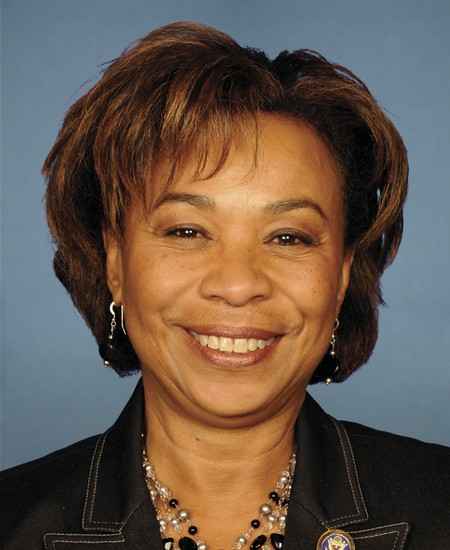
Rep. Barbara Lee
Sponsored bills
Maddy summaryThis bill creates a federal grant program to fund supportive services for residents in affordable housing properties. It provides 5-year competitive grants to non-profit organizations or tribes managing properties assisted by programs like the low-income housing tax credit or Section 8 housing. Grantees must use at least 25% of funds for staff salaries/benefits and can cover services including health access, education, financial literacy, aging-in-place support, and disability services - though residents cannot be required to accept these services. The program targets residents of qualifying affordable housing properties, focusing on improving health, economic stability, and community integration.
Maddy summaryHRES 1437 is a ceremonial resolution designating the week beginning September 9, 2024, as "National Hispanic-Serving Institutions Week." It recognizes Hispanic-serving institutions (HSIs) - colleges and universities with at least 25% Hispanic enrollment - and their role in educating low-income students, advancing economic mobility, and serving 31.7% of all undergraduate students. The resolution calls for the public and organizations to observe this week with ceremonies and activities during Hispanic Heritage Month. It does not create new laws, allocate funding, or change existing policies - it is purely a symbolic gesture of recognition.
Maddy summaryThis bill designates the U.S. Postal Service facility at 130 South Patterson Avenue in Santa Barbara, California, as the "Brigadier General Frederick R. Lopez Post Office Building." It updates all official U.S. government references to the building to reflect this new name, with no policy changes or funding impacts.
Maddy summaryThis bill caps the interest rate at 6% on student loans that active-duty servicemembers (or their spouses jointly) consolidate or refinance *during* military service, but only if those loans were originally taken out *before* they joined the military. It directly affects servicemembers who use consolidation or refinancing to manage pre-service student debt while serving. The key provision limits interest rates on these specific consolidated/refinanced loans to 6% for the duration of military service, excluding other types of debt. The bill defines "student loan" to include both federal loans under the Higher Education Act and qualifying private loans.
Maddy summaryThe CREATE AI Act of 2023 establishes a National Artificial Intelligence Research Resource (NAIRR) to improve access to AI research tools, computational resources, data, and educational materials for researchers and students across the United States. The NAIRR will provide computational resources, curated datasets, educational tools, and access to AI testbeds, with special emphasis on supporting groups historically underrepresented in STEM fields. Governed by a Steering Subcommittee chaired by the Director of the Office of Science and Technology Policy and managed by a Program Management Office within the National Science Foundation, the NAIRR includes specific requirements for ethical AI development, privacy protections, and security measures. The resource will be accessible to researchers at U.S. institutions of higher education, nonprofits, government agencies, and certain businesses, with priority given to projects addressing privacy, ethics, civil rights, and AI safety.
Maddy summaryHRES 1432 designates September 10, 2024, as "National Firearm Suicide Prevention Day" to raise public awareness about firearm suicides and promote safe storage practices. The resolution encourages healthcare professionals to discuss safe firearm storage with patients and supports the day's goals of reducing firearm suicides through education. It directly affects the general public and healthcare providers by highlighting evidence that safe storage lowers suicide risk, referencing statistics like 54.6% of U.S. suicides in 2022 involving firearms. The bill is symbolic, with no new legal requirements, and aligns with existing awareness efforts like Firearm Suicide Prevention Day.
Maddy summaryHRES 1422 is a resolution recognizing the 60th anniversary of the Wilderness Act (enacted in 1964), which established the National Wilderness Preservation System. The resolution commends advocates for the Act, acknowledges wilderness areas' role in protecting over 112 million acres of public lands, and highlights their benefits for recreation, clean water, wildlife habitat, and climate resilience. It specifically emphasizes the importance of including Tribal governments in wilderness designation and management. As a commemorative resolution, it does not create new laws or directly affect any group.
Maddy summaryHR 8096, the Future of Water Act of 2024, amends the Commodity Exchange Act and related law to prohibit the trading of water, water rights, or water-related financial products (like indices or data) as commodities for future delivery. This change directly affects commodity markets, futures traders, and entities seeking to create financial instruments based on water resources. The bill adds specific language to existing statutes to explicitly exclude water and water rights from being traded as future commodities, preventing their inclusion in futures contracts or related financial products. It does not alter water management, rights, or usage rules, only restricting their financial speculation in commodity markets.
Maddy summaryThis bill would allow states to skip in-person interviews for SNAP (food stamp) benefit renewals if applicants agree to waive the interview and have already proven they qualify for continued benefits. It also requires states to offer phone or virtual interview options when interviews are still needed for renewal. The change directly affects SNAP recipients who may face fewer in-person requirements and state agencies administering the program. The policy aims to reduce paperwork burdens without altering eligibility rules for food assistance.