Sarah Keys Evans Congressional Gold Medal Act This bill provides for the award of a Congressional Gold Medal to Sarah Keys Evans in recognition of her achievements relating to the desegregation of passengers on interstate buses in the 1950s.
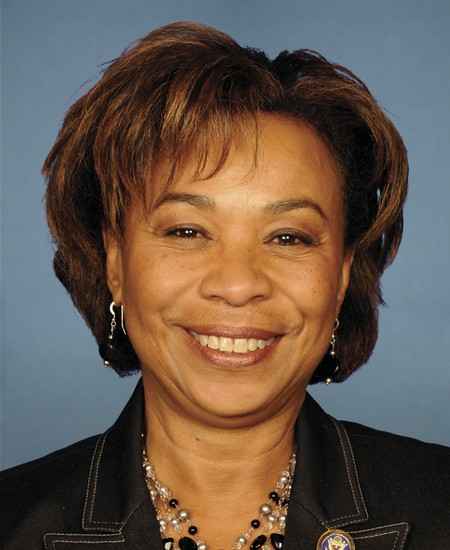
Rep. Barbara Lee
Sponsored bills
Greyhound Protection Act of 2021 This bill modifies the federal criminal statute commonly known as the Wire Act. Currently, the Wire Act contains four prohibitions on the use of a wire transmission facility (e.g., the telephone or internet) for certain gambling activities. All four prohibitions apply to sports gambling. However, there have been conflicting interpretations of the applicability of the prohibitions to nonsports gambling (e.g., state lotteries). This bill amends the Wire Act to expressly state that the statute does not authorize the use of wire communications to gamble on commercial greyhound racing or permit the transport of animals for commercial dog racing or related activities.
Filipino Veterans Family Reunification Act of 2021 This bill exempts from worldwide or numerical limitations certain family-sponsored immigrant visas for the sons and daughters of Filipino World War II veterans who were naturalized under certain laws providing for naturalization for service during World War II.
United States Postal Service Shipping Equity Act This bill authorizes the mailing of alcoholic beverages by certain entities in accordance with the delivery requirements otherwise applicable to a privately carried shipment. The authorization applies to an entity (including a winery, brewery, beverage distilled spirits plant, or other wholesaler, distributer, importer, or retailer of alcoholic beverages) that has registered with, obtained a permit from, or obtained approval of an application from the Department of the Treasury. The bill directs the U.S. Postal Service (USPS) to prescribe regulations (1) requiring direct delivery to a duly authorized agent at a postal facility or to the addressee, who must be at least 21 years of age and present a valid, government-issued photo identification at the time of delivery; (2) prohibiting such alcoholic beverages from being for resale or any other commercial purpose; and (3) requiring such entity to certify that the mailing is not in violation of applicable laws or regulations and to provide other information as directed by the USPS. The U.S. district courts shall have jurisdiction to render judgment upon any claim brought by a state, local, or tribal government against the USPS of a violation of state, local, or tribal law regarding the sale, mailing, transportation, or importation of alcoholic beverages into any U.S. state, territory, or district. The USPS shall not be liable for interest prior to judgment or for punitive damages.

Untraceable Firearms Act of 2021 This bill establishes a federal statutory framework to regulate the manufacture, sale, offer to sell, transfer, purchase, and receipt of ghost guns (i.e., guns without serial numbers). Additionally, the bill revises the federal statutory framework regulating the manufacture, possession, sale, import, shipment, delivery, receipt, and transfer of undetectable firearms. Among the revisions, the bill defines undetectable firearm as a firearm without a major component wholly made of detectable material.
Raise the Age Act This bill establishes new restrictions on the sale or transfer of certain semiautomatic firearms to individuals under 21 years of age. Specifically, this bill makes it unlawful for a licensed gun dealer, importer, manufacturer, or collector to sell or deliver a semiautomatic center-fire rifle that has (or has the capacity to accept) an ammunition feeding device with a capacity of more than five rounds to an individual who the licensee knows or has reasonable cause to believe is under age 21. The prohibition does not apply if the individual under age 21 is a full-time law enforcement officer or active-duty member of the Armed Forces. The bill also requires the Federal Bureau of Investigation to report on the operation of its public access line, including a description of information sharing protocols and recommendations for improving such protocols.
Freedom for Families Act This bill prohibits using federal funds for facilities used to detain noncitizen families and addresses related issues. Specifically, no funds made available may be used to operate or construct a family detention center, whether operated by U.S. Immigration and Customs Enforcement or a contractor. This prohibition shall also apply to funds made available before this bill's enactment. Funds obligated to operate such centers must instead be used for implementing and developing nondetention programs that are community-based and consistent with international best practices. The Department of Homeland Security (DHS) may place an apprehended noncitizen family into such a nondetention program if DHS makes an individualized determination that doing so will facilitate the family's compliance with immigration laws. The programs must provide to participants a legal orientation and meaningful access to counsel.
21st Century STEM for Girls and Underrepresented Minorities Act This bill directs the Department of Education to make grants to local educational agencies to pay the costs of carrying out STEM (science, technology, engineering, and mathematics) education activities for girls and underrepresented minorities.
This resolution expresses the sense of the House of Representatives that it is the duty of the Department of Defense (DOD) to reduce the overall environmental impact of military activities and missions and to monitor and report greenhouse gas emissions from all of its operations. The resolution also suggests that DOD take other environmentally conscious actions, including committing to annual greenhouse gas emission reporting mechanisms and repurposing and managing its properties to promote carbon sequestration and biodiversity.
Ending the Monopoly of Power Over Workplace Harassment through Education and Reporting Act or the EMPOWER Act This bill makes it an unlawful labor practice for an employer to enter into, or attempt to enforce, a contract with an employee or job applicant that contains a nondisparagement or nondisclosure clause that covers workplace or sexual harassment, including retaliation for participating in a workplace harassment proceeding. The bill exempts certain settlement or separation agreements from such prohibition. The bill also requires the Securities and Exchange Commission to promulgate a regulation that requires any issuer of securities to submit a report for the most recent five-year period with respect to workplace and sexual harassment. The commission must provide for the development and dissemination of training programs and information regarding workplace and sexual harassment. The bill denies a tax deduction for amounts related to judgments and expenses in connection with litigation related to workplace or sexual harassment. It also excludes from gross income, for income tax purposes, any amount received in connection with a claim or settlement related to workplace or sexual harassment, or other unlawful discrimination.