

Maddy summaryThis bill raises the federal minimum wage to $15 per hour initially, with future increases tied to a "stability wage" calculated using average hourly earnings and cost-of-living adjustments (CPI). It modifies income tax brackets so that tax rates apply to income levels adjusted based on this stability wage calculation. The bill eliminates special minimum wage certificates for workers with disabilities and changes how earned income is counted for means-tested benefits. These changes would affect most workers, taxpayers across income levels, and individuals receiving government benefits based on income. The bill's provisions would take effect three months after enactment.
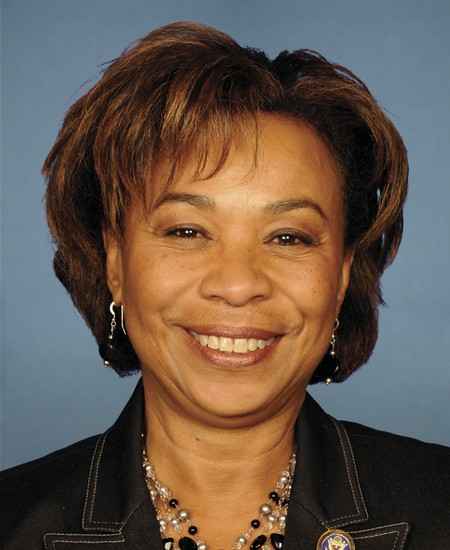
Rep. Barbara Lee
Sponsored bills
Maddy summaryHR 9878, the No Shame at School Act of 2024, requires schools to automatically certify students from households with unpaid meal fees for free or reduced-price meals (instead of allowing discretion), and mandates retroactive reimbursement for past unpaid meals. It directly affects school districts and students in households owing meal fees by prohibiting stigmatizing practices like special tokens, public lists of names, or withholding grades due to unpaid fees. Key provisions ban schools from physically segregating students, using debt collectors, or taking food away from students who owe fees, while requiring clear communication to households about meal applications. The bill defines "covered child" as any student enrolled in a participating school meal program whose household owes fees or is eligible for free/reduced meals.
Maddy summaryHR 9872, the Sickle Cell Disease Treatment Centers Act of 2024, establishes a federal grant program to create coordinated care networks for sickle cell disease patients. It funds "hub-and-spoke" systems where medical hubs (like hospitals or universities) partner with local spokes (clinics, health centers) and community organizations to provide comprehensive, lifelong care - including pain management, genetic counseling, mental health services, and pediatric-to-adult transition support. The program specifically prioritizes underserved communities, historically Black colleges, rural areas, and regions with high sickle cell disease prevalence, while requiring data collection on patient outcomes and health disparities. Grants allocate 70% to hub-spoke networks, 20% to community organizations, and 5% each to the National Sickle Cell Coordinating Center and CDC data collection efforts.
Maddy summaryHR 9862, the Combating the Housing Supply Shortage Act of 2024, allows states to redirect unused private activity bond capacity toward new multifamily rental housing projects. It creates a "supplemental residential rental limitation" based on each state's previous year's housing bond issuance relative to national totals, enabling states to allocate unused bond volume for new rental construction. This mechanism specifically affects states and local housing authorities that issue private activity bonds for multifamily housing projects. The bill does not create new funding but reallocates existing unused bond capacity to increase housing supply, with provisions requiring states to report bond usage and housing need percentages. The changes apply to bonds issued after the bill's enactment.
Maddy summaryThe Child Safety and Well-Being Act of 2024 (HR 9875) establishes a Children's Commission to represent children's interests in federal policymaking. The Commission, composed of 15 diverse members including experts, youth with lived experience, and representatives from various backgrounds, will advise Congress and federal agencies on policies affecting children, particularly marginalized youth defined as those experiencing systemic barriers. The Commission will review agency actions, receive complaints about how children are treated, and publish annual reports with recommendations to improve child well-being policies. It is authorized $5 million annually for operations and must study the feasibility of requiring agencies to create "child impact statements" assessing how policies affect children.
Maddy summaryHRES 1513 is a symbolic House resolution affirming that the term "woke" originates from Black history and liberation movements, not modern political discourse. It highlights historical roots, including Marcus Garvey’s "Wake up Ethiopia!" and 1940s labor activism, while condemning media and right-wing groups for misusing and distorting the term (e.g., the Stop W.O.K.E. Act). The resolution encourages accurate historical use of "woke" and opposes efforts to erase its connection to social justice. It does not create new laws but directly addresses Black educators and movements targeted by legislation seeking to limit inclusive history teaching.
Maddy summaryHRES 1507 designates the week of September 23-29, 2024, as "National Diaper Need Awareness Week" to highlight the importance of diapers for infant health and the financial strain on families. The resolution notes that diaper need affects nearly 1 in 2 families with young children and that diaper costs can consume 14% of a low-wage family’s post-tax income. It encourages public support for diaper banks through donations and participation in diaper drives to help families meet this basic need.
Maddy summaryThis resolution formally censures Representative Glen Clay Higgins (LA-03) for a September 25, 2024, social media post containing racist remarks and false claims about Haitians. The bill requires Higgins to appear in the House chamber to receive the censure, with the resolution publicly read by the Speaker. It specifically references his post describing Haiti as "the nastiest country," falsely accusing Haitians of eating pets, and labeling them "slapstick gangsters and thugs." The censure is a formal disciplinary action by the House, not a policy change.
Maddy summaryThe Industrial Agriculture Conversion Act of 2024 creates federal grants to help medium and large livestock operations convert to climate-smart farming. It targets producers operating defined "medium" (e.g., 200-699 dairy cows) or "large" (e.g., 10,000 swine) concentrated animal feeding operations (CAFOs), funding up to 90% of costs for projects like adding pasture access, switching to specialty crops, or installing irrigation. The bill explicitly excludes manure lagoons and methane digesters from funding and prohibits packers from refusing to buy livestock from farms using these grants. Socially disadvantaged farmers may qualify for reduced cost-sharing requirements when working with community or minority-serving organizations.
Maddy summaryThis bill eliminates a tax credit for using carbon dioxide (CO2) in enhanced oil recovery (EOR) operations. It amends the Internal Revenue Code by removing Section 43 (the EOR credit) and modifying Section 45Q to prohibit the credit for new facilities starting construction after the law's enactment. The primary effect is ending the federal tax incentive for oil companies that inject CO2 to extract more oil from existing wells. This change directly affects oil and gas companies planning new EOR projects using CO2, as they will no longer qualify for this specific tax credit.