

Department of State, Foreign Operations, and Related Programs Appropriations Act, 2023 This bill provides FY2023 appropriations for the Department of State, foreign operations, and related programs. The bill provides appropriations to the State Department for Administration of Foreign Affairs, International Organizations, and International Commissions. The bill provides appropriations for related agencies and programs, including the U.S. Agency for Global Media, the Asia Foundation, the U.S. Institute of Peace, the Center for Middle Eastern-Western Dialogue Trust Fund, the Eisenhower Exchange Fellowship Program, the Israeli Arab Scholarship Program, the East-West Center, and the National Endowment for Democracy. The bill provides appropriations for other commissions, including the Commission for the Preservation of America's Heritage Abroad, the U.S. Commission on International Religious Freedom, the Commission on Security and Cooperation in Europe, the Congressional-Executive Commission on the People's Republic of China, and the U.S.-China Economic and Security Review Commission. The bill provides appropriations to the U.S. Agency for International Development (USAID), the State Department and the President for International Security Assistance, and the President and International Financial Institutions for Multilateral Assistance. The bill provides appropriations for bilateral economic assistance, including programs and activities conducted by the President; the State Department; Independent Agencies, including the Peace Corps, the Millennium Challenge Corporation, the Inter-American Foundation, and the U.S. African Development Foundation; and the Department of the Treasury. The bill provides appropriations for export and investment assistance to the Export-Import Bank of the United States, the U.S. International Development Finance Corporation, and the U.S. Trade and Development Agency. The bill sets forth requirements and restrictions for using funds provided by this and other appropriations acts.
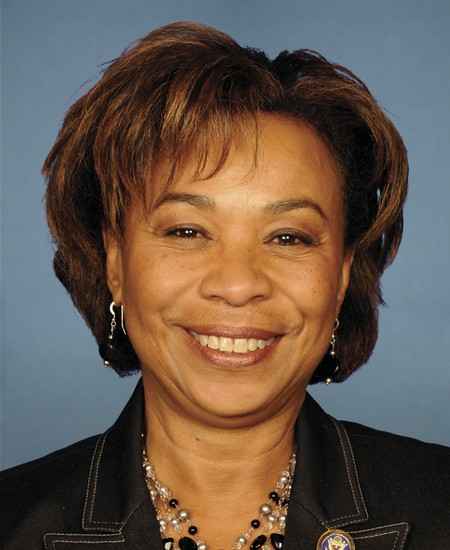
Rep. Barbara Lee
Sponsored bills
Break Free From Plastic Pollution Act of 2021 This bill sets forth requirements and incentives to reduce the production of a variety of products and materials, including plastics, and increase efforts to collect, recycle, or compost products and materials. The bill makes certain producers of products (e.g., packaging, paper, single-use products, beverage containers, or food service products) fiscally responsible for collecting, managing, and recycling or composting the products after consumer use. In addition, the bill establishes (1) minimum percentages of products that must be reused, recycled, or composted; and (2) an increasing percentage of recycled content that must be contained in beverage containers. Beginning on January 1, 2023, the bill phases out a variety of single-use products, such as plastic utensils. The bill also sets forth provisions to encourage the reduction of single-use products, including by establishing programs to refund consumers for returning beverage containers and by establishing a tax on carryout bags. The bill creates a temporary moratorium on new or expanded permits for certain facilities that manufacture plastics until regulations are updated to address pollution from the facilities. The Environmental Protection Agency (EPA) must publish guidelines for a national standardized labeling system for recycling and composting receptacles. Producers must include labels on their products that are easy to read and indicate whether the products are recyclable, compostable, or reusable. The EPA must also ensure that certain clothes washers have filtration units as required by this bill. Finally, the bill establishes limitations on the export of plastic waste to other countries.
Health Equity and Accountability Act of 2022 This bill directs the Department of Health and Human Services (HHS) and others to undertake efforts to reduce health disparities. For example, the bill (1) requires more detailed reporting of demographic and health disparities data, including related to public health emergencies; (2) directs certain components of HHS to support health workforce diversity; and (3) increases access to culturally and linguistically appropriate health care. The bill also modifies eligibility and other requirements for Medicare, Medicaid, private health insurance, nutrition assistance, and other programs to reduce health disparities among vulnerable populations. The bill includes specific provisions with respect to noncitizens; maternal, infant, and child health; mental and behavioral health; specified conditions that disproportionately affect racial and ethnic minority groups, such as certain cancers, HIV/AIDS, kidney disease, and diabetes; investments in communities facing health and other inequities; and nondiscrimination in the provision of services in federally supported health programs. Additionally, the bill (1) revises health information technology programs to address health disparities, and (2) supports health impact assessments and other efforts pertaining to environmental justice and social determinants of health (i.e., nonmedical factors that influence health outcomes, such as income and educational attainment). The bill also requires various studies and reports on issues related to health care and health disparities, including a report by the Government Accountability Office on health workforce diversity.
This resolution calls on the Russian government to immediately release Brittney Griner. The resolution urges the United States, in all interactions with the Russian government, to raise the case of Brittney Griner and to press for her release. The resolution further urges the Russian government to provide consular access to Brittney Griner while she remains in detention and to respect her human rights. Finally, the resolution expresses support to the family of Brittney Griner and a commitment to bringing her home.
This bill designates the facility of the United States Postal Service located at 502 East Cotati Avenue in Cotati, California, as the Arturo L. Ibleto Post Office Building.
Maddy summaryHRES 1203 is a ceremonial resolution congratulating the Golden State Warriors for winning the 2022 NBA Finals. It does not create any policy changes or affect any individuals or organizations through legislative action. The resolution simply expresses the House's recognition of the team's championship victory, their historic achievements, and contributions to the sport. As a symbolic gesture, it has no binding effect or practical impact beyond acknowledgment.
Veterans Equal Access Act This bill directs the Department of Veterans Affairs (VA) to authorize VA health care providers to (1) provide veterans with recommendations and opinions regarding participation in their state's marijuana programs, and (2) complete forms reflecting such recommendations and opinions.
Stop Anti-Abortion Disinformation Act or the SAD Act This bill prohibits advertisements that use deceptive or misleading statements related to the provision of abortion services. Abortion services include (1) surgical and non-surgical procedures to terminate a pregnancy, or (2) providing referrals for such procedures. The Federal Trade Commission must promulgate rules to implement the prohibition, and the bill provides for enforcement by the commission.
My Body, My Data Act of 2022 This bill establishes protections, subject to certain limits, for personal reproductive or sexual health information. This includes information relating to past, present, or future surgeries or procedures, such as the termination of a pregnancy. Specifically, commercial entities, including individuals, nonprofits, and common carriers, may not collect, retain, use, or disclose personal reproductive or sexual health information except (1) with the express written consent of the individual to whom such information relates, or (2) as is strictly necessary to provide a requested product or service. Commercial entities also must provide individuals with access to, and a reasonable mechanism to delete, any of their reproductive or sexual health information upon request. Further, commercial entities must maintain and publish a privacy policy describing their practices with respect to such information. The bill's provisions do not apply to entities that are subject to certain existing health-related privacy regulations, such as the privacy regulations issued under the Health Insurance Portability and Accountability Act of 1996. Additionally, the provisions do not apply to the disclosure of personal reproductive or sexual health information for the publication of newsworthy information of legitimate public concern. The bill provides for enforcement by the Federal Trade Commission and by private civil actions.
Save America’s Forgotten Equines Act of 2021 or the SAFE Act of 2021 This bill prohibits the transporting, receiving, possessing, purchasing, selling, or donation by a person of an equine (e.g., horse) that the person has reason to believe will be slaughtered for human consumption.