Maddy summaryThis resolution (HRES 462) is a symbolic House of Representatives measure commemorating the 1989 Tiananmen Square events as described in the resolution and condemning China's government for "continued and intensifying crackdown on human rights" in mainland China and Hong Kong. It specifically calls on China to end censorship about the events, allow a UN investigation, uphold Hong Kong's autonomy under the Joint Declaration, and permit exiled activists to return safely. The resolution makes no binding policy changes but expresses support for human rights movements in China, Hong Kong, Tibet, and Xinjiang. As a non-binding resolution, it does not alter U.S. law or policy.
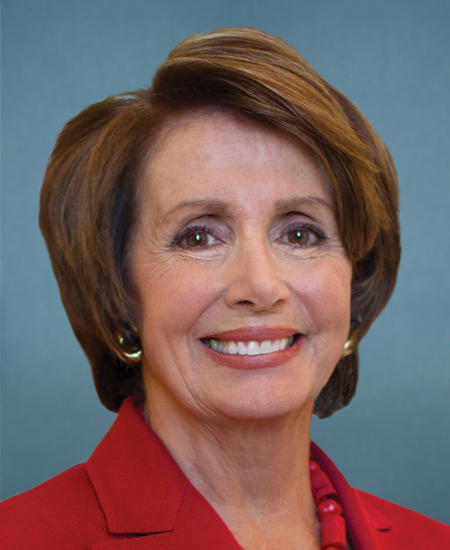
Rep. Nancy Pelosi
Sponsored bills
Maddy summaryThis bill renames a U.S. Postal Service facility at 300 Long Beach Boulevard in Long Beach, California, as the "Alan S. Lowenthal Post Office Building." It directly affects the postal facility and all federal documents, maps, or records referencing it. The key provision updates every official reference to the building to use the new name, ensuring consistency in government records. The bill does not change postal services, funding, or policy - only the building's official designation.
Maddy summaryThis bill designates the U.S. Postal Service facility at 7911 Imperial Highway in Downey, California, as the "Lucille Roybal-Allard Post Office Building." It updates all official references in federal laws, documents, and records to use this new name for the specific post office location. The change affects the facility's official identification but does not alter its operations or services.
Maddy summaryHR 3420, the My Body, My Data Act of 2023, restricts how companies can handle reproductive and sexual health data - such as pregnancy details, contraceptive use, or abortion-related information - by requiring them to collect only what’s necessary for requested services and limiting employee access. It gives individuals the right to access, correct, or delete their data, see which third parties received it, and get clear privacy policies explaining data practices. The Federal Trade Commission enforces the law, with penalties for violations including $100-$1,000 per violation per day, and bans retaliation for exercising these rights. The law applies to companies (like health apps or insurers) but excludes HIPAA-covered healthcare providers and entities subject to existing federal health privacy rules.
Maddy summary# Comprehensive Summary: Maternal Health and Vaccination Legislation This proposed legislation establishes a comprehensive framework to improve maternal health outcomes across multiple dimensions, with a strong focus on equity and addressing systemic disparities. The bill is organized into 13 titles covering various aspects of maternal health care. ## Key Focus Areas 1. **Maternal Health Equity**: The legislation emphasizes reducing racial and ethnic disparities in maternal health outcomes, with specific provisions targeting communities of color and underserved populations. 2. **Incarcerated Mothers**: Includes provisions to end shackling of pregnant individuals in correctional facilities and establishes programs for maternal health care in prisons and jails. 3. **Technology and Telehealth**: Creates grant programs for telehealth models, technology-enabled collaborative learning, and digital tools to improve access to maternal care. 4. **Climate Change Impact**: Addresses how climate change affects maternal and infant health, with a focus on vulnerable populations. 5. **Public Health Emergencies**: Establishes protocols for maternal care during public health crises like pandemics. 6. **Vaccinations**: Expands maternal vaccination awareness and equity campaigns. ## Major Provisions **Maternal Vaccination Campaign (Title XIII)**: - Expands awareness campaigns to specifically target pregnant and postpartum individuals - Allocates $17 million annually (2024-2028) for vaccination outreach - Includes specific efforts to increase vaccination rates among racial/ethnic minority groups **Technology and Telehealth (Titles IX)**: - $6 million annually for technology-enabled collaborative learning models - $6 million annually for digital tools to promote equity in maternal health - Creates a demonstration project for alternative payment models in maternal care **Climate Change and Maternal Health (Title XII)**: - $100 million for a grant program to protect vulnerable mothers and babies from climate change risks - $5 million for education and training at health profession schools - Establishes a National Institutes of Health Consortium on Birth and Climate Change Research **Incarcerated Mothers (Title VIII)**: - Requires 25% grant reduction for states that don't restrict restraints on pregnant incarcerated individuals - Establishes model programs in Bureau of Prisons facilities for pregnant and postpartum incarcerated individuals - $10 million annually for State and local prison and jail programs **Public Health Emergency Response (Title XI)**: - $100 million for data collection on maternal health during public health emergencies - $30 million for expanding maternal mortality reviews - $45 million for Pregnancy Risk Assessment Monitoring System (PRAMS) - $15 million for research on public health emergencies' impact on maternal health ## Cross-Cutting Themes - **Equity Focus**: Nearly every provision includes specific measures to address racial and ethnic disparities - **Data Collection**: Strong emphasis on collecting and analyzing demographic data - **Community Involvement**: Requires input from community-based organizations and affected populations - **Interagency Coordination**: Mandates collaboration between multiple federal agencies - **Long-Term Investment**: All funding is allocated for 5-year periods (2024-2028) The legislation represents a comprehensive, multi-faceted approach to improving maternal health outcomes in the United States, with particular attention to vulnerable populations and systemic barriers that contribute to poor maternal health outcomes.

Maddy summaryThe Child Care for Working Families Act establishes a federal entitlement program providing subsidized child care for working families with children under age 6 who are not yet in kindergarten. It creates a sliding fee scale where families at or below 85% of State median income pay no copayment, while higher-income families pay up to 7% of their income based on income thresholds. The bill requires states to develop quality rating systems for child care providers and ensures providers receive sufficient funding to meet quality standards, including wages equivalent to elementary educators. It prioritizes access for underserved populations including children with disabilities, infants and toddlers, children experiencing homelessness, and families in low-income communities. The program is funded with $20 billion for fiscal year 2024 and subsequent years through 2029.
Maddy summaryHR 2370, the Access to AEDs Act, authorizes $25 million in federal funding (2024-2028) to help public elementary and secondary schools improve access to automated external defibrillators (AEDs) and CPR training. The bill directs the Secretary of Health and Human Services to award grants to school districts and partners for developing AED programs, training staff and students, purchasing and maintaining AEDs, and creating cardiac emergency response plans. It specifically targets schools to address sudden cardiac arrest (SCA), which is a leading cause of death among student athletes and youth, with 90% of SCA victims dying without immediate CPR and defibrillation. The law requires grantees to report on their activities and establishes a clearinghouse to collect data on school AED access and costs.
Maddy summaryThe Armenian Genocide Education Act (HR 2803) establishes a Library of Congress program to support U.S. schools in teaching about the Armenian Genocide of 1915-1923. The program will develop educational resources, provide teacher training, and maintain an online resource center to help schools incorporate accurate historical information into curricula. It prioritizes schools without existing Armenian Genocide education programs, with $2 million authorized annually for five years. The Librarian of Congress will report yearly on the program’s activities to Congress.
Maddy summaryHR 1351, the "Save Oak Flat From Foreign Mining Act," repeals Section 3003 of the 2015 National Defense Authorization Act, which had mandated transferring 2,422 acres of Oak Flat in Arizona’s Tonto National Forest to foreign-owned Resolution Copper for mining. The bill withdraws this land from all mining activities, preventing Resolution Copper from using destructive block cave mining that would destroy the sacred site and harm water resources. Oak Flat, a National Register-listed Traditional Cultural Property sacred to Indigenous tribes, would be protected from a mine projected to deplete 775,000 acre-feet of groundwater over 40 years and create a 4,000-acre toxic waste dump. The legislation directly affects Resolution Copper (owned by Rio Tinto and BHP) and aims to halt the project that would obliterate cultural resources and exacerbate regional water shortages.
Air Traffic Noise and Pollution Expert Consensus Act of 2023 This bill requires the Federal Aviation Administration to enter into an arrangement with the National Academies of Sciences, Engineering, and Medicine to examine and report on the various health impacts of air traffic noise and pollution.