

Maddy summaryHR 2053, the "Stop Giving Big Oil Free Money Act," requires oil and gas companies holding specific Gulf of Mexico leases to renegotiate their terms to pay royalties when oil and gas prices reach certain thresholds. It directly affects companies with "covered leases" (existing leases issued under specific laws before the bill's enactment) by blocking new leases or lease transfers unless they modify payment terms to include price-based royalty requirements. The bill mandates that companies must agree to pay royalties if prices meet or exceed thresholds described in existing law (43 U.S.C. 1337(a)(3)(C)), ending current royalty relief for high prices. This applies to both new leases and transfers, including subsidiaries, and requires changes effective October 1, 2026.
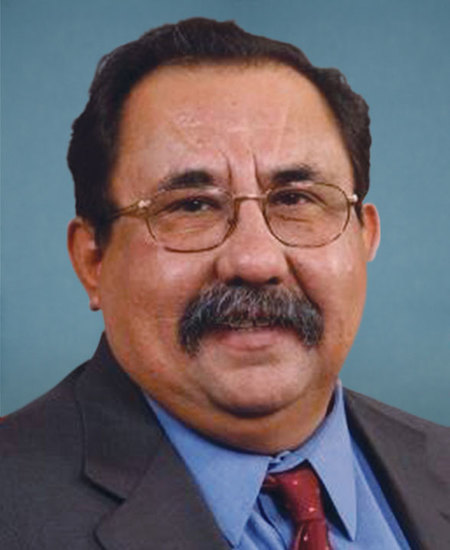
Rep. Raúl M. Grijalva
Sponsored bills
Maddy summaryThe Women's Retirement Protection Act aims to improve retirement security for women by requiring spousal consent for certain retirement plan distributions and beneficiary changes in defined contribution plans (like 401(k)s). It directly affects women participating in workplace retirement plans, particularly those in defined contribution plans who face greater financial vulnerability during divorce. Key provisions include adding "spousal consent requirements" to retirement plans to prevent unilateral decisions about retirement savings, creating grants for financial literacy programs for women, and providing assistance for low-income women and domestic violence survivors in obtaining retirement benefits through divorce. The bill addresses documented disparities where women's average Social Security benefit is $1,638 monthly compared to men's $2,020, and women aged 80+ have a higher poverty rate than men in the same age group.
Maddy summaryHCONRES 18 is a symbolic resolution designating March 10, 2025, as "Abortion Provider Appreciation Day." It expresses congressional support for abortion providers and clinic staff who deliver care amid heightened challenges following the Dobbs decision. The resolution acknowledges the risks providers face, including harassment and violence, and celebrates their role in ensuring patient access to abortion care. It does not create new laws, funding, or policy changes - it solely serves as a formal expression of appreciation for providers' work.
American Teacher Act This bill establishes grants to increase the minimum salary of public elementary and secondary school teachers. It also authorizes a national campaign regarding the value of the teaching profession. First, the bill directs the Department of Education (ED) to award four-year grants to state educational agencies (SEAs) and, through them, subgrants to local educational agencies to establish a minimum annual salary of $60,000 (to be adjusted annually for inflation) for these teachers. Second, the bill directs ED to award grants to eligible SEAs to provide cost-of-living adjustments to the annual base salary of teachers. Finally, the bill authorizes ED to carry out a national campaign to (1) increase awareness about the importance of teachers and the value of the teaching profession, (2) encourage secondary school and college students to consider teaching as a professional career, and (3) diversify the pool of individuals who enter the teaching profession.
Maddy summaryThis bill mandates that all new $20 U.S. currency printed after December 31, 2028, must prominently feature Harriet Tubman's portrait on the front. It requires the Treasury Secretary to release a preliminary design for this updated $20 bill by December 31, 2026. The bill directly affects the U.S. Treasury Department, codifying a 2016 announcement to feature Tubman on the $20 note (replacing Andrew Jackson) and ending a historical pattern where no woman had appeared on U.S. paper money.
Maddy summaryThis bill provides federal grants to public or nonprofit health care providers serving minority, low-income, or medically underserved communities to expand maternal and infant health services. It specifically funds prenatal, postnatal, and postpartum care while requiring grantees to offer culturally appropriate services and limit administrative costs to 10% of grant funds. Priority is given to organizations led by or located within the communities they serve, aiming to reduce racial and economic disparities in care access and health outcomes. The funding is authorized for fiscal years 2026-2030, with grantees required to coordinate with other federal maternal health programs to avoid duplication.
Maddy summaryHR 1918, the Farewell to Foam Act of 2025, prohibits the sale of most foam food containers, packaging peanuts, and foam coolers starting January 1, 2028. It directly affects restaurants, grocery stores, food vendors, manufacturers, and retailers who sell these items, excluding medical coolers used for drugs or medical products. The bill imposes escalating civil penalties for violations: $250 for the second offense, $500 for the third, and $1,000 for fourth or subsequent violations, with reduced penalties for small businesses under specific revenue thresholds. Enforcement is led by the EPA Administrator, with states allowed to enforce under federal guidelines.
Maddy summaryThe Mining Waste, Fraud, and Abuse Prevention Act of 2025 fundamentally changes hardrock mining regulations on Federal land. It closes all Federal land to new mining claims under the general mining laws, requires new permits for exploration and operations, and establishes new royalty rates for mineral production. The bill creates a financial assurance requirement for reclamation costs and directs revenues to fund the Abandoned Hardrock Mine Reclamation Program. It also establishes a small miner's lease program with lower fees and no royalties for qualifying small-scale operators.
Maddy summaryThis bill would redirect U.S. nuclear weapons funding to clean energy and social programs, but only after the President certifies all nuclear-armed nations have begun verifiable global elimination under the Treaty on the Prohibition of Nuclear Weapons. It requires converting nuclear weapons industry facilities and retraining workers for clean energy development. Funds would support climate initiatives, healthcare, housing, education, and environmental restoration. The bill's implementation is contingent on international progress toward nuclear disarmament, as it does not mandate immediate action.
Protecting Americans’ Social Security Data Act This bill prohibits political appointees and special government employees from accessing Social Security data systems that contain personally identifiable information about Social Security beneficiaries. Specifically, political appointees and special government employees may not access systems maintained by the Social Security Administration (SSA) that issue or record Social Security account numbers, that are used to determine eligibility for or to pay Social Security benefits, or that otherwise contain personally identifiable information about individuals receiving or applying for benefits. The bill also establishes a civil right of action for an individual whose information was negligently accessed or disclosed in violation of these provisions. The individual may bring suit against the United States if the violator was a U.S. employee or officer, or against the violator if they were not a U.S. employee or officer. Such a claim must be brought within two years of the affected individual’s discovery of the violation. Upon a finding of liability, defendants are liable for specified monetary damages. If an individual is criminally charged or subject to proposed disciplinary or adverse action by a federal or state agency for having accessed or disclosed information in violation of these provisions, SSA must notify the individual whose information was accessed or disclosed of the violation as soon as practicable. Finally, the bill requires the SSA Office of the Inspector General to investigate and report to Congress on any unauthorized access to or disclosure of information in a beneficiary data system.