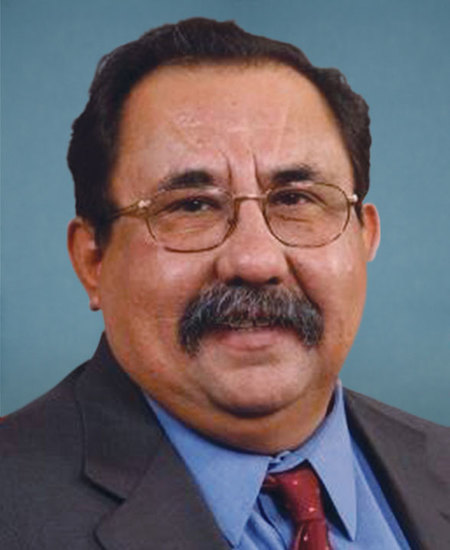
Photo of Raúl M. Grijalva
D United States House · District 7 · Arizona

Rep. Raúl M. Grijalva

Compare
Total votes
2,237
all sessions
Attendance
74%
579 missed
Among the lowest in the chamber
With party
97%
of cast votes
Bipartisan score
1%
crosses aisle rarely
Sponsored
2,161
bills & resolutions
Lower than 92% of chamber peers
Committees
0
assignments
2,161 bills and resolutions

Sponsored bills

Total
2,161
Primary
79
Co-sponsor
2,082
This page
2,161
matching current filters
Co-sponsor HR 452
Signed into law · United States House · Co-sponsor
Miracle on Ice Congressional Gold Medal Act

Miracle on Ice Congressional Gold Medal Act This act provides for the award of Congressional Gold Medals to the members of the 1980 U.S. Olympic men's ice hockey team in recognition of the team's achievement at the 1980 Winter Olympic Games.

Signed into law Dec 12, 2025 1 co-sponsor
Co-sponsor HR 1262
Passed · United States House · Co-sponsor
Mikaela Naylon Give Kids a Chance Act

Give Kids a Chance Act of 2025 This bill expands the Food and Drug Administration’s (FDA’s) authority with respect to research on rare pediatric diseases, including by permitting the FDA to take enforcement action against drug sponsors that fail to satisfy pediatric study requirements and by reauthorizing programs that support pediatric research.  Specifically, the bill modifies requirements relating to molecularly targeted pediatric cancer investigations to permit research on new drugs in combination with active ingredients that have already been approved, provided certain conditions are met; permits the FDA to take enforcement action against drug sponsors that fail to comply with pediatric study requirements, if such sponsors demonstrated a lack of due diligence in satisfying the requirement; renews the FDA’s authority to award priority review vouchers to sponsors of new products intended to treat rare pediatric diseases through September 30, 2029; and reauthorizes through FY2027 certain funding for the National Institutes of Health to support priority pediatric research.  The bill also provides statutory authority for the FDA’s interpretation of the orphan drug exclusivity period. The bill specifies, consistent with FDA regulations, that the seven-year market exclusivity period for drugs for rare diseases or conditions (i.e., orphan drugs) prohibits the approval of the same drug for the same approved use or indication with respect to the disease or condition. (In Catalyst Pharmaceuticals, Inc. v. Becerra , a court rejected the FDA’s interpretation and held that orphan drug exclusivity extends to all uses or indications for the disease or condition.)

Passed Dec 2, 2025 1 co-sponsor
Co-sponsor HR 820
In committee · United States House · Co-sponsor
Bottles and Breastfeeding Equipment Screening Enhancement Act

Maddy summaryThis bill requires the Transportation Security Administration (TSA) to create and update guidance within 90 days (and every five years) to ensure hygienic handling of breast milk, baby formula, infant water, juice, and cooling accessories during airport security screening. The guidance must be developed with maternal health organizations and set standards to minimize contamination risks when these items undergo re-screening or additional testing. It also mandates a one-year audit by the DHS Inspector General to assess TSA compliance and evaluate how screening technologies impact the processing of these infant items. The bill directly affects traveling parents and caregivers who transport these essential supplies.

In committee Jul 10, 2025 1 co-sponsor
Co-sponsor HR 1417
In committee · United States House · Co-sponsor
Rural Health Care Facility Technical Assistance Program Act

Maddy summaryHR 1417 establishes a new program within the U.S. Department of Agriculture to provide tailored technical assistance to rural health care facilities. The program directly supports facilities like hospitals, clinics, and health centers in rural areas by helping them identify operational needs, improve financial management, and access USDA loan and grant programs. Key provisions include prioritizing facilities in medically underserved areas or facing financial vulnerability, with a $2 million annual funding limit for fiscal years 2026-2030. The program requires annual reports on outcomes and effectiveness to Congress, focusing on preventing facility closures and strengthening rural health care delivery.

In committee Mar 28, 2025 1 co-sponsor
Co-sponsor HRES 216
In committee · United States House · Co-sponsor
Condemning the Members of Congress constituting the leadership team of the House Republican Conference.

Maddy summaryHRES 216 is a resolution condemning the leadership of the House Republican Conference for allowing a social media post that falsely questioned the immigration status and patriotism of Congressman Adriano Espaillat (Chairman of the Congressional Hispanic Caucus). The resolution specifically names House Speaker Mike Johnson, Majority Leader Steve Scalise, Majority Whip Tom Emmer, and other top Republican leaders as responsible for the post. It characterizes the post as xenophobic and inappropriate, stating such rhetoric violates the standards of conduct expected of members of Congress.

In committee Mar 11, 2025 1 co-sponsor
Co-sponsor HRES 218
In committee · United States House · Co-sponsor
Recognizing and honoring teachers who have earned or maintained National Board Certification.

Maddy summaryHRES 218 is a resolution recognizing and honoring teachers who have earned or maintained National Board Certification as of March 2025. It specifically honors approximately 141,464 certified teachers nationwide, acknowledges their contributions to student learning (including research showing improved outcomes for students), and encourages school districts and states to support more teachers in pursuing this certification. The resolution has no legal effect or funding provisions - it is purely a symbolic gesture of appreciation for educators meeting rigorous teaching standards.

In committee Mar 11, 2025 1 co-sponsor
Co-sponsor HR 2029
In committee · United States House · Co-sponsor
Stop Comstock Act

Maddy summaryHR 2029, the "Stop Comstock Act," amends federal obscenity laws to remove outdated restrictions on abortion and contraception. It deletes references to "indecent" materials and abortion-related language from Title 18 (e.g., removing "or means for procuring abortion" from section 552 and revising definitions in sections 1461 and 1462). The bill clarifies that federal law does not prohibit the distribution of materials related to abortion or contraceptives, updating how "obscene" is defined. These changes directly affect federal enforcement of obscenity laws, particularly regarding medical information and devices. The bill focuses on modernizing statutory language to align with current legal standards for protected speech and healthcare access.

In committee Mar 11, 2025 1 co-sponsor
Co-sponsor HR 2025
In committee · United States House · Co-sponsor
Northeastern Arizona Indian Water Rights Settlement Act of 2025

Maddy summary# Summary of the Water Rights Settlement Act This comprehensive legislation resolves long-standing water rights claims for three Native American tribes in the Colorado River Basin: 1. **Navajo Nation, Hopi Tribe, and San Juan Southern Paiute Tribe** - The act establishes specific water allocations and delivery systems for these tribes, including the implementation of the "iiná bá - paa tuwaqat'si" pipeline (a major water delivery infrastructure project). 2. **Water Rights Settlement** - The legislation satisfies tribal water rights claims through: - Quantification of water entitlements - Specific delivery mechanisms - Accounting rules for Colorado River water (distinguishing between Upper Basin and Lower Basin water) - Implementation of the "iiná bá - paa tuwaqat'si" pipeline system 3. **Reservation Creation** - The legislation ratifies a treaty creating the San Juan Southern Paiute Reservation (approximately 5,400 acres within the Navajo Reservation), establishing it as a reservation held by the U.S. in trust for the San Juan Southern Paiute Tribe. 4. **Key Implementation Provisions**: - Detailed accounting rules for Colorado River water (Section 17) - Limited waiver of sovereign immunity for enforcement purposes (Section 18) - Authorization for use of Navajo-Gallup Water Supply Project facilities (Section 20) - Specific requirements for Upper Basin water use in the Lower Basin 5. **Legal Framework**: - Includes comprehensive waivers of claims and releases of liability - Establishes an "Enforceability Date" with specific conditions for implementation - Includes specific provisions to ensure the settlement doesn't prejudice other water rights claims - Addresses unique circumstances of this settlement (Section 21(f)) This legislation represents a major settlement of water rights claims that has been negotiated between the federal government, the states, and the tribes, with specific implementation mechanisms and accounting rules for Colorado River water. It resolves critical water supply needs for these tribes while addressing complex legal and operational aspects of water rights in the Colorado River Basin.


In committee Mar 11, 2025 1 co-sponsor
Co-sponsor HR 2040
In committee · United States House · Co-sponsor
NEWBORN Act

Maddy summaryHR 2040, the NEWBORN Act, creates federal grants for local health departments to run infant mortality pilot programs in the 50 highest-risk counties. The $10 million annual funding (2025-2029) requires grantees to develop community-specific plans addressing causes like preterm birth, maternal complications, and infant injuries. Programs must include outreach to at-risk mothers, standardized services (postpartum care, smoking cessation, nutrition counseling), rural health initiatives, and public education campaigns. Grantees must report annually on program outcomes, with funds limited to 10% for evaluation. The bill directly affects communities with high infant mortality rates and at-risk mothers and infants through these targeted, evidence-based interventions.

In committee Mar 11, 2025 1 co-sponsor
Co-sponsor HR 2045
In committee · United States House · Co-sponsor
Medicare Dental, Vision, and Hearing Benefit Act of 2025

Maddy summaryThis bill would expand Medicare to cover dental, vision, and hearing services for beneficiaries 65 and older (and some younger people with disabilities), effective January 1, 2026. It would provide 100% coverage for preventative dental services in 2026, with basic and major dental services gradually increasing to 80% coverage by 2029. Vision benefits would include 80% coverage for annual eye exams and specific limits on eyeglasses, frames, and contact lenses ($100 per year for lenses, $100 every two years for frames, $200 every two years for contacts). Hearing services would include 80% coverage for hearing exams and hearing aids, with a limit of one hearing aid per ear every 48 months. The bill also adds oral health professionals to the United States Preventive Services Task Force to help guide coverage decisions.

In committee Mar 11, 2025 1 co-sponsor
Showing 11 to 20 of 2,161 bills