

Environmental Justice Mapping and Data Collection Act of 2021 This bill establishes an interagency Environmental Justice Mapping Committee that must create a tool to identify environmental justice communities. Environmental justice communities are communities with significant representation of communities of color, low-income communities, or tribal and indigenous communities that experience, or are at risk of experiencing, higher or more adverse human health or environmental effects, as compared to other communities. The Environmental Protection Agency (EPA) must establish an environmental justice data repository to maintain the data collected by the committee. The EPA must make the repository available to regional, state, local, and tribal governments.
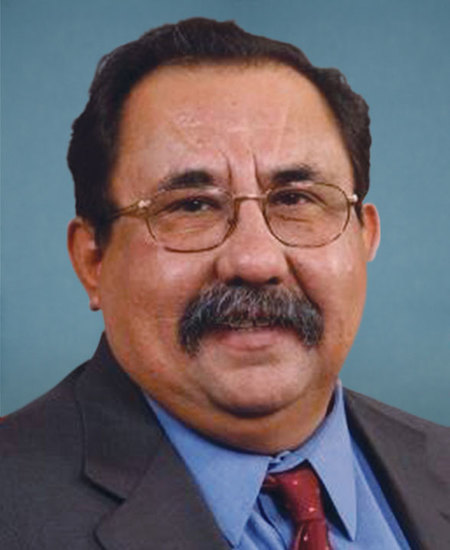
Rep. Raúl M. Grijalva
Sponsored bills
Ally's Act This bill requires private health insurance plans to cover certain hearing devices and systems (e.g., bone-anchored auditory implants) and related items and services. The bill also imposes limits on cost sharing.
Medicare Economic Security Solutions Act This bill modifies provisions relating to enrollment periods for Medicare medical services. Among other things, the bill establishes a late enrollment penalty of 15% of monthly premiums and applies the penalty for a period equal to twice the number of months in each 12-month period during which the individual was not enrolled. Currently, the late enrollment penalty is 10% of monthly premiums for each 12-month period during which the individual was not enrolled, and the penalty continues to apply for as long as the individual is enrolled in Medicare medical services. The bill also expands the special enrollment periods to individuals who have health insurance coverage other than through their employer.
Improving Social Determinants of Health Act of 2021 This bill requires the Centers for Disease Control and Prevention (CDC) to establish a program to improve health outcomes and reduce health inequities by, for example, coordinating activities across the CDC. As part of the program, the CDC must award grants to eligible organizations to build capacity to address social determinants of health. The CDC shall provide for an independent evaluation of certain grants and report findings to Congress.
Women and Climate Change Act of 2021 This bill addresses climate change and its effects on women and girls. Specifically, the bill establishes the Federal Interagency Working Group on Women and Climate Change within the Department of State. The bill outlines the functions of the working group, including the coordination of agencies' policies and activities relating to combating the effects of climate change on women and improving the government's response to and strategy for climate change. In addition, the Office of Global Women's Issues of the State Department must submit a strategy to prevent and respond to the effects of climate change on women.
End Diaper Need Act of 2021 This bill establishes and expands programs to increase access to diapers and related supplies primarily for low-income families. The Department of Health and Human Services must award demonstration grants to entities with experience in community distribution of basic necessities or other community services to meet diapering needs of eligible families with infants and toddlers. Additionally, the bill permits states to use Medicaid funds to provide medically necessary diapers and supplies to certain low-income families. These families must have a child who is over age three and diagnosed with a serious condition such as bowel or bladder incontinence. It also allows individuals to buy medically necessary diapers and supplies with funds from health savings accounts and other tax-advantaged accounts for health care expenses.
Insular Area Medicaid Parity Act This bill eliminates Medicaid funding limitations for U.S. territories beginning in FY2021.
Nationally Enhancing the Well-being of Babies through Outreach and Research Now Act or the NEWBORN Act This bill establishes a pilot program through which the Health Resources and Services Administration must award grants to territorial, tribal, and local health departments in areas with the highest rates of infant mortality to address birth defects, premature births, and other leading causes of infant death.
Restricting First Use of Nuclear Weapons Act of 2021 This bill prohibits the use of federal funds to conduct a first-use nuclear strike unless Congress expressly authorizes such a strike pursuant to a declaration of war. A first-use nuclear strike is an attack using nuclear weapons against an enemy that did not first launch a nuclear strike against the United States, its territories, or its allies.
COVID-19 Mine Worker Protection Act This bill requires the Department of Labor to issue health and safety standards to protect coal miners from occupational exposure to COVID-19 (i.e., coronavirus disease 2019). Labor shall provide for emergency standards within seven days of this bill's enactment, and such emergency standards shall be in force until permanent standards are promulgated. Labor shall also collect data to track and investigate cases of exposure to COVID-19 among coal miners.