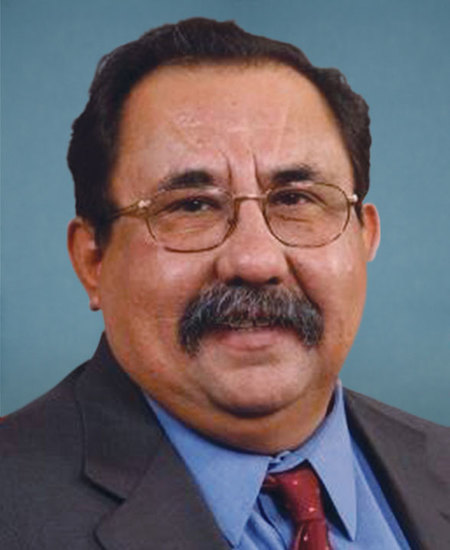
Photo of Raúl M. Grijalva
D United States House · District 7 · Arizona

Rep. Raúl M. Grijalva

Compare
Total votes
2,237
all sessions
Attendance
74%
579 missed
Among the lowest in the chamber
With party
97%
of cast votes
Bipartisan score
1%
crosses aisle rarely
Sponsored
2,161
bills & resolutions
Lower than 92% of chamber peers
Committees
0
assignments
2,161 bills and resolutions

Sponsored bills

Total
2,161
Primary
79
Co-sponsor
2,082
This page
2,161
matching current filters
Co-sponsor HR 696
In committee · United States House · Co-sponsor
CARES Windfall for the Wealthiest Repeal Act

CARES Windfall for the Wealthiest Repeal Act This bill restores and makes permanent the limitation on excess businesses losses of noncorporate taxpayers. It also allows taxpayers a carryback of their net operating losses arising in 2019 and 2020.

In committee Feb 2, 2021 1 co-sponsor
Co-sponsor HR 697
In committee · United States House · Co-sponsor
Stop Subsidizing Multimillion Dollar Corporate Bonuses Act

Stop Subsidizing Multimillion Dollar Corporate Bonuses Act This bill extends the $1 million limit on the deductibility of executive compensation to all employees of publicly traded corporations.

In committee Feb 2, 2021 1 co-sponsor
Co-sponsor HR 695
In committee · United States House · Co-sponsor
USPS Fairness Act

USPS Fairness Act This bill repeals the requirement that the U.S. Postal Service annually prepay future retirement health benefits.

In committee Feb 2, 2021 1 co-sponsor
Co-sponsor HR 651
In committee · United States House · Co-sponsor
Public Health Emergency Privacy Act

Public Health Emergency Privacy Act This bill imposes privacy, confidentiality, and security requirements on the use and disclosure of COVID-19 (i.e., coronavirus disease 2019) emergency health data. This is data that is linked to an individual or device, such as test results. The requirements apply to organizations that collect, use, or disclose emergency health data electronically or that manage websites or applications for contact tracing and other COVID-19 response activities. These organizations must provide notice of privacy and other policies. They must also ensure the accuracy of, prevent discrimination based on, and limit disclosure of the data. If an organization collects data from at least 100,000 individuals, it must publicly report additional information about how it uses and discloses the data. Furthermore, the bill prohibits the use of emergency health data for commercial advertising or in ways that restrict access to opportunities, services, and other accommodations. It also prohibits government entities and organizations from using this data to infringe on the right to vote. The Department of Health and Human Services must report on the civil rights impact of the collection, use, and disclosure of health data. The bill provides for enforcement by the Federal Trade Commission, states, and a private right of action. It further specifies that certain dispute resolution mechanisms, such as arbitration, are unenforceable with respect to disputes arising under the bill.


In committee Feb 2, 2021 1 co-sponsor
Co-sponsor HR 551
In committee · United States House · Co-sponsor
Energy Debt Relief for American Families Act

Energy Debt Relief for American Families Act This bill authorizes supplemental funding to states through the Low Income Home Energy Assistance Program to assist eligible households pay 100% of any utility bills they are unable to pay because of economic distress caused by the COVID-19 (i.e., coronavirus disease 2019) pandemic.

In committee Feb 2, 2021 1 co-sponsor
Co-sponsor HR 588
In committee · United States House · Co-sponsor
Stopping the Mental Health Pandemic Act

Stopping the Mental Health Pandemic Act This bill requires the Substance Abuse and Mental Health Services Administration to award grants to states, tribal nations, local governments, behavioral health and primary care providers, and community organizations to support behavioral health treatment and services during the COVID-19 (i.e., coronavirus disease 2019) pandemic.

In committee Feb 2, 2021 1 co-sponsor
Co-sponsor HR 596
In committee · United States House · Co-sponsor
ACCESS Act

Advancing Connectivity during the Coronavirus to Ensure Support for Seniors Act or the ACCESS Act This bill provides funding to increase access to telehealth services and virtual visits in skilled and other nursing facilities during the COVID-19 (i.e., coronavirus disease 2019) emergency. The bill designates the funding as emergency spending, which is exempt from discretionary spending limits. Specifically, the bill provides additional funding for FY2021, to remain available through FY2022, to the Telehealth Resource Center Program to address barriers to telehealth faced by skilled and other nursing facilities. The Office for the Advancement of Telehealth within the Federal Office of Rural Health Policy in the Health Resources and Services Administration manages this program. In addition, the bill provides funding for FY2021, to remain available through one month after the emergency period ends, to the Department of Health and Human Services (HHS) for grants to nursing facilities to support virtual visits for residents during the COVID-19 emergency. HHS must develop relevant guidance for these grants within 15 days. HHS must also coordinate with the Federal Communications Commission to ensure grantees have access to telecommunications and broadband services.

In committee Feb 2, 2021 1 co-sponsor
Co-sponsor HR 598
In committee · United States House · Co-sponsor
Quality Care for Nursing Home Residents and Workers During COVID–19 and Beyond Act

Quality Care for Nursing Home Residents and Workers During COVID-19 and Beyond Act This bill modifies several requirements for Medicare skilled nursing facilities (SNFs) and Medicaid nursing facilities (NFs) to address the public health emergency relating to COVID-19 (i.e., coronavirus disease 2019) and the overall standard and administration of care in such facilities. Specifically, during the public health emergency, SNFs and NFs must comply with specified quality of care, worker safety, and transparency requirements, subject to civil penalties. Requirements include (1) testing residents and employees for COVID-19 weekly or before shifts, respectively, and reporting any lack of available testing kits on a daily basis; (2) providing at least two weeks of paid sick leave to each employee; and (3) reporting the number of COVID-19 cases and deaths, including demographic information, on a daily basis. The bill also establishes general requirements for SNFs and NFs with respect to minimum staffing levels and protections for whistleblowers and residents, subject to civil penalties, as well as training requirements for nurses. It also requires specific consent procedures in relation to the administration of certain psychotropic drugs and prohibits the use of pre-dispute arbitration agreements in such facilities.

In committee Feb 2, 2021 1 co-sponsor
Co-sponsor HR 533
In committee · United States House · Co-sponsor
Stop COVID–19 Test Surprise Medical Bills Act of 2021

Stop COVID-19 Test Surprise Medical Bills Act of 2021 This bill modifies provisions requiring health insurance plans to cover COVID-19 (i.e., coronavirus disease 2019) diagnostic testing services at no cost, without prior authorization, and without medical management requirements. The bill specifies that a plan may not make determinations about the circumstances surrounding individuals' tests, such as why they sought testing or whether they showed symptoms of COVID-19. The bill also specifies that plans may encourage individuals to obtain tests from lower priced providers as long as such efforts do not delay, or impede access to, testing. The bill also requires the Department of Health and Human Services (HHS) to survey and report on the cash prices of testing services and the compliance of providers with the requirement to publish such prices. Additionally, HHS, jointly with the Department of the Treasury and the Department of Labor, must issue guidance clarifying the process for submitting claims for testing services.

In committee Feb 2, 2021 1 co-sponsor
Co-sponsor HR 616
In committee · United States House · Co-sponsor
Emergency Water is a Human Right Act

Emergency Water is a Human Right Act This bill creates a grant program, administered by the Department of Health and Human Services, to provide funds to states and Indian tribes to assist low-income households that pay a high proportion of household income for drinking water and wastewater services. Further, any entity receiving financial assistance under this grant program must ensure that no home energy service or public water system service is or remains disconnected or interrupted during the COVID-19 (i.e., coronavirus disease 2019) public health emergency.

In committee Feb 2, 2021 1 co-sponsor
Showing 2,111 to 2,120 of 2,161 bills