

Maddy summaryHRES 232 designates the week of March 12-18, 2023, as "Sleep Awareness Week" to highlight the importance of sleep health. The resolution cites CDC recommendations (7+ hours nightly for adults) and data showing 35% of Americans sleep less than 7 hours, linking poor sleep to health risks like heart disease and mental health conditions. It encourages public health officials, healthcare providers, and individuals to prioritize sleep health and discuss it with medical professionals. The resolution has no binding effect or policy changes - it is purely symbolic recognition.
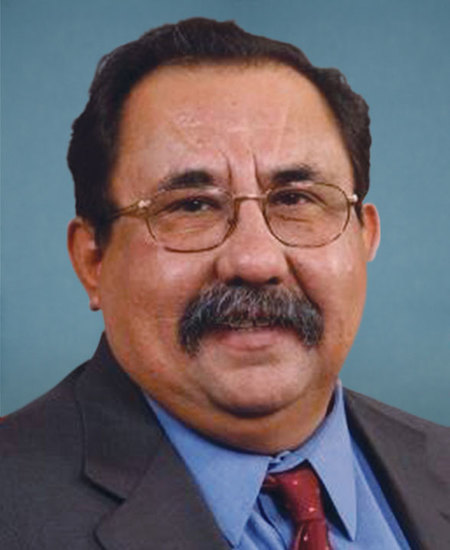
Rep. Raúl M. Grijalva
Sponsored bills
Maddy summaryHR 1794 authorizes the minting of commemorative coins to honor the 2028 Los Angeles Olympic and Paralympic Games. It specifies four coin types ($5 gold, $1 silver, half-dollar clad, and proof silver $1) with defined weights, sizes, and mintage limits (e.g., up to 100,000 gold coins). A surcharge is added to each coin sale (e.g., $35 for gold coins), with all surcharge funds directed to the U.S. Olympic and Paralympic Properties to support legacy programs and the Games' operations. The coins must be issued only during 2028 and are legal tender, though the bill focuses solely on commemorative coinage, not policy changes.
This resolution recognizes the Islamic faith as one of the great religions of the world, acknowledges the onset of Ramadan (the holy month of fasting and spiritual renewal for Muslims), and expresses respect to Muslims in the United States and throughout the world on this occasion.
Maddy summaryThe Pell Grant Sustainability Act adjusts Federal Pell Grants to keep pace with rising college costs by indexing them annually to inflation. It directly affects low-income undergraduate students who receive Pell Grants, ensuring the maximum award amount increases each academic year based on the Consumer Price Index. The bill replaces previous fixed amounts with a new formula: starting in 2023-2024, grants will be set at $6,895 (or the prior year's amount if higher), then adjusted yearly by the inflation rate. This change aims to restore the grant's purchasing power, which covered 80% of costs in 1974-75 but only 30% by 2020-21.
Transparency in Government Contracts Act This bill expands the Small Business Administration's (SBA) reporting requirements to include certain disaggregated demographic data about federal contracts (and subcontracts to the extent practicable) awarded to small businesses owned by socially and economically disadvantaged individuals. The SBA also must include whether such a small business participates in the 8(a) business development program.
Maddy summaryThe Loan Forgiveness for Educators Act would provide full student loan forgiveness to educators who work in high-need schools or early childhood education programs. After completing 5 years of qualifying service, educators would have 100% of their outstanding student loans forgiven, with the option for monthly loan forgiveness during their service period. The bill defines "high-need schools" as those with over 30% of students in poverty or identified for improvement, and includes special provisions for educators working in Native American, Tribal, and Bureau of Indian Education schools. Educators could count service completed before the law's enactment toward their 5-year requirement, and the program would cover both FFEL and Direct Loan programs.
Maddy summaryThis bill restores access to VA housing loans and educational benefits for Black World War II veterans who were denied GI Bill benefits due to racial discrimination, as well as for their living spouses, children, grandchildren, or direct descendants. It defines eligibility by requiring applicants to certify that their veteran relative was denied GI Bill benefits on racial grounds, with a five-year application window starting from the bill's enactment date. The VA must process these applications within 90 days and report to Congress on the number of recipients and total benefit value within one year. This addresses historical discrimination by creating new pathways to benefits for affected individuals and their families.
Maddy summaryThe Office of Gun Violence Prevention Act of 2023 establishes a new office within the Department of Justice to coordinate federal efforts on gun violence prevention. The office, led by a Director appointed by the Attorney General, will evaluate existing programs, identify data gaps, and make evidence-based policy recommendations to Congress and the President. It will work with an advisory council including DOJ officials and external members like gun violence survivors, community service providers, and public health experts. The office must produce an annual report to Congress on gun violence trends and policy recommendations, and the bill authorizes funding to support these activities.
Maddy summaryThe LOAN Act (HR 1731) makes significant changes to federal student financial aid programs. It doubles the maximum Federal Pell Grant amount for eligible students, expands Pell Grant eligibility to graduate students and "Dreamer" students (undocumented individuals who came to the U.S. as children), and restores the total semesters of Pell Grant eligibility from 12 to 18. The bill also eliminates interest capitalization on federal student loans, repeals origination fees, and creates automatic enrollment in income-driven repayment plans for borrowers who are delinquent or rehabilitating defaulted loans. Additionally, it establishes new refinancing programs for both federal and private student loans with interest rates capped at 5.0% for new loans.
Maddy summaryHR 1723, the Abortion is Health Care Everywhere Act of 2023, amends the Foreign Assistance Act to remove restrictions on using U.S. foreign aid funds for abortion services. It explicitly allows U.S. foreign assistance programs to fund comprehensive reproductive health care, including abortion services, training, and equipment. This change directly affects U.S. international health programs and recipient countries, enabling them to integrate safe abortion care into broader reproductive health services. The bill aims to align U.S. policy with global health guidelines by making abortion services a standard part of reproductive health care funded through foreign assistance.