

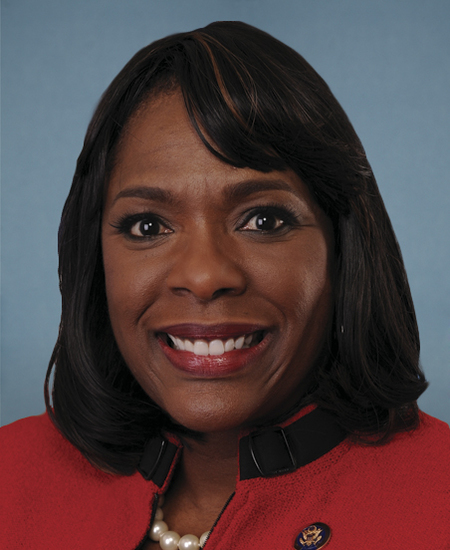
Photo of Terri A. Sewell
D United States House · District 7 · Alabama On the 2026 ballot

Rep. Terri A. Sewell

Compare
Total votes
2,837
all sessions
Attendance
96%
107 missed
Near the chamber average
With party
98%
of cast votes
Near the chamber average
Bipartisan score
1%
crosses aisle rarely
Near the chamber average
Sponsored
1,741
bills & resolutions
Higher than 88% of chamber peers
Committees
7
assignments
1,741 bills and resolutions

Sponsored bills

Total
1,741
Primary
64
Co-sponsor
1,677
This page
1,741
matching current filters
Co-sponsor HCONRES 4
In committee · United States House · Co-sponsor
Expressing the sense of Congress that tax-exempt fraternal benefit societies have historically provided and continue to provide critical benefits to the people and communities of the United States.

Maddy summaryHCONRES 4 is a symbolic resolution expressing Congress's support for tax-exempt fraternal benefit societies (like mutual aid organizations). It recognizes these groups, which have over 7 million members nationwide, as historically and currently providing critical community benefits - including life/health insurance, charitable work, and volunteer services - valued at over $3.8 billion annually. The resolution affirms that their tax-exempt status under Section 501(c)(8) of the Internal Revenue Code remains beneficial and should continue to be promoted. This is a non-binding expression of congressional sentiment, not a policy change.

In committee Jan 28, 2025 1 co-sponsor
Co-sponsor HRES 70
In committee · United States House · Co-sponsor
Expressing the sense of the House of Representatives that Congress should take all appropriate measures to ensure that the United States Postal Service remains an independent establishment of the Federal Government and is not subject to privatization.

Maddy summaryThis resolution expresses the House of Representatives' position that Congress should take steps to prevent the privatization of the United States Postal Service (USPS), ensuring it remains a federal independent agency. It highlights USPS’s constitutional role, self-sustaining nature (relying on service revenue, not taxpayer funds), and critical functions - serving 168 million addresses daily, supporting rural communities, and underpinning e-commerce. The resolution opposes privatization, noting it would raise prices, reduce services, and harm the $1.9 trillion mailing industry. As a non-binding resolution, it reflects the House’s stance but does not create new law or policy.

In committee Jan 28, 2025 1 co-sponsor
Co-sponsor HR 783
In committee · United States House · Co-sponsor
Sustainable Cardiopulmonary Rehabilitation Services in the Home Act

Sustainable Cardiopulmonary Rehabilitation Services in the Home Act This bill permanently allows services relating to cardiac rehabilitation programs, intensive cardiac rehabilitation programs, and pulmonary rehabilitation programs to be furnished via telehealth at a beneficiary's home under Medicare.

In committee Jan 28, 2025 1 co-sponsor
Co-sponsor HR 802
In committee · United States House · Co-sponsor
STAR Act of 2025

Maddy summaryThe STAR Act of 2025 adds a 25% tax credit for qualified semiconductor design expenses incurred by U.S. companies. It directly affects businesses conducting semiconductor design in the United States, covering both in-house costs (like wages and supplies for U.S. design work) and contracted design services. The credit excludes duplicating existing products, cosmetic design, or activities unrelated to performance or reliability improvements. This incentive expires for design expenses paid after December 31, 2036.

In committee Jan 28, 2025 1 co-sponsor
Co-sponsor HR 764
In committee · United States House · Co-sponsor
Global Health, Empowerment and Rights Act

Maddy summaryHR 764, the Global Health, Empowerment and Rights Act, removes two barriers for foreign nongovernmental organizations (NGOs) seeking U.S. foreign assistance. It ensures these organizations cannot be denied funding solely because they provide health services (like counseling and referrals) using non-U.S. government funds, as long as those services comply with local laws. The bill also requires that foreign NGOs face the same rules on using non-U.S. funds for advocacy and lobbying as U.S. NGOs receiving similar aid. This directly affects international health-focused NGOs working in countries where U.S. aid is provided.

In committee Jan 28, 2025 1 co-sponsor
Co-sponsor HR 801
In committee · United States House · Co-sponsor
Charitable Act

Maddy summaryHR 801, the Charitable Act, creates a new tax deduction for individuals who do not itemize deductions on their federal tax returns. It allows these taxpayers to deduct up to one-third of their standard deduction amount for charitable contributions in 2026 and 2027. The bill directly affects non-itemizing individual taxpayers by providing a limited, direct deduction for charitable giving without requiring them to itemize. The deduction is capped at 1/3 of the standard deduction amount for those tax years, effective for returns filed in 2027 and 2028.

In committee Jan 28, 2025 1 co-sponsor
Co-sponsor HR 609
In committee · United States House · Co-sponsor
Assuring Medicare’s Promise Act of 2025

Maddy summaryHR 609, the Assuring Medicare's Promise Act of 2025, directs revenue from the net investment income tax (currently applied to investment income) into the Medicare Hospital Insurance Trust Fund. It expands the tax base to include certain business income for high-income individuals with modified adjusted gross income exceeding $400,000 ($500,000 for joint filers), with a phase-in to limit the tax increase. The bill ensures this tax revenue directly supports Medicare's hospital insurance program, applying to taxable years beginning after December 31, 2025. The changes do not alter the tax rate but broaden the income types subject to the tax for high earners.

In committee Jan 22, 2025 1 co-sponsor
Co-sponsor HR 608
In committee · United States House · Co-sponsor
COVER Now Act

Maddy summaryThe COVER Now Act allows cities, counties, or other local governments in states that have not expanded Medicaid to provide health coverage to Medicaid-eligible residents. Local governments in non-expansion states can apply for a federal demonstration project to cover these residents, with the federal government paying 90-100% of costs over seven years (starting at 100% for the first three years). The bill prohibits states from retaliating against localities that participate, such as by shifting costs, reducing funding, or blocking healthcare provider participation. This directly affects uninsured residents in non-expansion states and local governments seeking to fill coverage gaps.

In committee Jan 22, 2025 1 co-sponsor
Co-sponsor HR 610
In committee · United States House · Co-sponsor
Close the Medigap Act of 2025

Maddy summaryThe Close the Medigap Act of 2025 would prohibit Medigap insurance issuers from denying coverage or charging higher premiums based on health status, pre-existing conditions, genetic information, or other factors. It requires insurers to spend a minimum percentage of premiums on health care claims and improves the Medicare Plan Finder website to provide clearer information about coverage options, out-of-pocket costs, and guaranteed issue requirements. The bill applies to Medigap policies effective January 1, 2026, with full implementation by 2031, and requires Medigap brokers to disclose payments they receive from insurers. These changes would directly affect Medicare beneficiaries, particularly those with pre-existing conditions who have historically faced barriers to obtaining affordable supplemental coverage.

In committee Jan 22, 2025 1 co-sponsor
Co-sponsor HR 637
In committee · United States House · Co-sponsor
911 SAVES Act

Supporting Accurate Views of Emergency Services Act of 2025 or the 911 SAVES Act This bill requires the Office of Management and Budget to categorize public safety telecommunicators as a protective service occupation under the Standard Occupational Classification system no later than 30 days after the enactment of this bill. (The Standard Occupational Classification system is a federal statistical standard used by federal agencies to classify workers into occupational categories for the purpose of collecting, calculating, or disseminating data.)

In committee Jan 22, 2025 1 co-sponsor
Showing 561 to 570 of 1,741 bills
Previous 1 … 56 57 58 … 175 Next