

Maddy summaryHR 537 authorizes a Congressional Gold Medal to honor 60 diplomats who saved Jewish lives during the Holocaust by issuing visas and passports against their governments' orders, risking expulsion and personal danger. The medal will be presented to the next of kin of these diplomats, alongside representatives from their home countries, and permanently displayed at the United States Holocaust Memorial Museum. The bill also permits the sale of bronze duplicates to cover production costs, with proceeds going to the U.S. Mint. This legislation recognizes the diplomats' humanitarian actions without creating new government programs or altering existing laws.
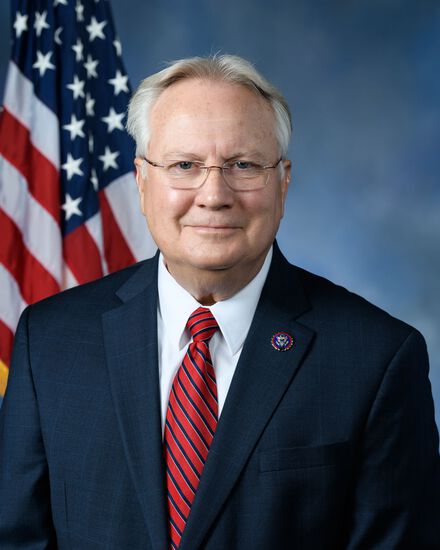
Rep. Jerry L. Carl
Sponsored bills
Maddy summaryHR 8693, the "No American Land for Communist China Act," prohibits U.S. citizens or entities from purchasing real estate adjacent to specific federal lands if owned by the Chinese government or businesses with 25%+ Chinese government ownership. It directly affects Chinese government entities and Chinese-owned businesses operating in the U.S., restricting their ability to buy land near protected federal areas. The bill requires the President to take necessary actions to block such purchases, covering lands managed by Interior, Defense, Agriculture (Forest Service), or designated Indian country. This is a policy restriction, not a funding measure, targeting land transactions near sensitive federal properties.
Maddy summaryHRES 1280 is a ceremonial resolution commending the University of South Alabama (USA) on its 60th anniversary. It recognizes USA’s educational, research, and healthcare contributions as the Gulf Coast’s flagship institution, highlighting its growth from 276 students in 1964 to over 13,500 today. The resolution has no legal effect or policy changes - it simply expresses congressional appreciation and directs copies to USA leadership, including the university president and health system executives. This is purely symbolic, with no funding, regulations, or new obligations.
Maddy summaryHR 8653 authorizes the posthumous award of a Congressional Gold Medal to Major Thomas D. Howie, a U.S. Army officer who died during the Battle of Normandy in WWII. The bill specifies the medal will be presented to his nephew, Tom Howie, or his next of kin, and then permanently displayed at The Citadel Museum. It also permits the U.S. Mint to produce and sell bronze duplicates to cover costs. This is a commemorative measure honoring Major Howie's military service and sacrifice, with no substantive policy changes.
Maddy summaryHR 5403, the CBDC Anti-Surveillance State Act, prohibits the Federal Reserve from issuing or facilitating central bank digital currency (CBDC) directly or indirectly to individuals through financial institutions. It specifically bans Federal Reserve banks from offering digital products to individuals, maintaining individual accounts, or using CBDC for monetary policy implementation. The bill also clarifies that its restrictions do not apply to existing physical cash or private, permissionless digital payment systems. This bill directly affects the Federal Reserve's ability to develop or deploy a government-run digital dollar. The law aims to prevent the Federal Reserve from creating a digital currency that could enable transaction tracking or government oversight of personal financial activity.
Maddy summaryHR 895, the Combating Organized Retail Crime Act of 2023, expands federal law to better prosecute organized retail theft by amending sections 2314 and 2315 of Title 18. It clarifies that crimes involving stolen goods valued at $5,000 or more over 12 months - including retail theft - can be prosecuted under existing federal statutes, and broadens definitions to include goods taken via "any facility of interstate or foreign commerce." The bill also creates a new Organized Retail Crime Coordination Center within Homeland Security, requiring it to coordinate federal, state, and local law enforcement efforts, share threat information with retailers, and produce annual public reports on trends. This directly affects law enforcement agencies, retailers, and criminal justice systems by standardizing prosecution thresholds and enhancing interagency collaboration.
Maddy summaryThis bill amends a 2021 law to specify the location for the National Medal of Honor Monument on federal land in Washington, D.C. It requires the monument to be placed within the National Mall's "Reserve" area and attached to, or no more than 1,000 feet from, the Lincoln Memorial. The change directly affects the National Medal of Honor Museum Foundation, which is authorized to build the monument under existing law. This policy adjustment finalizes the physical placement of the monument to honor Medal of Honor recipients, aligning it with the Lincoln Memorial's historical significance.
Maddy summaryHRES 1226 is a non-binding resolution honoring 282 law enforcement officers killed in the line of duty during 2023, listed by name in the resolution. It formally acknowledges their sacrifice, expresses unwavering support for current officers, and recognizes the need for adequate resources to protect them. The resolution does not create new laws or policies but serves as a ceremonial tribute to memorialize fallen officers and support their families, aligning with existing National Police Week observances established since 1962.
Maddy summaryThis bill amends federal law to simplify interstate firearm transfers. It replaces "rifle or shotgun" with "firearm" in transfer rules, allowing all firearms to be treated uniformly. The key change permits licensed dealers to sell firearms to other licensed dealers anywhere in the U.S., and lets licensed sellers transfer firearms to unlicensed buyers at temporary locations (like gun shows) in any state. It also updates residency definitions for military members and federal employees stationed across state lines, clarifying which state they're considered residents of for firearm purposes. The bill directly affects licensed firearm dealers, military personnel, and federal employees who travel between states.
Maddy summaryHJRES 98 is a congressional resolution seeking to block a National Labor Relations Board (NLRB) rule that defined how businesses are considered "joint employers" for labor law purposes. The bill targets the NLRB's October 2023 rule (88 Fed. Reg. 73946), which would have changed how companies like franchisors or staffing agencies are held responsible for workers' rights. If passed, this resolution would cancel the rule, directly affecting businesses managing multiple employer relationships and labor organizations enforcing workplace standards. The measure uses a standard process under federal law to disapprove an agency rule, not creating new policy but reversing an existing regulation.