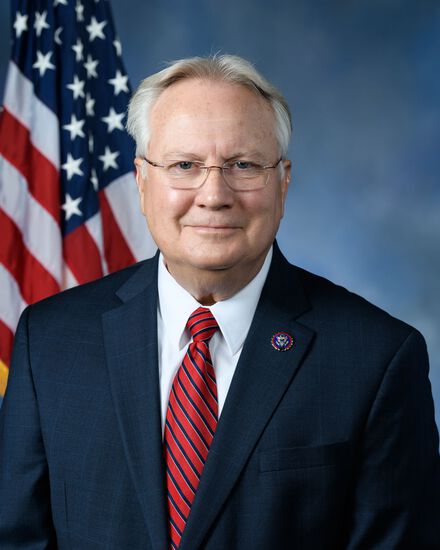
Photo of Jerry L. Carl
R United States House · District 1 · Alabama

Rep. Jerry L. Carl

Compare
Total votes
2,168
all sessions
Attendance
99%
13 missed
Higher than 84% of chamber peers
With party
96%
of cast votes
Near the chamber average
Bipartisan score
3%
crosses aisle rarely
Near the chamber average
Sponsored
469
bills & resolutions
Lower than 76% of chamber peers
Committees
0
assignments
469 bills and resolutions

Sponsored bills

Total
469
Primary
17
Co-sponsor
452
This page
469
matching current filters
Co-sponsor HR 707
Passed · United States House · Co-sponsor
Ghost Army Congressional Gold Medal Act

Ghost Army Congressional Gold Medal Act This bill directs the Speaker of the House of Representatives and the President pro tempore of the Senate to award a Congressional Gold Medal to the 23rd Headquarters Special Troops and the 3133d Signal Service Company, known as the Ghost Army , collectively, in recognition of its service during World War II.

Passed May 19, 2021 1 co-sponsor
Co-sponsor HR 1827
In committee · United States House · Co-sponsor
Gun Owner Registration Information Protection Act

Gun Owner Registration Information Protection Act This bill prohibits federal funding of, or support for, state databases that list (1) firearms lawfully owned or possessed by individuals, or (2) individuals who lawfully own or possess firearms.

In committee May 18, 2021 1 co-sponsor
Co-sponsor HR 1776
In committee · United States House · Co-sponsor
Regulations from the Executive in Need of Scrutiny Act of 2021

Regulations from the Executive in Need of Scrutiny Act of 20 21 This bill revises provisions relating to congressional review of agency rulemaking. Specifically, the bill establishes a congressional approval process for a major rule. A major rule may only take effect if Congress approves of the rule. A major rule is a rule that results in (1) an annual effect on the economy of $100 million or more; (2) a major increase in costs or prices for consumers, individual industries, government agencies, or geographic regions; or (3) significant adverse effects on competition, employment, investment, productivity, innovation, or the ability of U.S.-based enterprises to compete with foreign-based enterprises. In addition, the bill establishes a congressional disapproval process for a nonmajor rule. A nonmajor rule may only take effect if Congress does not disapprove of the rule.

In committee May 18, 2021 1 co-sponsor
Co-sponsor HR 1680
In committee · United States House · Co-sponsor
Lawful Interstate Transportation of Firearms Act

Lawful Interstate Transportation of Firearms Act This bill revises criminal provisions related to the interstate transportation of firearms and ammunition. An individual may transport a firearm between two places (e.g., states) where it is legal to possess, carry, or transport the firearm. During transport, the firearm must be unloaded and secured or securely stored. Additionally, an individual may transport ammunition, or a detachable magazine or feeding device, between two places where it is legal to possess, carry, or transport the ammunition, magazine, or feeding device. During transport, the ammunition, magazine, or feeding device must not be loaded into a firearm and must be securely stored. The term transport includes staying in temporary lodging; stopping for food, fuel, vehicle maintenance, an emergency, or medical treatment; or any other activity incidental to the transport. The bill prohibits the arrest or detention of an individual for a state or local firearm or ammunition violation unless there is probable cause to believe the individual failed to comply with the provisions of this bill, and there is probable cause to believe the individual committed another crime.


In committee May 18, 2021 1 co-sponsor
Co-sponsor HR 1690
In committee · United States House · Co-sponsor
Defending our Defenders Act

Defending Our Defenders Act This bill establishes federal criminal offenses involving the murder of federal, state, or local law enforcement officers. Violators are subject to life in prison or death. The bill sets forth aggravating factors (e.g., intent to ambush or prior history of promoting violence against a law enforcement officer) to be considered in determining whether to impose the death penalty.

In committee May 18, 2021 1 co-sponsor
Co-sponsor HCONRES 34
In committee May 17, 2021 1 co-sponsor
Co-sponsor HR 3134
In committee · United States House · Co-sponsor
Combatting Racist Training in the Military Act of 2021

Combatting Racist Training in the Military Act of 2021 This bill prohibits the Armed Forces and academic institutions of the Department of Defense from promoting specified anti-American and racist theories (e.g., that any race is inherently superior or inferior to any other race). Specifically, the bill prohibits including anti-American and racist theories or materials in curricula, reading lists, seminars, workshops, trainings, or other educational or professional settings in a manner that could appear as sponsorship, approval, or endorsement; contracting with, hiring, or otherwise engaging speakers, consultants, diversity trainers, and other persons for the purpose of advocating anti-American and racist theories; compelling members of the Armed Forces to affirm or profess belief in anti-American and racist theories; and segregating members of the Armed Forces by race in any setting, including educational and training sessions.

In committee May 12, 2021 1 co-sponsor
Co-sponsor HR 2903
In committee · United States House · Co-sponsor
Creating Opportunities Now for Necessary and Effective Care Technologies (CONNECT) for Health Act of 2021

Creating Opportunities Now for Necessary and Effective Care Technologies (CONNECT) for Health Act of 2021 or the CONNECT for Health Act of 2021 This bill expands coverage of telehealth services under Medicare. Among other provisions, the bill allows the Centers for Medicare & Medicaid Services (CMS) to waive certain restrictions, such as restrictions on the types of technology that may be used; permanently removes geographic restrictions on originating sites (i.e., the location of the beneficiary) and allows the home of the beneficiary to serve as the originating site for all services; permanently allows federally qualified health centers and rural health clinics to serve as the distant site (i.e., the location of the health care practitioner); and allows the CMS to generally waive coverage restrictions during any public health emergency. Additionally, the CMS must report on the effects of expanded telehealth services during the COVID-19 public health emergency, including with respect to the utilization, quality, and outcomes of services. The Center for Medicare and Medicaid Innovation may also test alternative payment models relating to expanded telehealth services.

In committee Apr 29, 2021 1 co-sponsor
Showing 381 to 390 of 469 bills
Previous 1 … 38 39 40 … 47 Next